FIFA Crisis: Examining the Case For and Against Infantino's World Cup Sell-Off Plan
Key Takeaways
- •FIFA President Gianni Infantino proposed selling stakes in the World Cup through a new competition vehicle, drawing condemnation from UEFA, the English FA, and senior football figures including Arsène Wenger.
- •FIFA reported revenue exceeding $7.5 billion across the 2018–2022 cycle and holds billions in reserves, making it one of the wealthiest sporting bodies in the world.
- •The introduction of outside capital into sports competitions aligns with broader industry trends, as private equity firms and sovereign wealth funds have already invested in rugby, tennis, golf, and European club football.
- •UEFA's 55 member associations represent a minority of FIFA's 211 members, and the remaining 156 associations from Africa, Asia, and the Americas may be more receptive to Infantino's financial distribution promises.
- •Dissenting FIFA members face a mid-November deadline to identify a unity candidate capable of challenging Infantino ahead of the scheduled presidential election in March.
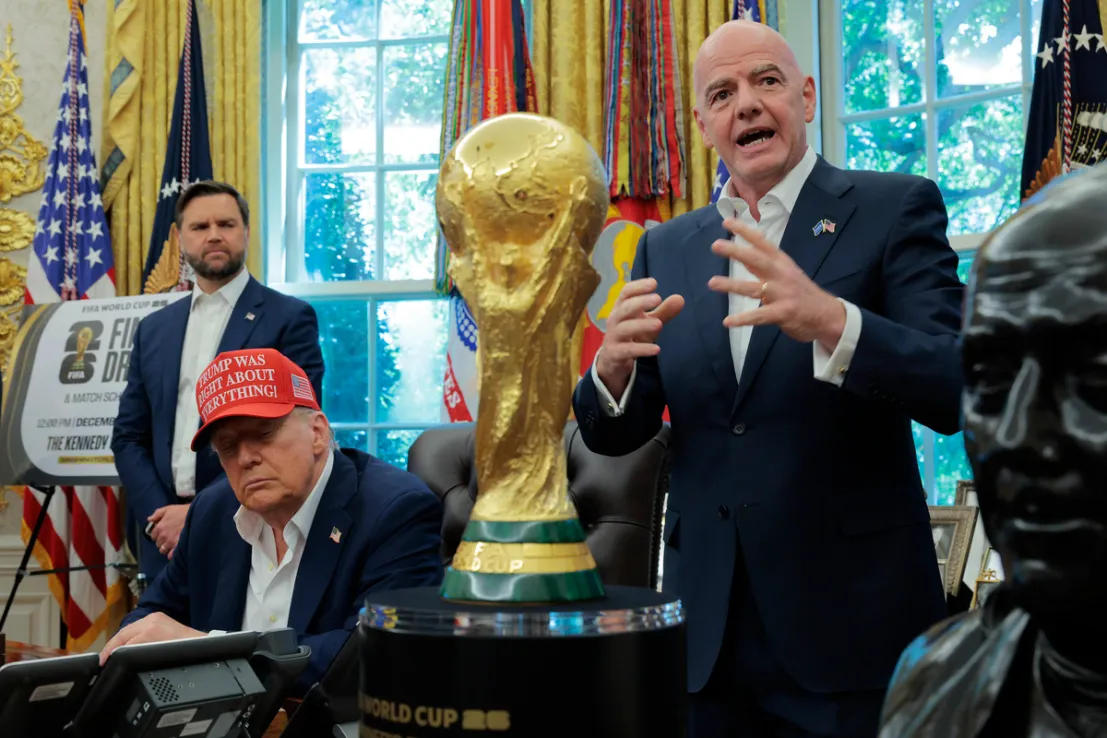
Defending Gianni Infantino is no simple task, yet it is possible to construct both a behavioural rationale and a commercial argument for the FIFA president's controversial proposal to sell stakes in the World Cup.
Over the weekend, one newspaper drew an evocative parallel between Infantino and Icarus, suggesting his plan to offload World Cup stakes had melted under the heat of global condemnation. An alternative comparison might be to Zaphod Beeblebrox, the egotistical character from The Hitchhiker's Guide to the Galaxy, who famously became the only being to survive the Total Perspective Vortex intact.
Rather than having his ego annihilated by the Vortex's revelation of his insignificance against the vastness of creation, the two-headed President of the Galaxy emerged unscathed, requested a drink, and proclaimed: "It just told me what I knew all the time. I'm a really terrific and great guy. Didn't I tell you, baby. I'm Zaphod Beeblebrox!"
Douglas Adams's fictional inventor of the Vortex, Trin Tragula, sought to illustrate that the key to surviving the universe is the absence of a sense of proportion — without it, one would be crushed. Infantino may well be wishing at this moment that his critics could rediscover that same quality.
The Behavioural Case for Infantino
Neither a behavioural excuse nor a commercial justification — even if carefully developed and aggressively promoted by the FIFA president's loyalists — would guarantee his political survival. Nevertheless, observers should not be surprised to see him remain in office for a considerable period, nor should they expect the push for external investment into FIFA competitions to disappear.
The ascent to leadership within international sports governing bodies follows a long, demanding, and frequently unseemly path. Election campaigns require the cultivation of global relationships over many years, and many of the associated dealings can feel unsavoury.
A sport's competition and governance calendars bring voters and candidates together at world and regional championships, congresses, and conferences. These formal occasions allow campaign contact networks to be built and potential votes to be tallied.
The most consequential travel, however, takes place between such events — in private one-on-one meetings where pledges of financial support may be offered and commitments of votes extracted in exchange.
Inevitably, more promises are made than can ever be honoured, and more pledges are banked than are ultimately delivered in secret ballots. Numerous presidential candidates have been stunned to receive only a fraction of the votes they believed they had secured through months of behind-the-scenes diplomacy.
Once installed, however, sports leaders benefit from a trifecta of advantages: highly secure tenure, a luxurious working lifestyle, and adulation from dependent member nations, board and council colleagues, staff, commercial partners, and prospective host-city representatives. Sitting presidents rarely face serious re-election challenges, shielded by the implicit understanding that opposition risks exclusion from the financial benefits of the organisation.
These dynamics apply equally to minor and major sports, though the scale of financial rewards, accommodation, and transport may differ considerably. In football and the Olympics, every such factor is amplified to its maximum.
The financial sums are so vast, the hosting, broadcasting, and sponsorship stakes so enormous, that presidential authority must feel comparable to that of a political leader of a medium-sized nation — or perhaps even a medieval monarch. FIFA reported revenue exceeding $7.5 billion across its four-year 2018–2022 cycle and holds reserves in the billions, making it one of the wealthiest sporting bodies on earth.
The behavioural defence for Infantino, then, is essentially this: he is only human, even if he appears to have lost his sense of proportion.
The Commercial Case for FIFA
The headlines surrounding the FIFA president's proposal for outside investment in a new competition vehicle have accused him of selling off the World Cup — "heresy!" to critics. Combined with promised financial distributions to member nations ("bribes!"), a compressed sign-up deadline ("threats!"), the reported involvement of Josh Kushner ("Trump!"), suggestions of substantial personal gain ("greed!"), and the media's uncovering of the story ("secrecy!"), there is no shortage of grounds for suspicion.
Yet is the fundamental concept truly so outlandish?
The sports industry's broader trend in recent years has been to introduce outside capital into event hosting — both to launch new competitions and to elevate existing ones. For some governing bodies, this functions as venture capital, enabling projects that would otherwise never leave the planning stage. For others, it facilitates enhanced event production, broader marketing reach, or expansion into new geographic markets. Private equity firms such as CVC Capital Partners have already taken stakes in club rugby competitions and tennis's commercial operations, while Gulf sovereign wealth funds have taken ownership positions in golf and invested heavily across European club football.
It is conceivable that FIFA is pursuing elements of all these objectives across its tournament portfolio, and that despite its considerable balance-sheet wealth, external capital could stimulate bolder strategic thinking and introduce a more productive risk appetite than a sprawling governing bureaucracy could otherwise sustain.
None of this means that Infantino and his associates have approached this public-private hybrid enterprise correctly. The underlying concept, however, is very much on trend.
The commercial justification for Infantino, then: the right idea, but flawed in much of its intended execution.
What Comes Next
The FIFA president could be removed within days, weeks, or months. More likely, however, he will appeal to the broad majority of FIFA members outside UEFA, arguing that he is guilty at worst of excessive ambition on behalf of their sport. This is the moment when years of relationship-building yield their dividends.
Europe has served as football's financial breadbasket for over a century, but the balance of economic power has been shifting away from the continent. While UEFA's members may currently be mobilising in high dudgeon to remove Infantino, they may ultimately discover that the rest of the football world is more inclined to forgive — and that the balance of power tilts even further from European hands. UEFA comprises 55 of FIFA's 211 member associations; the remaining 156, many from Africa, Asia, and the Americas, have historically been less hostile to FIFA leadership proposals tied to increased financial distributions.
If FIFA's dissenting members wish to maximise their prospects of unseating Infantino, they must identify a single unity candidate capable of rallying all factions. The deadline for doing so is mid-November, ahead of the scheduled election in March next year. Acting swiftly to select that candidate would substantially improve the chances of successfully forcing an emergency early electoral process.
Ed Warner is chair of Sussex Cricket and GB Wheelchair Rugby and writes his sport column at sportinc.substack.com.
Related coverage: UEFA to boycott World Cup over Infantino's FIFA sell-off following unanimous vote | Wenger rubbishes Infantino sell-off plan as senior FIFA figures desert president | UEFA blasts FIFA over Infantino plan to sell football's soul for £4bn | FIFA World Cup sell-off is a money grab and faces defeat, says UEFA | FA turns up heat on Infantino by pulling support for embattled FIFA president
