Chainlink Price Rises After Fidelity's Spot LINK ETF Filing, but Risks Point to a Drop to $7
Key Takeaways
- •Fidelity’s proposed spot LINK ETF would add to existing Chainlink products from Grayscale and Bitwise, while giving Fidelity’s more than 50 million U.S. customers access to LINK through its platform.
- •Grayscale and Bitwise Chainlink funds held $158 million after accumulating $176 million in inflows, but recorded more than $1.45 million in net withdrawals during November.
- •LINK’s 24-hour trading volume fell 14% to $262 million, while futures open interest declined from $784 million in September to $382 million over the last 24 hours.
- •Chainlink’s fee revenue, staked LINK value and total value secured have fallen, reaching $11.24 million for the quarter so far, $387 million and $32 billion, respectively.
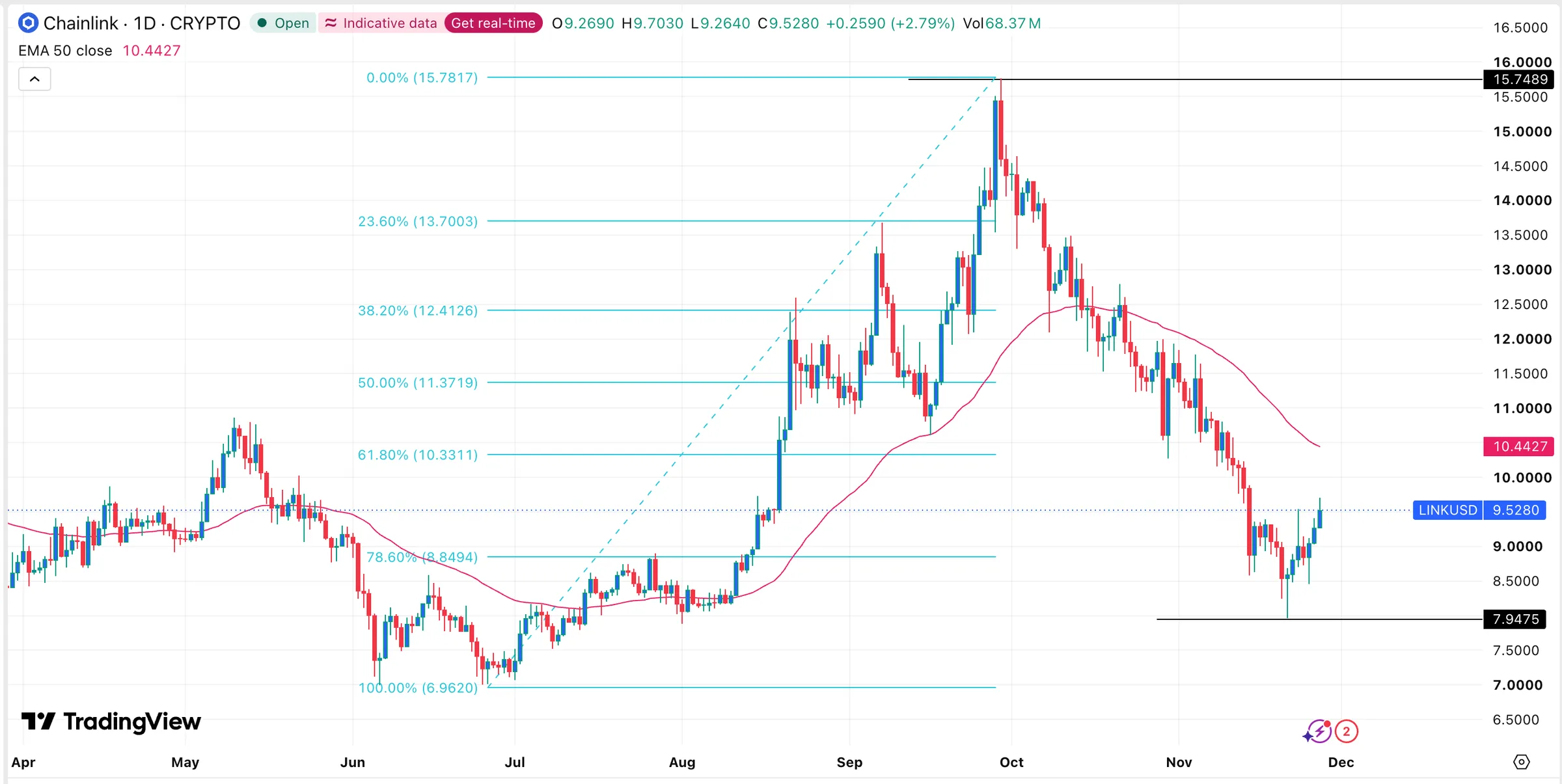
- •LINK remains below its 50-day moving average and the 61.8% Fibonacci retracement level, with the analysis identifying $7.94 as support and a possible move toward $7 if that level breaks.
Chainlink (LINK) extended its recovery on Nov. 27 after Fidelity, one of the largest financial services companies in the United States, broadened its cryptocurrency investment offerings. The asset manager filed for a spot Chainlink exchange-traded fund (ETF) with the Securities and Exchange Commission (SEC) on Nov. 25.
Binance recorded LINK trading at $9.59 at 08:18 UTC on Nov. 27. The rebound followed several weeks of selling pressure across the cryptocurrency market and carried the token to its highest level since Nov. 14. Despite Fidelity's proposed market entry, however, existing Chainlink investment funds registered net withdrawals in November.
The filing broadens mainstream investor access to LINK, but fund-flow and on-chain data point to weakening participation across both spot and derivatives markets.
Fidelity Adds LINK and Files for a Spot ETF
Fidelity announced that it added the LINK token to its platform, a notable step given that the firm serves more than 50 million customers in the US, who will now have access to the Chainlink token. In parallel, the company filed to launch a spot Chainlink ETF with the SEC. The proposed fund would join products from issuers such as Grayscale and Bitwise, which have already launched their own Chainlink ETFs.
Fidelity is one of the biggest players in crypto ETFs. Data shows that its FBTC ETF holds over $10 billion in assets, while its Ethereum fund manages more than $1 billion in assets under management (AUM). These figures underline the firm's scale as one of the largest crypto asset managers.
The filing is for a proposed product, so its potential effect on LINK demand remains dependent on whether the fund ultimately launches and attracts assets. The central question is whether a Fidelity Chainlink ETF will attract meaningful investor demand. The two existing funds from Grayscale and Bitwise have accumulated $176 million in inflows and now hold $158 million in assets. This month, they recorded more than $1.45 million in outflows — the first month in which these funds have seen withdrawals.
Investor Demand Continues to Slide
The new developments coincide with a sustained decline in investor demand for LINK. Trading activity has cooled even as the token's price moved higher: CoinMarketCap data shows that 24-hour trading volume dropped by 14% to $262 million.
The futures market reflects the same trend. Open interest has been in a pronounced downtrend, sliding from $784 million in September to $382 million over the last 24 hours — a sign that demand among speculators has continued to fall.
The softer demand figures come as Chainlink's fundamentals deteriorate. According to DeFi Llama, the network's fee revenue has continued falling over the past few quarters. Chainlink generated $15.28 million in fees in the second quarter, down from $15.75 million in Q1 and $16 million in the fourth quarter of last year. So far this quarter, it has made $11.24 million, a sign that its business is being affected by the ongoing crypto winter.
Other metrics also worsened this month. The value of staked LINK tokens has dropped to $387 million from a September high of $606 million, well below the $1.27 billion peak reached in December 2024. Falling staked balances indicate that demand among long-term holders continues to deteriorate.
Usage is declining as well. The closely watched total value secured (TVS) metric has dropped to $32 billion from a record high of over $60 billion a few months ago.
Technical Analysis
The daily timeframe chart shows that LINK has been in a strong downward trend over the past few months, slumping from its year-to-date high of $15.7 to the current $9.51. The token is now attempting to rebound and sits at its highest level since Nov. 14, with the gains continuing after Fidelity made its ETF application. Even so, the rebound remains modest relative to the scale of the prior decline.
Despite the recent bounce, technical signals remain cautious. Chainlink is stuck below the 50-day moving average and the 61.8% Fibonacci retracement level, and it is slowly forming a bearish flag pattern. On this setup, the token is likely to resume the downward trend and possibly retest the support level at $7.94, its lowest point this month. A move below that level would point to more downside, potentially toward $7.
This article provides market information and does not constitute financial advice. Investors should conduct independent research before making investment decisions.

