Professional Forecasters See Continued US GDP Growth and Low Odds of Contraction
Key Takeaways
- •The Philadelphia Fed's Survey of Professional Forecasters, the oldest quarterly macroeconomic survey in the United States, projects a median 2.6% GDP growth for 2026 and a low probability of an outright contraction.
- •NABE's November 2026 Outlook Survey places its median 2026 GDP growth forecast at 2.4% on a fourth-quarter-over-fourth-quarter basis, slightly below the SPF median.
- •NABE panelists raised their 2026 and 2027 forecasts for business investment and growth while lowering job growth forecasts and expecting unemployment to hold near 4.2%.
- •Energy is identified as the main source of inflation pressure, and the NABE panel raised its oil price forecasts for both 2026 and 2027.
- •Recession odds are little changed, with more than half of NABE panelists not expecting the next recession to begin before 2029, though half see risks tilted to the downside.
The latest Survey of Professional Forecasters (SPF) points to continued growth in US gross domestic product and a low probability of an outright contraction, according to the quarterly poll conducted by the Federal Reserve Bank of Philadelphia.
The SPF, which the Philadelphia Fed describes as the oldest quarterly survey of macroeconomic forecasts in the United States, aggregates individual projections from professional forecasters into a median that is widely used as a benchmark for the consensus economic outlook.
The full November survey results are published by the Philadelphia Fed's Real-Time Data Research Center.
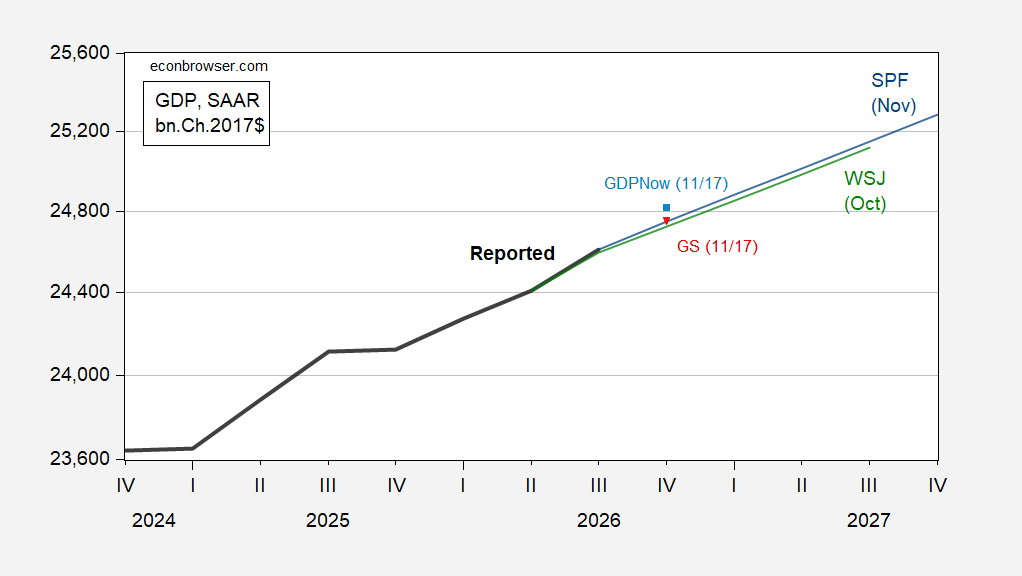
Figure 1 charts the advance GDP release (bold black line) against the November SPF median (blue), the October Wall Street Journal survey mean (green), the Atlanta Fed's GDPNow estimate (light blue square), and Goldman Sachs's projection (inverted red triangle), all expressed in billions of chained 2017 dollars, seasonally adjusted at annual rates. Level paths are constructed by iterating growth rates on the latest reported relevant GDP level, except in the case of the SPF. Sources: the Bureau of Economic Analysis 2026:Q3 advance estimate, the Philadelphia Fed, the Wall Street Journal, the Atlanta Fed, Goldman Sachs, and the author's calculations.
Separately, the National Association for Business Economics (NABE) released the results of its November 2026 Outlook Survey, which is available behind a paywall. NABE's panel places the median forecast for 2026 GDP growth at 2.4% on a fourth-quarter-over-fourth-quarter basis, below the SPF median of 2.6%. Because the two surveys draw on different panels of economists, the gap between their medians is best read as the spread of professional opinion around a shared expansionary outlook rather than a disagreement over direction.
The association summarized the panel's findings as follows:
“Panelists have raised their 2026 and 2027 forecasts for both business investment and growth, and have lowered their job growth forecasts for 2026 and 2027 while expecting the unemployment rate to hold near 4.2%. Energy remains the main source of inflation pressure, and the panel raised its oil price forecasts for both years. Productivity forecasts edged lower, yet nearly half of panelists now cite stronger productivity growth as the greatest upside risk, overtaking an end to the wars in Ukraine and the Middle East. On the downside, broadening geopolitical conflicts regained ground as the top risk, and half of the panel sees risks tilted to the downside. Even so, confidence that a downturn is not imminent held: recession odds are little changed, and more than half of panelists do not expect the next recession to begin before 2029.”
Taken together, the two surveys point to expectations of continued economic expansion through 2026 and 2027, with unemployment seen holding near current levels, inflation pressure centered on energy, and recession risk viewed as distant by a majority of respondents. Near-term checkpoints are the Bureau of Economic Analysis's upcoming GDP estimates, including revisions to the 2026:Q3 advance figure charted above, along with the next quarterly rounds of both surveys, which will show whether forecasters hold or revise their assumptions on growth, hiring, and energy prices — the factor the NABE panel identifies as the main source of inflation pressure.

