Prediction Markets Give Fed 74% Odds of Standing Pat in September
Key Takeaways
- •Polymarket, Kalshi and Myriad all show about 73% to 75% odds that the Fed will make no change in September.
- •The September Fed-decision markets are drawing significant activity, with Polymarket recording $33.9 million in volume and Kalshi nearly $10 million wagered.
- •The federal funds rate affects borrowing costs and can shift money between safe assets and risk assets such as tech stocks and crypto.
- •At its July meeting, the FOMC kept rates at 3.50% to 3.75% in a 9-3 vote, with three members favoring a hike.
- •The September 15–16 FOMC meeting will include updated economic projections and a press conference after the policy statement.
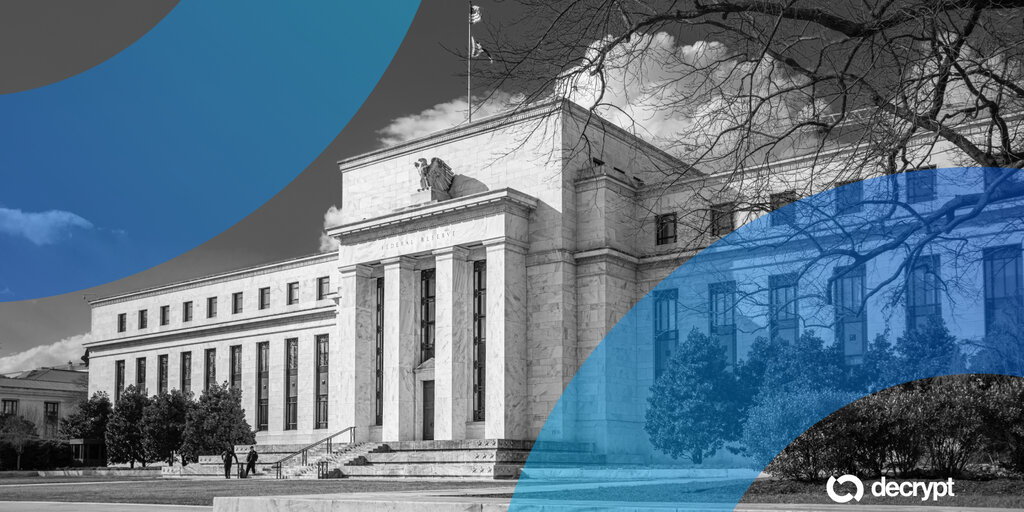
Prediction markets are converging on a single forecast for the Federal Reserve's September meeting: don't expect anything to change.
Polymarket's "Fed Decision in September?" market puts the odds of no change at 74%, with a quarter-point hike at 25% and a cut near 1%, on $33.9 million in volume. CFTC-regulated exchange Kalshi lands almost identically at 73.5%, backed by close to $10 million wagered on its September Fed-decision contract. Myriad, the prediction platform run by Decrypt's parent company Dastan, lists "No Change" at about 75% odds in its "Fed Decision in September?" market, where it has been trading around 71%, and the market resolves after the September 15–16 FOMC meeting. The spread across all three platforms is tight enough to read as consensus. Rate expectations were once read almost exclusively through fed funds futures, but prediction markets — where traders stake real money on defined outcomes — now run as a parallel gauge alongside futures-based tools like CME's FedWatch.
Traders and investors track Fed decisions so closely because the federal funds rate ripples through nearly every corner of financial markets. The rate sets the baseline cost of borrowing money, which in turn shapes how much investors are willing to pay for riskier bets. When the Fed hikes, borrowing gets pricier and safe assets like Treasuries offer better returns, pulling money away from speculative corners of the market. When it cuts, cheap money tends to flow back into risk assets such as tech stocks and crypto.
That dynamic has played out repeatedly this year. Bitcoin and Ethereum have wavered around recent Fed holds, and prices slid earlier in the year as a strong jobs report cast doubt on rate cuts. Traders have also been bracing for a surprise hike even with a hold as the base case.
The calm pricing reflects the broader backdrop. At its July meeting, the FOMC held the federal funds rate at 3.50%–3.75% in a divided 9–3 vote, with three members pushing for a hike. A Reuters poll found nearly 70% of economists expect no change through the rest of 2026.
The FOMC meets September 15–16, with its policy statement due September 16. September is also one of the quarterly meetings where officials update their Summary of Economic Projections, including the "dot plot" of individual rate expectations, and the chair holds a press conference after the statement — additional layers of guidance for markets looking past the decision itself.

