Kalshi Launches Citizen Debt Forecast as Prediction Market Data Enters Fiscal Forecasting
Key Takeaways
- •Federal Reserve economists published a paper concluding that Kalshi prediction markets offer a real-time, market-based benchmark for macroeconomic expectations valuable to researchers and policymakers.
- •Traditional expectations measures such as the Survey of Professional Forecasters update at lower frequency and capture only part of the forecast distribution.
- •Kalshi is the largest federally regulated prediction market and is overseen by the CFTC.
- •The Congressional Budget Office's debt forecasts update only twice a year and are constrained to a legislative baseline, while Kalshi's Citizen Debt Forecast updates continuously and can reflect expected legislative changes.
- •The Kalshi debt forecast is slightly more optimistic than the CBO's, though the author cautions against reading too much into that difference.
Kalshi Research is producing notable work both on the fundamentals of prediction markets and on how data derived from those markets can be used to improve other forecasts.
Economists at the Federal Reserve, for example, recently published a paper titled Kalshi and the Rise of Macro Markets, which finds:
Prediction markets offer a new market-based approach to measuring macroeconomic expectations in real-time. We evaluate the accuracy of prediction market-implied forecasts from Kalshi, the largest federally regulated prediction market overseen by the CFTC. We compare Kalshi with more traditional survey and market-implied forecasts, examine how expectations respond to macroeconomic and financial news, and how policy signals are interpreted by market participants. Our results suggest that Kalshi markets provide a high-frequency, continuously updated, distributionally rich benchmark that is valuable to both researchers and policymakers.
The finding is notable because traditional measures of macroeconomic expectations, such as the Survey of Professional Forecasters or market-based measures derived from asset prices, generally update at lower frequency or capture only part of the forecast distribution. A continuously traded, regulated market offers an alternative benchmark that policymakers can watch in real time as news arrives.
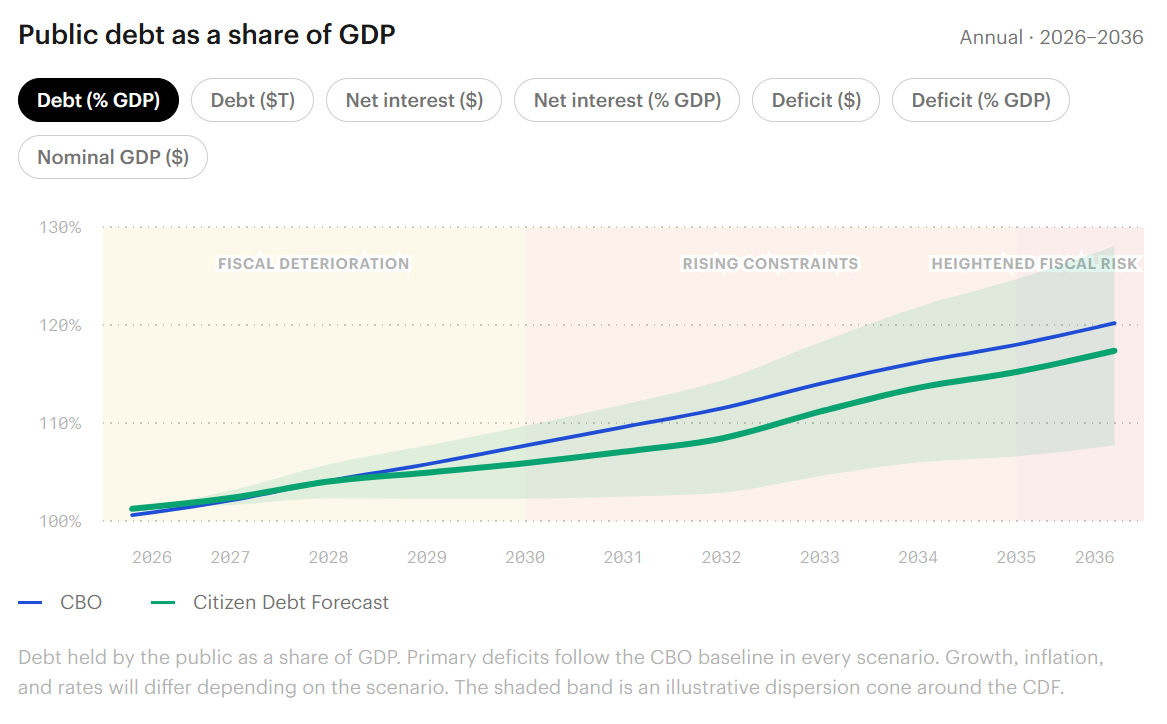
Kalshi offers one concrete example of how this kind of data might be put to use: the Citizen Debt Forecast (CDF). The Congressional Budget Office (CBO) forecasts the future path of U.S. debt, but it updates only twice a year and is constrained to a legislative baseline, even in cases where most observers expect, for instance, that taxes will increase or spending will be cut. That constraint matters for fiscal debates: U.S. federal debt held by the public has been rising as a share of GDP in recent years, and official baseline projections are a central reference point in budget negotiations. The Kalshi CDF, by contrast, updates continuously and can incorporate market expectations about future legislative changes.
As seen in the accompanying chart, the Kalshi forecast is slightly more optimistic than the CBO forecast, though the author cautions against reading too much into that difference. The broader issue is how prediction market data can be integrated into a wide variety of forecasts.
The post The Kalshi Citizen Debt Forecast (CDF) appeared first on Marginal REVOLUTION.
