Bitcoin, Ethereum, and Dogecoin Rise as XRP Falls After Warsh-Led Fed Holds Rates
Key Takeaways
- •The Federal Reserve under Chair Kevin Warsh held interest rates steady at its October 2026 meeting.
- •Bitcoin, Ethereum, and Dogecoin rose following the decision, while XRP traded lower against the broader market trend.
- •Rate-hold decisions are generally read as neutral-to-positive for risk assets because they keep liquidity conditions stable.
- •Dogecoin's gains indicate positive retail sentiment, potentially supported by upcoming 21Shares and Grayscale Dogecoin ETF launches.
- •XRP's decline is more likely tied to regulatory and token-specific factors than to the Federal Reserve's policy decision.
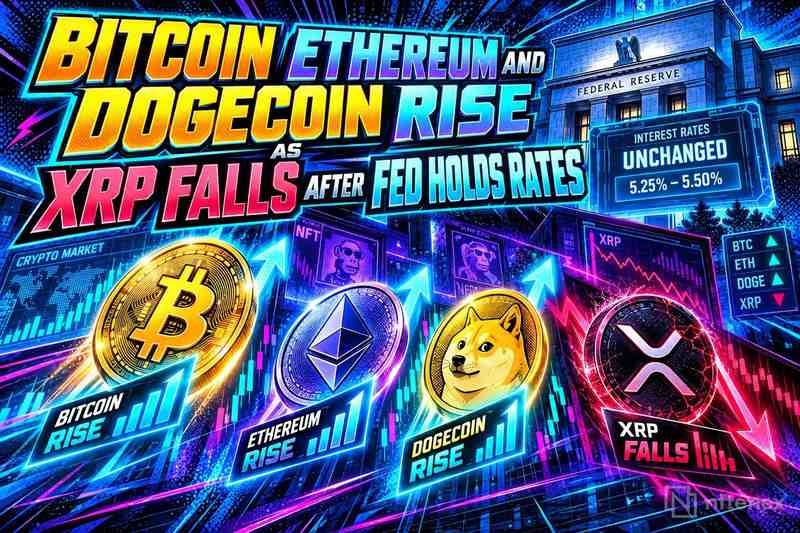
The Federal Reserve, led by Chair Kevin Warsh, held interest rates steady at its October 2026 meeting, producing a split reaction across the cryptocurrency market. Bitcoin, Ethereum, and Dogecoin all moved higher after the decision, while XRP bucked the broader trend and traded lower — a divergence that highlights how a single macro policy decision can generate uneven outcomes even within the same asset class.
A Divided Market After the Fed Holds
The reaction was far from uniform. In the hours following the Federal Open Market Committee announcement, Bitcoin, Ethereum, and Dogecoin registered gains, according to market data tracked on CoinGecko. XRP moved in the opposite direction, a divergence suggesting that token-specific factors were at work beyond the macro backdrop. For related coverage, see Bitcoin slips below $79K as jobs data revives Fed fears.
A rate hold leaves the Fed's benchmark borrowing cost unchanged, keeping financing conditions where they stood rather than tightening or easing them. The split stands out because rate-hold decisions are generally read as a neutral-to-positive signal for risk assets. When the cost of capital stays flat rather than rising, liquidity conditions remain relatively stable, which tends to support speculative assets broadly. Bitcoin's and Ethereum's positive reactions fit that logic; XRP's decline does not, pointing to dynamics unique to that asset in this cycle. For related coverage, see Bitcoin Slides After Blowout Jobs Report Revives Fed Hike Odds.
This is not the first time the Fed's posture has produced uneven crypto outcomes. When Bitcoin hit $82,000 on dovish Fed signals, Ethereum, XRP, and Dogecoin all spiked in tandem. XRP's absence from the current rally suggests the divergence reflects conditions specific to the token at present, rather than a structural change in how the market processes rate news.
Why a Steady Rate Decision Matters for These Tokens
Under Chair Kevin Warsh, the Fed has walked a delicate line between managing inflation and supporting economic growth. Holding rates steady signals that policymakers are not yet prepared to tighten further, preserving the liquidity environment on which crypto markets have historically relied for momentum. Bitcoin and Dogecoin, assets that closely track broad risk appetite, were among the beneficiaries of that read.
Crypto's sensitivity to central bank policy stems from how these assets are valued: with no corporate earnings or coupon payments anchoring their price, valuations rest heavily on liquidity conditions and future expectations, making them more reactive to Fed signaling than many traditional assets. Ethereum's gain alongside Bitcoin is consistent with its role as the primary infrastructure layer for decentralized applications and digital ownership protocols. Rising Ethereum prices tend to reflect both macro sentiment and expectations for on-chain activity, and a stable rate environment keeps the institutional allocation calculus from turning sharply negative.
Dogecoin's place among the gainers deserves separate mention. Unlike Bitcoin or Ethereum, Dogecoin carries no fundamental utility thesis beyond community and cultural resonance. Its participation in the rally indicates that retail sentiment responded positively to the rate hold. The upcoming launch of 21Shares and Grayscale Dogecoin ETFs may also be providing structural tailwinds to the token independent of macro factors.
XRP's decline under the same conditions is harder to attribute to macro forces alone. The token's price action has historically been dominated by regulatory classification questions and network-specific news flows, particularly when the broader market is reacting to a single macro event. Traders watching the asset will want to determine whether the move reflects fresh negative catalysts or simple profit-taking after recent outperformance. Past episodes — such as when Bitcoin and XRP rallied together after a key Fed inflation report — show the token is capable of moving with the macro trend, making today's divergence worth monitoring.
What Analysts Are Watching Next
The original report referenced an analyst outlook on where the market goes from here, though the full forecast was not available in the research brief at the time of publication. What the current setup does make clear is a market that is selectively rewarding assets aligned with prevailing risk appetite while punishing those carrying unresolved overhangs — even in a nominally supportive macro environment.
For Bitcoin and Ethereum, the question following a rate hold is typically whether the steady-state policy environment is already priced in, or whether further macro relief — such as a rate cut later in the cycle — could drive another leg higher. Incoming inflation and employment readings will help shape expectations for the Fed's path, and analysts tracking Federal Reserve guidance will be closely reading the full FOMC statement from the October 2026 meeting for language around the future rate trajectory.
For XRP specifically, any analytical framework that ignores token-specific catalysts will be incomplete. The asset's tendency to decouple from macro trends means its next move is more likely to be driven by regulatory developments or network adoption data than by what the Fed does at its next meeting.
The broader creator economy and digital ownership infrastructure that Ethereum underpins stands to benefit most from a prolonged period of stable rates, as protocol teams can plan treasury management and development cycles with greater predictability. Rate volatility, by contrast, compresses the planning horizon for NFT marketplaces, tokenization platforms, and on-chain royalty systems that depend on ETH-denominated economics. In that sense, the Warsh Fed's decision to hold is less a catalyst and more a floor — removing one source of downside risk while the market works through the token-specific stories still playing out in real time.
Disclaimer: This article is for informational purposes only and does not constitute financial or investment advice. Cryptocurrency and digital asset markets carry significant risk. Always do your own research before making decisions.

