Federal Reserve Proposes Two-Day Redemption Limit and Capital Buffers for Supervised Stablecoin Issuers
Key Takeaways
- •The Federal Reserve proposed a two-business-day maximum redemption window for holders of stablecoins issued by Fed-supervised entities, extendable only if an issuer threatens safety or financial stability.
- •Issuers would need to back every coin at face value at all times using eligible assets such as US dollars, Federal Reserve balances, insured bank demand deposits, Treasury bills with 93 days or less to maturity, and certain tokenized holdings.
- •Capital requirements include a 2 percent credit-risk charge on uninsured deposits and undercollateralized repo, plus operational-risk charges of 2 percent on the first $20 billion of coins outstanding, 1.5 percent between $20 billion and $50 billion, and 1 percent above $50 billion.
- •The proposals would cover stablecoin subsidiaries of state member banks and uninsured state-chartered issuers with $10 billion or more outstanding, and repeated capital shortfalls would trigger liquidation and redemption of all coins.
- •Governor Michael Barr endorsed the package but objected that the Board could act on anti-money-laundering failures only when they are significant or systemic, and the GENIUS Act will start no later than January 18, 2027.
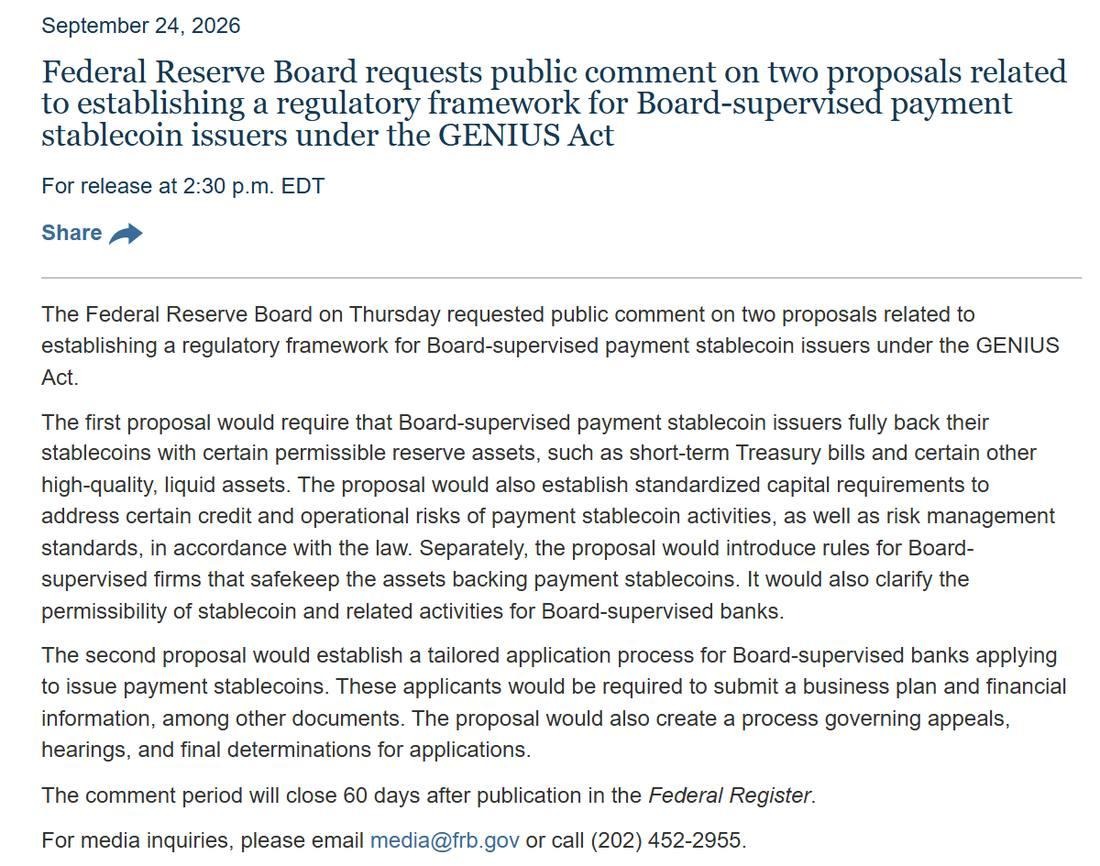
The Federal Reserve Board on Thursday unveiled two proposals for public comment that would implement the GENIUS Act — the federal framework governing payment stablecoins — establishing standards for stablecoin reserves, capital charges, redemption timelines, and the process banks must follow to launch stablecoin subsidiaries.
At the heart of the package is a simple commitment: two business days. That is the longest a holder would wait to receive dollars from a stablecoin issuer supervised by the Federal Reserve, provided the proposals survive the comment process and take effect. Redemption is the mechanism that lets holders exchange coins for dollars at face value, and because the clock counts business days, a request made on a weekend or holiday would wait until banking hours resume.
Both proposals are tied to the GENIUS Act, and each will remain open for comment for 60 days after its notice is published in the Federal Register. The rules would cover stablecoin issuers that operate as subsidiaries of state member banks, along with uninsured state-chartered issuers holding $10 billion or more in coins outstanding — a threshold that would place the largest uninsured state-chartered players under the central bank's direct supervision. Source: Federal Reserve Board press release, September 24, 2026.
What Counts as Backing
Every coin would need reserves worth at least its face value at all times. Eligible assets include US dollars, balances at Federal Reserve Banks, demand deposits at insured banks, and Treasury bills with 93 days or less remaining to maturity. Overnight repurchase agreements and funds holding only those assets would also qualify, as would tokenized versions of certain permitted holdings — a reflection of Wall Street's steady migration of reserve assets onchain, which BlackRock and Ondo underscored with their own announcement the same day.
The proposal would additionally require issuers to spread their risk. Concentrating uninsured deposits at a single bank, or repo exposure with a single counterparty, is precisely the kind of concentration the rule aims to limit. If an issuer's reserves fall below full backing, it must notify the Fed and then liquidate and redeem, unless a plan to recover quickly wins the Board's approval. The two-day redemption window itself could be extended only if the Board determines that an issuer threatens safety or financial stability.
Capital Charges and a Hard Stop
Capital follows its own formula. Credit risk on uninsured deposits and undercollateralized repo carries a 2 percent charge. Operational risk would also be charged against coins outstanding, with the rate sliding as an issuer grows: 2 percent on the first $20 billion, 1.5 percent on the stretch between $20 billion and $50 billion, and 1 percent above $50 billion — a structure that ties an issuer's capital burden directly to the size of its coin supply. Source: Federal Reserve Board staff memo on the GENI Act proposal, page 5.
Enforcement moves quickly. An issuer that falls short of the minimum at quarter end would file a plan to return to compliance. Missing the mark again the following quarter would trigger liquidation of everything — reserves included — with every coin redeemed.
Interest is off the table. The GENIUS Act bars issuers from paying yield simply for holding a stablecoin, and the proposal presumes that certain third-party arrangements amount to prohibited yield.
A Second Rule for Banks, Plus Custody
The second proposal addresses applications. Insured state member banks seeking a stablecoin subsidiary would submit a business plan, financial information, capital structure documents, biographical reports, and certifications. Denials would come with an appeals and hearing process.
Custodians pick up obligations as well. Firms that safekeep reserve assets — and the private keys used to issue coins, the credentials that control the creation of new tokens — would face minimum standards. A separate anti-tying rule would prevent any issuer from forcing customers to purchase an additional product.
Barr Backs the Package, With One Objection
Governor Michael Barr endorsed the proposals in a written statement. He called for clear redemption rights for all holders and asked for public feedback on interest rate and foreign currency risk within the reserves — questions commenters can address directly during the 60-day window.
His objection sits elsewhere. Under the proposal, the Board could act against an issuer over an anti-money laundering failure only if the problem is significant or systemic. Barr worries that this bar may weaken the Board's ability to prove that compliance programs are working. Elsewhere in Washington, SEC Commissioner Hester Peirce has been pitching zero-knowledge proofs as a lighter way to run KYC checks.
Nothing Takes Effect Yet
For now, nothing is binding. Final rules could accelerate the timeline, but the latest the GENIUS Act starts is January 18, 2027. The OCC, FDIC, and NCUA have already published their own proposals, giving the industry parallel comment channels across the federal banking regulators as the final texts take shape.

