FDIC Risk Report Flags Rising Big-Bank Exposure to Shadow Lenders
Key Takeaways
- •The FDIC report identified risks tied to bank lending to nonbank financial institutions, including potential liquidity stress and collateral-related losses in a downturn.
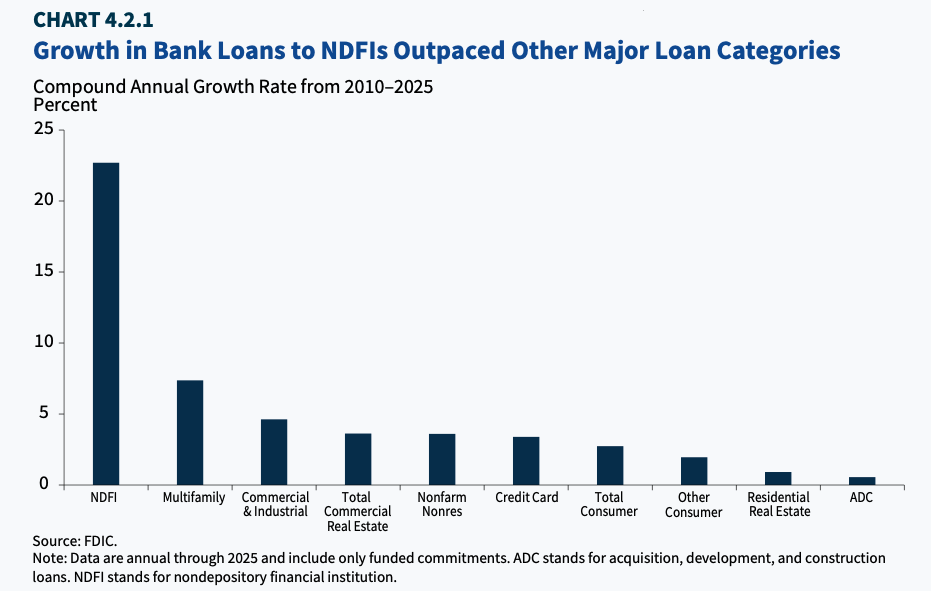
- •Bank loans to shadow banks rose 35% year over year in 2025, while St. Louis Fed data cited by Gilburt showed 26% annual growth since 2012.
- •At the end of 2025, banks with more than $100 billion in assets held 86% of the loan portfolio tied to shadow lenders.
- •Gilburt says large banks face multiple balance-sheet risks, including commercial real estate exposure, consumer-debt stress, underwater securities, derivatives and commercial lending defaults.
- •Gilburt advises depositors to review the financial strength of the banks holding their money rather than relying solely on FDIC protection.
Avi Gilburt, writing for GoldSeek, says recent publications from the Federal Reserve and other regulators have pointed to significant risks in the banking system, often contrasting with comments from bank chief executives and analysts covering large banks.
Gilburt argues that the current banking environment appears more dangerous than it was in 2007. He cites warnings about potential deposit runs linked to the commercial real estate refinancing wall, elevated delinquency rates in student loans, and growing stress in credit-card and auto lending.
A recently published FDIC risk report, he writes, contains several findings that merit further attention. The focus of his article is the report's discussion of nonbank financial institutions, or NDFIs, commonly referred to as shadow banks. This category encompasses a broad set of lenders that operate outside traditional bank regulation, including private credit funds, fintech lenders, mortgage companies, and business development companies. The private credit market in particular has expanded rapidly in recent years as institutional investors have sought higher-yielding alternatives to traditional fixed income, deepening the interconnections between regulated banks and less-supervised entities.
According to the FDIC report, bank lending to NDFIs has been the fastest-growing loan category since the global financial crisis, and the banking industry has continued to increase its exposure to nonbanks. In 2025, these loans grew 35% year over year. Gilburt also cites St. Louis Fed data showing that, since 2012, loans to shadow banks have grown by 26% annually. He says historical precedent suggests that such rapid growth has often come before a crisis.
The exposure is also highly concentrated among the largest banks. At the end of 2025, banks with more than $100 billion in assets held 86% of this loan portfolio. Ten of those banks held about 66% of all loans to shadow lenders. This concentration means that distress among even a handful of large nonbank borrowers could have outsized effects on the institutions that provide them with credit lines and warehouse facilities.
The FDIC explicitly identifies risks associated with this activity. In an economic downturn, shadow lenders may need to sell assets, which could put downward pressure on asset values. That, in turn, could affect the valuation of assets pledged as collateral or held by other shadow lenders and banks.
The report also notes that NDFIs relying on less stable funding sources could face substantial liquidity stress because of margin calls on collateral pledged under their bank facilities. Such stress could increase liquidity demands on banks if NDFIs collectively draw on bank-funded credit lines to protect their operations. At the same time, individual NDFI borrowers could lose access to funding.
Gilburt says the rapid growth in lending to shadow banks is likely driven by profitability. Because shadow banking is subject to more limited regulation, he writes, banks can earn attractive returns while allocating relatively little capital to these loans. He adds that regulators have repeatedly warned that shadow banking represents a key risk to global financial stability. The Financial Stability Oversight Council has also identified nonbank financial institutions as a priority area for monitoring, reflecting broader concern among U.S. and international regulators about the sector's growth and its ties to the traditional banking system.
He also argues that broad deregulation of the U.S. banking industry in 2025 and 2026 freed a substantial amount of capital, much of which appears to have been directed toward shadow banks. He points to the 35% year-over-year growth rate in these loans and notes that Forbes recently published an extensive list of the deregulatory actions.
In Gilburt's view, the fast expansion of bank lending to shadow lenders has created a large and increasingly concentrated risk in the financial system. While these exposures may look profitable under normal conditions, he says a downturn could amplify liquidity pressure, collateral losses, and funding stress across both banks and nonbanks. With regulation becoming less restrictive, he argues that this risk deserves closer attention.
Broader bank-balance-sheet concerns
Gilburt says larger banks now face more major balance-sheet issues than smaller banks, a topic he says he has addressed in previous articles. He contrasts the current environment with the 2008 global financial crisis, arguing that one major issue caused that crisis, while large bank balance sheets today contain multiple significant risk factors.
Those risk factors, according to Gilburt, include commercial real estate problems, rising consumer-debt risks approaching 2007 levels, underwater long-term securities, over-the-counter derivatives, high-risk shadow banking exposure, and elevated default risk in commercial and industrial lending, also known as C&I lending. Based on those factors, he says the current banking environment presents greater risks than those seen during the 2008 global financial crisis.
Gilburt says almost all of the banks recommended to his clients are community banks, which he says do not have the issues he has outlined over the past several years. He adds that not all community banks are strong, and that many small community banks are weaker than larger banks. He says his research has found some community banks with conservative business models that he considers solid and safe.
He also says he has reviewed many larger banks in public articles and that the substance of that analysis is unfavorable for the future of larger banks in the United States. He points to New York Community Bank as an example suggesting that banking problems have not been fully resolved. He also says he previously identified the reasons Silicon Valley Bank failed and argues that those issues have not been resolved.
Gilburt concludes that depositors should examine the banks that hold their money and assess whether those institutions are financially sound. He says reliance on the FDIC may not be as prudent in coming years as some depositors believe, citing his earlier articles on the banking industry's desired move toward bail-ins.
Author
Avi Gilburt is an Elliott Wave analyst and founder of ElliottWaveTrader.net, a live trading room featuring his analysis of the S&P 500, precious metals, oil and the U.S. dollar, along with a team of analysts covering other markets.

