DOJ Says FBI Seized Over $560K in Crypto Tied to Hamas Funding Probe
Key Takeaways
- •The FBI seized more than $560,000 in cryptocurrency as part of a DOJ investigation into suspected Hamas financing.
- •The seizure is an enforcement step, not a court verdict, and is typically followed by forfeiture proceedings to determine permanent ownership.
- •Blockchain records are permanent and public, allowing law enforcement to trace, freeze, and seize crypto assets tied to investigations.
- •TRM Labs reported that the use of cryptocurrency in terrorist financing expanded in 2024, reinforcing federal enforcement priorities.
- •The action increases compliance pressure on exchanges, which are expected to flag and report suspicious transaction flows.
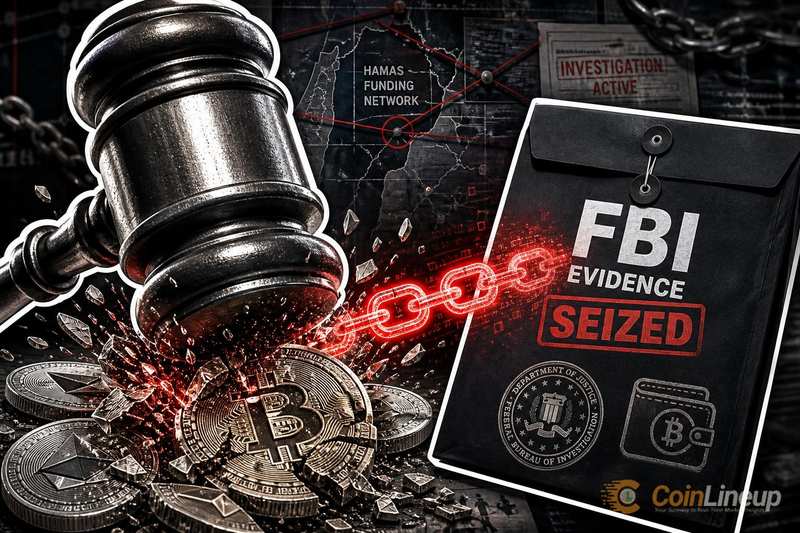
The U.S. Department of Justice says the FBI seized more than $560,000 in cryptocurrency as part of an investigation into suspected Hamas funding. The department described the action as part of its ongoing effort to disrupt terrorist financing moving through digital assets, according to its official announcement.
What the DOJ says the FBI seized
According to the DOJ, the FBI seized more than $560,000 in crypto tied to the investigation. The department framed the seizure as part of its broader work to disrupt Hamas terrorist financing schemes, attributing the action to the FBI and describing the funds as connected to a probe into suspected Hamas financing activity.
At this stage, the action is an enforcement step rather than a court verdict. A seizure means the government has taken control of the assets while the investigation continues; it does not, on its own, prove any individual guilty. Under U.S. law, seizure actions are typically followed by forfeiture proceedings, in which a court decides whether the government can permanently keep the assets — so the legal process around these funds is only beginning.
Why the seizure matters for crypto enforcement and compliance
The case shows that crypto wallets and transactions can become direct targets in federal investigations. When investigators trace funds on a public blockchain — the shared digital ledger that records crypto transactions — they can identify wallets and, in some cases, freeze or seize the assets inside them. Chainalysis, one of the firms whose tooling is widely used by government agencies, has documented in its annual crypto crime reports that illicit crypto flows remain a small fraction of overall transaction volume even as enforcement activity grows — context worth keeping in mind when high-profile seizure cases make headlines.
That traceability is the practical takeaway for regular users. Crypto is not as anonymous as many newcomers assume: blockchain records are permanent and public, which is precisely what allows law enforcement to follow the money.
For exchanges and their compliance teams, cases like this add pressure to monitor suspicious activity closely. The same tracing tools that helped authorities in a recent international crypto scam crackdown apply here, and platforms are expected to flag and report questionable flows.
Terrorist financing groups have continued to experiment with crypto. TRM Labs reported that the use of crypto in terrorist financing expanded in 2024, underscoring why federal agencies keep prioritizing these cases.
What this case signals about DOJ and FBI crypto investigations
Federal agencies are publicly emphasizing crypto-related enforcement. Announcing a seizure sends a deterrence signal both to bad actors and to the intermediaries, such as exchanges, that handle their transactions. These announcements also tend to feed into policy debates: U.S. regulators and lawmakers have repeatedly cited terrorist-financing cases when discussing stricter rules for crypto service providers, so enforcement actions like this one often ripple into the compliance requirements platforms face.
This fits a wider pattern of governments demonstrating their reach into digital assets. Authorities elsewhere have taken similar steps, such as when the Bank of Russia flagged 2,600 crypto wallets on a blacklist to restrict suspected illicit activity.
It is worth keeping the distinction clear: the DOJ has described an allegation and an ongoing probe, not a proven case. The seizure reflects where the investigation stands today, not a final legal outcome.
For regular crypto holders, legitimate holdings on a mainstream exchange are not affected by a case like this. The news is, however, a reminder that crypto transactions are traceable and that platforms are watching for suspicious activity. Anyone holding Bitcoin on an exchange should expect compliance checks to remain strict, and should understand that the openness of the blockchain works both for and against the people using it.
Disclaimer: This article is for informational purposes only and does not constitute financial or investment advice. Cryptocurrency and digital asset markets carry significant risk. Always do your own research before making decisions.

