Hacked FBI jobs portal data may expose employees tied to sensitive intelligence roles
Key Takeaways
- •Leaked FBI recruitment records appear to connect named employees to intelligence-related assignments involving Russia and China, as well as surveillance and human intelligence functions.
- •Reuters independently verified details for more than 22 individuals in a 5,000-line sample that hackers claim is part of a 2–3 terabyte trove, most of which remains unverified.
- •The FBIJobs.gov portal and its Candidate Gateway store "sensitive but unclassified" data, including Social Security numbers, for both external applicants and current bureau personnel.
- •The FBI has not established whether the breach began in its own system or at a third-party supplier, and no public evidence confirms ShinyHunters or CVE-2026-35273 was responsible.
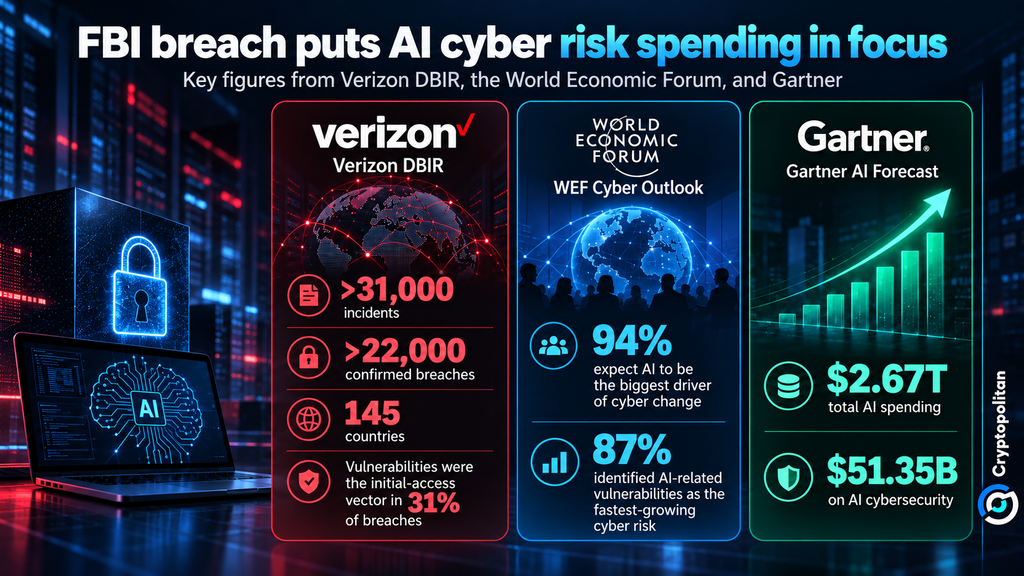
- •Industry reports indicate growing risk from AI-assisted attacks, with the World Economic Forum 94% of leaders expect AI to drive cybersecurity change and Gartner forecasting $51.35 billion in AI cybersecurity spending for 2026.
Personal data taken from the recruitment systems of the FBI may do more than expose employees' personal information: leaked records appear to connect named staff members to sensitive intelligence work, including assignments tied to Russia and China.
A review by Reuters examined a 5,000-line sample of personal information purportedly belonging to thousands of people at the bureau, according to the hackers. The group claimed the sample is only a small part of a data trove totaling 2–3 terabytes. Reuters independently verified details for more than 22 individuals, while the FBI has yet to confirm how many employees were involved in the incident. The rest of the claimed trove has not been independently verified.
Why a jobs portal holds spy-grade identity data
According to Reuters, the sensitivity of the leak stems from documents that appear to link named staff members to intelligence-related activity. Reviewers identified people connected to assignments concerning Russia and China, as well as surveillance and human intelligence functions.
The FBI's Privacy Impact Assessment, a public document describing how the bureau collects and protects personal information, explains why a recruitment platform holds such sensitive material. FBIJobs.gov and its Candidate Gateway store information designated "sensitive but unclassified," including name, Social Security number, date of birth, citizenship, gender, and veterans-preference eligibility.
Existing employees may also use the system to apply for positions available only to the internal workforce, through accounts connected to the bureau's HR systems. In other words, the portal's user base extends beyond outside applicants to current bureau personnel.
In a statement dated September 23, 2026, the FBI National Press Office said: "The FBI is aware of a cybercriminal enterprise group claiming a compromise of the fbijobs.gov portal and alleged impact to FBI employee personally identifiable information (PII)."
According to the FBI Statement on Compromise of fbijobs.gov Portal and Alleged Impact to FBI Employee PII, the bureau has not yet established whether the initial breach occurred in an FBI system or through a third-party supplier that supports the portal.
ShinyHunters, PeopleSoft, and the risk context
According to the FBI's privacy documentation, the recruitment platform relies on Oracle PeopleSoft, Oracle Database, and Drupal for its underlying infrastructure.Google's Mandiant]() previously linked the ShinyHunters group to attacks on Oracle PeopleSoft systems using CVE-2026-35273, a vulnerability rated as Oracle's most critical issue at 9.8 out of 10 — a score at the top of the critical range on the Common Vulnerability Scoring System.
That linkage does not, however, establish how the FBIJobs.gov breach happened. There is no public evidence that CVE-2026-35273 or ShinyHunters was responsible, and whether investigators establish or rule out a connection remains an open question. Google said it warned more than 100 organizations potentially exposed in the broader campaign, most of them in the United States, with 68% in higher education.
How stolen personnel data can supercharge AI-enabled attacks
There is no indication that artificial intelligence played any role in the FBI breach. The more urgent question is how the detailed personal information could be exploited afterward.
A Google threat intelligence report on the evolution of adversarial AI suggests that hackers are doing more than issuing simple prompts and are now operating with greater independence. In one example, a hacking group used a compromised cloud service to launch a large-scale credential-harvesting attack in less than six hours.
"Threat actors are increasingly relying on GenAI to assist them with various stages of their attacks," according to Verizon's 2026 Data Breach Investigations Report (DBIR).
Verizon's analysis covered more than 31,000 security incidents and over 22,000 confirmed breaches across 145 nations. The report found that vulnerabilities served as the means of initiating breaches in more than 31% of cases. The aftermath does not necessarily stop at the intrusion stage, because stolen personal data can also be used to launch further attacks.
Microsoft emphasized this risk in its guidance on the National Public Data breach in early 2024. The company highlighted that any exposed email address carries a heightened risk of phishing and account takeover, while compromised phone numbers can be used for phishing over phone calls and text messages.
In FBI's case, the situation may be more serious because the leaked information appears to go beyond employee contact details, connecting identities to information about roles and assignments. That combination may hand attackers improved tools for reconnaissance, impersonation, and highly tailored social engineering. AI could potentially accelerate and scale these efforts by helping attackers process stolen information, create convincing strategies, and automate their operations.
Cryptopolitan has also reported concerns over autonomous AI agents that could operate far faster than organizations can govern them.
The spending the breach could accelerate
The broader market is already responding to that pressure. The World Economic Forum's Global Cybersecurity Outlook 2026 found that 94% of surveyed leaders expect AI to be the biggest driver of change in cybersecurity, while 87% identified AI-related vulnerabilities as the fastest-growing cyber risk.
At the same time, Gartner forecasts worldwide AI spending to grow 49.5% in 2026, reaching $2.67 trillion, including $51.35 billion on AI cybersecurity.
The FBI leak does not create those trends on its own. But it shows why identity protection, threat detection, and AI-assisted defense are becoming harder for governments and enterprises to treat as optional. In this case, two questions remain open: how many employees were affected, and whether the compromise began inside an FBI system or with an outside supplier.

