European Stocks Hover Near Two-Week Lows as Bond Yields Hit Multi-Decade Highs
Key Takeaways
- •Germany's 10-year Bund yield rose to 3.22%, its highest level since May 2011, while the U.S. 30-year Treasury yield moved above 5.30%.
- •Brent crude hovered near three-week highs around $91.50 a barrel as disruptions in the Strait of Hormuz supported oil prices.
- •ECB Chief Economist Philip Lane said eurozone inflation near 3% is still well above the central bank's 2% target.
- •Markets are now almost fully pricing in a 25-basis-point ECB rate hike at the September meeting.
- •European equity indexes were mixed to flat on Wednesday, with the Stoxx Europe 600 near two-week lows after Tuesday's selloff.
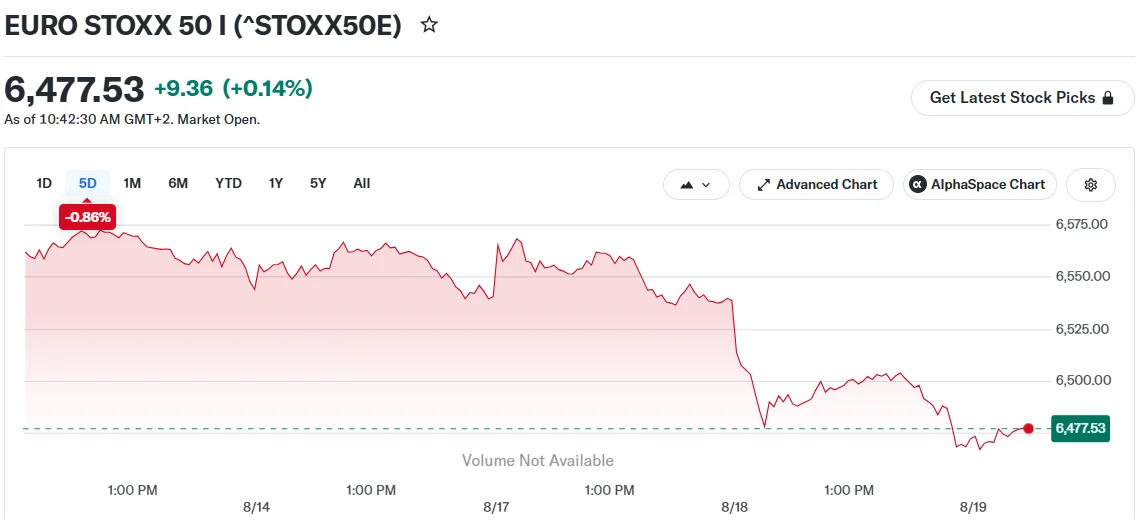
European equities struggled to find a clear direction on Wednesday, hovering near the flatline as traders continued to assess the fallout from a sharp selloff a day earlier. The pan-European Stoxx Europe 600 Index sat near two-week lows, still working to recover from its worst single-day drop in nearly a month.
At the index level, Germany's DAX fell 0.2%, while France's CAC 40 edged 0.2% higher. London's FTSE 100 and Spain's IBEX 35 were both flat. Euro Stoxx 50 and Stoxx 600 futures were also trading down around 0.2% in premarket activity.
Tuesday's selloff was driven by a mix of factors. Escalating threats in the Persian Gulf, rising crude oil prices, and soaring bond yields combined to force traders to unwind risk positions in short order. The move also reflected how quickly markets can turn when higher borrowing costs and energy prices hit sentiment at the same time, especially for sectors that depend on cheaper financing and steady growth expectations.
Bond Yields Reach Multi-Decade Highs
Germany's 10-year Bund yield jumped to 3.22%, its highest level since May 2011. The U.S. 30-year Treasury yield also surged past 5.30%. Both milestones underscore how sharply long-term borrowing costs have risen on both sides of the Atlantic.
Higher yields weigh on stock valuations in two key ways. First, they reduce the present value of companies' future earnings, a dynamic that hits tech and growth stocks hardest. Second, they make government bonds more attractive relative to equities, pulling money out of stock markets.
Renewed selling in chipmakers linked to the AI trade added further pressure on European markets on Wednesday. That matters for the broader region because semiconductors and other rate-sensitive names often help set the tone for equity trading when bond markets are moving sharply.
ECB Rate-Hike Bets Grow
ECB Chief Economist Philip Lane warned on Tuesday that Eurozone inflation, currently around 3%, remains "well above" the central bank's 2% target. He said price pressures, while down from their double-digit peaks, are still too high for policymakers to ease up.
In commodity markets, Brent crude futures hovered near three-week highs around $91.50 a barrel. Shipping disruptions through the Strait of Hormuz, caused by military activity in the Persian Gulf, are keeping oil prices elevated.
The combination of sticky inflation and high energy costs has forced markets to reprice their rate expectations. Futures contracts now almost fully price in a 25-basis-point rate hike from the European Central Bank at its September meeting, a sharp shift from earlier expectations of a prolonged pause. That shift puts more attention on incoming inflation readings and central bank guidance, because energy prices can feed through to transport and production costs even before they show up in broader consumer data.
Investors are watching closely for remarks from ECB President Christine Lagarde, seeking clues about how the central bank plans to handle a potential stagflationary environment, in which weak growth coincides with persistently high inflation.
Across the Atlantic, the Federal Reserve is set to release minutes from its July FOMC meeting. Traders will look for signs of how closely Fed officials were monitoring the labor market before the recent rise in long-term borrowing costs.
No major corporate earnings are scheduled in Europe on Wednesday, leaving the focus on UK and Eurozone inflation data, central bank commentary, and developments in the oil market. With fewer company-specific catalysts on the calendar, rates and energy prices are likely to remain the main drivers of market direction in the near term.

