HTX Corporate Crypto Accounts Face Potential Dead End Under EU's 21st Sanctions Package
Key Takeaways
- •The EU adopted its 21st sanctions package against Russia on July 23, 2026, targeting the cryptocurrency sector alongside Russian energy and financial services, with HTX exchange specifically affected.
- •EU Council regulations are directly binding on all member states without national transposition, meaning the sanctions carry immediate legal force across the entire bloc.
- •The assertion that corporate HTX account holders have zero legal withdrawal routes is only partially verified and should be treated as a reported claim rather than a definitive legal conclusion.
- •The International Consortium of Investigative Journalists reported that experts believe HTX is deploying tactics that could reduce the effectiveness of the sanctions.
- •Compliance teams are advised to carefully document their holdings, obtain qualified legal counsel, and monitor official EU and exchange communications as sanctions interpretation continues to evolve.
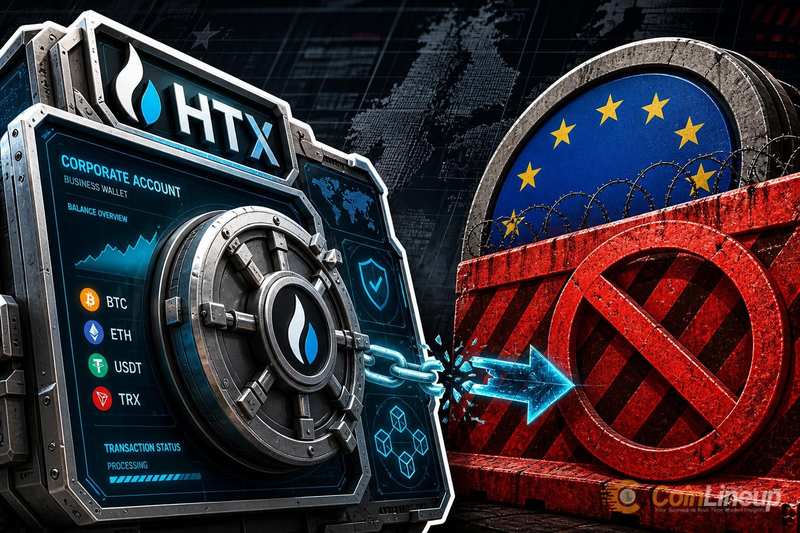
Corporate HTX crypto accounts held by companies within European Union jurisdiction may face a deadlock, with no clearly lawful path to withdraw funds after the EU targeted the exchange in its latest sanctions package. HTX, formerly known as Huobi and one of the world's largest cryptocurrency exchanges by trading volume, has operated across multiple jurisdictions under various regulatory regimes. The claim that zero legal exit routes exist for HTX corporate crypto accounts remains only partially verified and should be interpreted with appropriate caution.
EU Sanctions Update and HTX Accounts
The measure stems from the EU's 21st package of sanctions against Russia, adopted on July 23, 2026. The Council stated that the package targets Russian energy, financial services, and cryptocurrency sectors. The underlying legal act is published in the EU's Official Journal on EUR-Lex. The European Commission outlined the scope and rationale in an accompanying official questions-and-answers note. The Council's press release provides further detail on the package.
EU Council regulations are directly binding on all member states without requiring national transposition, which means the sanctions take immediate legal effect across the bloc. This particular package builds on the EU's broader sanctions response to Russia that has been expanding since 2022, with each successive round tightening restrictions on financial intermediaries and digital asset service providers.
The research behind this story is marked as partially verified with limited extracted facts. The specific mechanics of how the restrictions apply to individual corporate accounts have not been fully confirmed from the document text.
Why a Missing Legal Exit Route Matters
The core practical issue is the gap between holding crypto on paper and having a lawful route to move or redeem it. A balance can still appear inside an account even when every compliant withdrawal channel has been shut down by the sanctions regime.
Corporate entities generally encounter more rigid compliance barriers than retail users. Banks, counterparties, and the exchange itself must screen business transfers against sanctions lists before processing them. That screening process is where a trapped balance becomes a legal obstacle, not merely a technical one.
This challenge takes on added weight given the EU's parallel implementation of the Markets in Crypto-Assets Regulation (MiCA), the bloc's comprehensive crypto framework that establishes licensing and operating requirements for digital asset providers. The intersection of sanctions obligations and MiCA compliance creates a particularly complex environment for corporate account holders navigating both regimes simultaneously.
Reporting by the International Consortium of Investigative Journalists found that experts believe HTX is deploying tactics that could blunt the impact of the sanctions. Compliance specialists have separately mapped out what the 21st package means for crypto compliance teams.
The "zero legal exit routes" framing should be treated as the reported claim of this story rather than a settled legal conclusion. It reflects the difficulty of identifying a compliant off-ramp, not a confirmed ruling that withdrawal is impossible for every account.
What Affected Firms Should Watch Next
The regulatory landscape remains an open question beyond this single exchange. Debates over how enforcement agencies fill legislative gaps continue to shape how firms interpret their obligations. Other exchanges with exposure to EU markets may also face increased scrutiny under the sanctions framework.
Further legal review, exchange guidance, or regulator clarification may be necessary before any firm can reach a definitive conclusion about a specific account. This article is not legal advice and does not promise a particular withdrawal outcome.
The research record itself flags that its evidence gathering concluded early and recommends a narrower angle, which is an additional reason to avoid overstating certainty.
For compliance teams, the practical guidance is to document holdings carefully, seek qualified legal review, and monitor official EU and exchange updates as the interpretation of the sanctions evolves.
Disclaimer: This article is for informational purposes only and does not constitute financial or investment advice. Cryptocurrency and digital asset markets carry significant risk. Always conduct your own research before making decisions.

