EU Proposes Crypto Sanctions on Kyrgyzstan Over Russia Evasion Concerns
Key Takeaways
- •The EU proposed listing Kyrgyzstan in Annex LVII, making it the first country designated under the country-level crypto sanctions mechanism introduced through the 21st sanctions package on July 23, 2026.
- •The proposed restrictions would cover direct and indirect transactions between EU operators and all crypto service providers in Kyrgyzstan, and approval requires unanimity among all 27 EU member states.
- •TRM Labs reported high confidence that Kyrgyzstan-based TokenSpot operates as a front for Grinex, citing six identical TRON addresses and one shared aggregation address, with TokenSpot's TRON addresses receiving $3.54 billion and sending $3.14 billion between December 8, 2023 and September 27, 2026.
- •TokenSpot sent $679.5 million to the A7 network, its largest external counterparty, including $26.5 million directly to A7A5, the network's ruble-pegged stablecoin.
- •The United Kingdom imposed its own sanctions on October 8, 2026, designating 38 Russia-related companies including Xeltox Enterprises Ltd, which operates the Cryptomus and Heleket payment services.
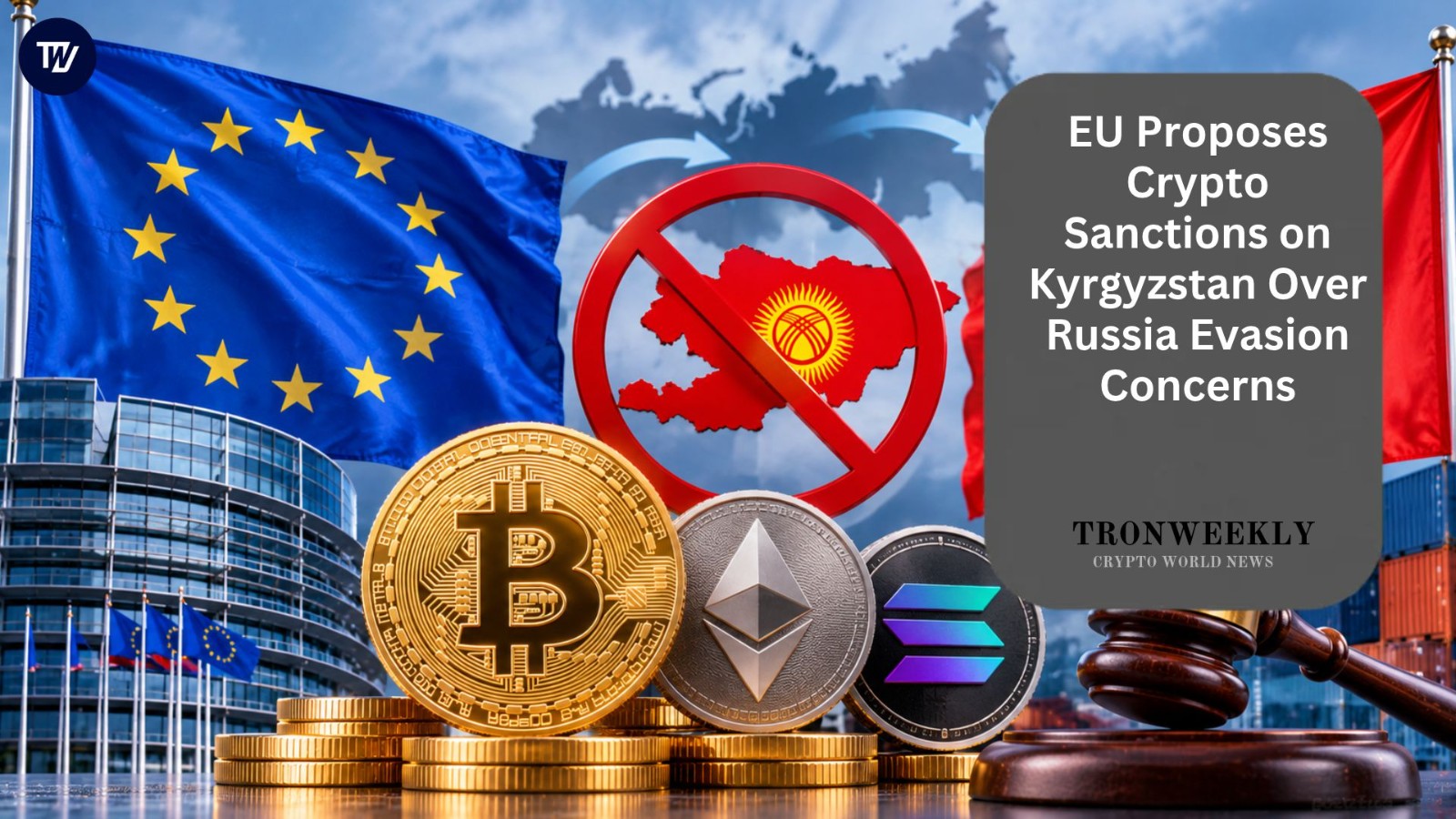
The European Union has proposed adding Kyrgyzstan to its crypto sanctions list, a move that would make the Central Asian nation the first country targeted under a mechanism designed to prevent sanctions evasion through cryptocurrency services. If approved, the measure would restrict EU operators from conducting direct or indirect transactions with crypto service providers established in Kyrgyzstan.
The proposal forms part of the EU's 22nd sanctions package against Russia and requires unanimous approval from all 27 member states before it can take effect, meaning a single member state's objection would be enough to block the designation. If adopted, it could reshape how European financial companies evaluate their cryptocurrency partners, since a platform's country of establishment — rather than an individual designation — would determine whether EU firms may continue using its services.
Background: Garantex, Grinex and Third-Party Operations
The proposal comes amid reports concerning Russia-based cryptocurrency exchanges operating through third parties. One case involves Garantex, a Russian exchange disrupted by enforcement action in March 2025. According to the US Treasury, former Garantex employees later created a new exchange called Grinex in Kyrgyzstan.
Country-Level Mechanism Could Restrict EU Exchange Access
The EU introduced the country-level mechanism through its 21st sanctions package on July 23, 2026. Under the framework, restrictions can be imposed on crypto service providers in countries that have systematically and repeatedly failed to ensure their services are not used for sanctions evasion. The corresponding regulation established Annex LVII without any country entries, and Kyrgyzstan appears set to become the first state added to it.
Unlike individual exchange designations, the country-level approach covers all providers in a listed jurisdiction. As a result, European firms could face restrictions even without any EU designation of a specific exchange.
Indirect payments are also covered by the rules, meaning EU operators cannot bypass the restrictions through intermediaries. European brokers, financial institutions and other enterprises that use cryptocurrency exchanges for transactions, settlement or other services could be affected.
Shared Wallets and A7 Transfers
Further detail on the blockchain links between the exchanges comes from blockchain intelligence firm TRM Labs, which published a report on the Kyrgyzstan-based TokenSpot exchange on October 6, 2026. According to TRM, it has high confidence that TokenSpot acts as a front company for Grinex, having identified similar wallet infrastructure across the two independently registered entities.
TRM found that TokenSpot and Grinex share six identical TRON addresses and one aggregation address to which they send transaction fees. The analysis also identified a deposit aggregator that received $146.3 million from 126 TokenSpot deposit addresses; the exchange itself later disclosed that it used that address.
The researchers additionally identified financial linkages with Russian-affiliated entities. Between December 8, 2023, and September 27, 2026, TokenSpot's TRON addresses received $3.54 billion and sent $3.14 billion. TRM noted those figures reflect the exchange's on-chain activity during the period in question, not illicit transactions.
"JUST IN: The EU could bar European brokers from using Kyrgyzstan-based crypto exchanges under a proposed sanctions measure needing unanimous approval from all 27 member states."
— Gokhshtein (@gokhshtein), November 26, 2026, on X
A7 was TokenSpot's largest counterparty outside its own exchange. The exchange sent $679.5 million to the A7 network and received $48.5 million from it. TokenSpot also sent $26.5 million directly to A7A5, the network's ruble-pegged stablecoin.
UK Sanctions Target Kyrgyz Crypto and Payment Companies
On October 8, 2026, the United Kingdom launched its own sanctions enforcement against other companies involved in these networks. That package included 38 Russia-related designations, targeting companies involved in cryptocurrency exchanges, payment processors, oil companies, and suppliers of goods connected to Russia's military-industrial complex.
Among the designated companies was Xeltox Enterprises Ltd, described by TRM as a Canadian company operating through Cryptomus and Heleket. TRM's analysis showed that the two payment services used the same infrastructure, employees, brand and funding source.
The October 2026 designations illustrate that international regulators are targeting not only cryptocurrency exchanges but also payment processors, financial intermediaries, and companies that support transaction networks. The UK sanctions and the EU's proposed restrictions nevertheless remain distinct enforcement actions.
Compliance Implications
The proposal could increase compliance obligations for cryptocurrency firms doing business in European jurisdictions. If the designation of Kyrgyzstan under Annex LVII becomes final, brokerages and financial organizations would need to reassess their service-provider registries, evaluate alternative transaction methods, and revise their screening procedures.
The measure would also affect legitimate cryptocurrency companies located in Kyrgyzstan. Firms with no ties to sanctioned Russian service providers would still face restrictions in their dealings with EU operators once the country-level measure is adopted.
TRM Labs' research helps illustrate the rationale behind the regulation by identifying financial ties among TokenSpot, Grinex, Garantex and A7. The firm's blockchain analyses should nonetheless be distinguished from the EU's legal assessments and the proposal for a country-level designation.
As of November 26, the decision remained pending unanimous approval from all 27 EU member states. If approved, the move could set a precedent for designating entire jurisdictions rather than individual crypto service providers. The next stage is a decision on the country's designation.

