Weekly Project Updates: Ethereum zkAPI Goes Live, Base Cobalt Reaches Mainnet, USDT on Bitcoin Advances via RGB
Key Takeaways
- •The Ethereum Foundation's zkAPI went live on Ethereum mainnet on October 1, 2026, using zero-knowledge proofs and an ETH orDC credit vault to decouple API payment identity from individual requests.
- •Base deployed its Cobalt upgrade to mainnet on September 30, 2026, after a September 23 Sepolia testnet phase, introducing validity transactions, B20 improvements, dynamic node upgrades, and on-chain verification of AWS Nitro and P-384 TEE attestation.
- •Tether confirmed in an August 2025 announcement its plan to issue USDT natively on Bitcoin via the RGB protocol, whose client-side validation model keeps balances and transfer proofs with users rather than published on-chain.
- •An October 2026 Utexo rollout featuring private transfers, direct BTC-USDT swaps, and BTC-backed lending comes from a single secondary source and has not been independently confirmed by Tether.
- •Bitcoin traded at $85,266, up 0.58% over 24 hours, with a market capitalization of approximately $1.71 trillion and a Fear & Greed Index reading of 65, classified as Greed.
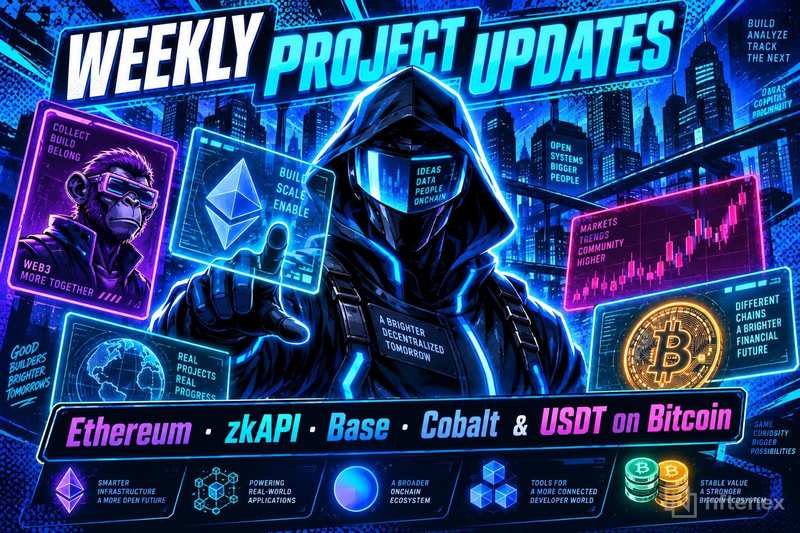
Three significant infrastructure moves defined this week's crypto project landscape: the Ethereum Foundation launched zkAPI, a privacy-preserving payment layer for API usage built with the Open Anonymity Project; Base pushed its Cobalt upgrade to mainnet; and Tether's plan to issue USDT natively on Bitcoin moved closer to reality through the RGB protocol, with secondary reports pointing to an Utexo-powered rollout.
Ethereum's zkAPI Launch: Separating Payment from Identity
The Ethereum Foundation announced on October 1, 2026 that zkAPI is now live on Ethereum mainnet. The system relies on zero-knowledge proofs and a vault holding ETH or USDC credits to authorize metered API usage without tying a developer's payment identity to individual requests.
The implementation was developed in collaboration with the Open Anonymity Project. By decoupling the payment credential from the API call, zkAPI addresses a persistent infrastructure problem: developers who rely on on-chain APIs today reveal their billing identity with every request, creating surveillance surfaces at the protocol level.
The implications are direct for the creator economy and NFT tooling built on Ethereum. Marketplace backends, metadata resolvers, and royalty enforcement contracts all depend on API infrastructure, and zkAPI means that infrastructure no longer leaks operator identity as a side effect of normal usage.
What to Watch Next
Adoption will hinge on documentation quality, SDK availability, and how quickly tooling teams integrate the vault-based credit model. The Ethereum Foundation's announcement is the primary signal to follow; the breadth of implementation across major API providers is the next metric worth tracking. The Zcash ecosystem's privacy tooling gains this year offer a useful parallel for how privacy primitives can shift from niche applications to standard infrastructure.
Base Cobalt Goes Mainnet: What the Upgrade Covers
Base's Cobalt upgrade went live on mainnet on September 30, 2026, following a Sepolia testnet deployment on September 23. The upgrade introduces B20 improvements, validity transactions, dynamic node upgrades, and on-chain verification of AWS Nitro and P-384 TEE attestation.
The on-chain TEE attestation component is the technically notable addition. With P-384 attestation verification running on-chain, Base nodes can prove the integrity of their execution environment at the protocol layer rather than relying on off-chain trust assumptions. Dynamic node upgrades, meanwhile, reduce the coordination overhead that has historically complicated L2 maintenance windows.
Developer and Ecosystem Details to Monitor
Validity transactions and the B20 improvement set are the items that NFT platforms and gaming asset contracts on Base should review for compatibility. Cobalt's rollout also establishes a baseline for how Base handles future confidential-compute integrations, a matter of consequence for any creator contract that processes sensitive royalty or licensing logic.
USDT on Bitcoin via Utexo: The Week's Bitcoin-Focused Development
Tether announced plans to launch USDT on Bitcoin's RGB protocol, emphasizing private, scalable, and user-controlled stablecoin issuance directly on the Bitcoin base layer. The announcement, published in August 2025, confirmed Tether's intent to bring native USDT issuance to Bitcoin without relying on a separate chain.
According to secondary reporting, a platform called Utexo is positioned to deliver a user-facing rollout in October 2026, including private transfers, direct BTC-USDT swaps, and BTC-backed lending. Those specific product details and timing come from a single secondary source and have not been independently confirmed by Tether's own published materials; readers should treat the Utexo-specific scope as unconfirmed reports pending further disclosure.
Bitcoin was trading at $85,266 at research time, up 0.58% over 24 hours, with a market capitalization of approximately $1.71 trillion and 24-hour volume near $14.8 billion. The Fear \u0026 Greed Index stood at 65, classified as Greed.
RGB's client-side validation model means USDT balances and transfer proofs are held by users rather than published to the chain, an approach that aligns with the privacy framing in Tether's announcement. For NFT and digital asset creators who have historically had to bridge to other chains to access stablecoin liquidity, native BTC-layer issuance represents a meaningful infrastructure shift, provided the Utexo implementation delivers on its reported feature set.
Why Confirmation of the Implementation Model Matters
The gap between Tether's confirmed RGB intent and the reported Utexo product scope is worth tracking closely. RGB is a relatively young protocol, and the specific mechanics of BTC-USDT swaps and BTC-backed lending built on top of it involve trust assumptions and liquidity models that have not yet been independently documented. Analysts watching Bitcoin's trajectory will note that a credible native stablecoin layer could meaningfully alter on-chain demand dynamics. The recent divergence in altcoin volume relative to Bitcoin also provides context: liquidity that currently routes through wrapped or bridged USDT on other chains could eventually consolidate on Bitcoin if RGB-native issuance scales.
This Week's Developments at a Glance
- Ethereum zkAPI: Live on mainnet as of October 1, 2026; uses ZK proofs and a credit vault to decouple API payment identity from individual requests, built with the Open Anonymity Project.
- Base Cobalt: Mainnet-live September 30, 2026; adds on-chain P-384 TEE attestation, validity transactions, B20 improvements, and dynamic node upgrades.
- USDT on Bitcoin via Utexo: Tether has confirmed RGB protocol plans; an October 2026 Utexo rollout featuring private transfers and BTC-backed lending is reported by a secondary source but has not been independently verified.
Disclaimer: This article is for informational purposes only and does not constitute financial or investment advice. Cryptocurrency and digital asset markets carry significant risk. Always do your own research before making decisions.

