Ethereum FOMO Meets Higher Binance Leverage Than Bitcoin, Data Shows
Key Takeaways
- •Santiment's social data shows 2.05 bullish Ethereum comments for every bearish one across X, Reddit and Telegram, while Bitcoin registered just 0.82 bullish comments per bearish one.
- •Ethereum's Binance Estimated Leverage Ratio stands near 0.69 with ETH around $2,400, above the roughly 0.53-0.55 readings recorded before the October 10, 2025 liquidation event, and has stayed above its 100-period moving average after prior resets.
- •Bitcoin's Estimated Leverage Ratio is near 0.19, close to its level before the October 2025 liquidation event and below a declining moving average, indicating its derivatives exposure has been easing rather than rebuilding.
- •CryptoQuant's leverage ratio is a sensitivity measure that can rise from higher open interest or falling exchange reserves, and it does not indicate whether the market is positioned for a long squeeze or a short squeeze.
- •Funding-rate and open-interest data are the key metrics needed to confirm whether Ethereum's social optimism is becoming a crowded derivatives trade or Bitcoin's lower leverage reflects genuine buying demand.
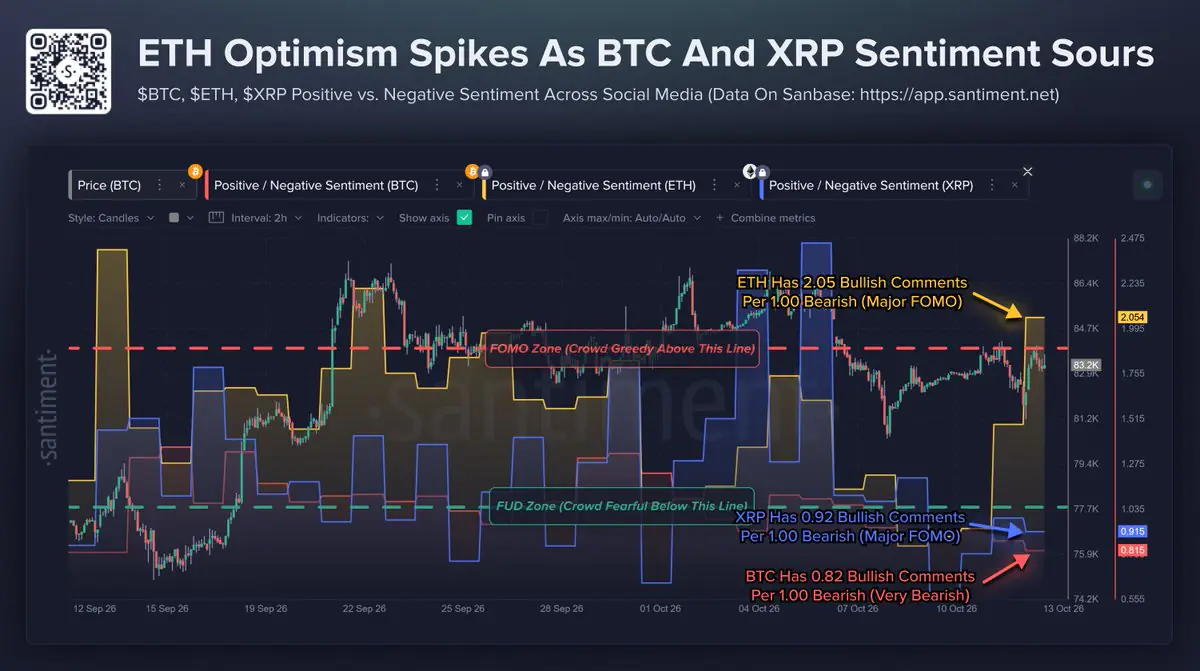
Ethereum traders are notably more upbeat than their Bitcoin counterparts, and the two assets are also diverging on derivatives leverage, according to fresh data from analytics firms Santiment and CryptoQuant.
Ethereum and Bitcoin Are Sending Opposite Messages
Santiment's latest social-data update found 2.05 bullish Ethereum comments for every bearish one across X Reddit and Telegram. The firm characterized the discussion around ETH as FOMO-driven, citing the asset's rebound and renewed attention on staking and future network upgrades. Santiment shared the findings in a post on X.
Bitcoin produced the opposite reading: 0.82 bullish comments for every bearish comment. Santiment linked the weaker mood to Bitcoin's rejection near $87,000, its slide toward $81,000 and the broader pressure on risk assets during the sell-off.
Neither figure indicates where either asset goes next. Social data measures the balance of public discussion, not the amount of capital committed to a trade. Its value in this case is that it shows where confidence has concentrated: Ethereum traders are discussing a rebound, while Bitcoin traders remain more defensive.
Leverage Ratio Is a Sensitivity Measure, Not a Long-or-Short Signal
The sentiment gap becomes more useful when placed beside derivatives positioning. CryptoQuant's Estimated Leverage Ratio compares open interest with the amount of an asset held in an exchange's reserves, providing a way to track how large the derivatives market has become relative to the coins available on that exchange.
Both ratios discussed here are measured on Binance, one of the largest crypto derivatives venues, which gives the ETH-versus-BTC comparison a consistent venue basis and is part of why the exchange's reserve and futures data serves as a common reference point for this type of analysis.
A higher ratio can result from rising open interest, falling exchange reserves, or both. It does not reveal whether the market is positioned for a long squeeze or a short squeeze, and it cannot measure order-book depth. It should therefore be read as a sign of potential derivatives sensitivity rather than a stand-alone trading signal.
The metric is also most meaningful against each asset's own history. ETH and BTC have different reserve patterns, derivatives markets and custody flows, so an ETH reading of 0.69 is not a simple numerical verdict over a BTC reading of 0.19. The more informative comparison is the recent direction of each ratio.
Read together, the two datasets serve complementary purposes: sentiment shows where conviction is building, while leverage shows whether derivatives exposure is remaining elevated around that conviction. A stronger risk warning would require further evidence, such as rising open interest and increasingly positive funding, not social optimism alone.
Ethereum's Leverage Ratio Has Rebuilt After Earlier Resets
CryptoQuant analyst MorenoDV_ placed Ethereum's Estimated Leverage Ratio on Binance near 0.69 while ETH traded around $2,400, according to a Quicktake analysis. The analysis compared that level with readings between roughly 0.53 and 0.55 before the October 10, 2025 liquidation event, the market-wide sell-off that forced leveraged positions closed and abruptly reset derivatives exposure.
More important than the single reading is what followed. CryptoQuant's chart showed the ratio rebuilding after sharp resets and remaining above its 100-period moving average. In other words, Ethereum's derivatives exposure relative to Binance reserves has stayed in a higher range even after prior bouts of deleveraging.
That does not prove ETH is about to decline, and it does not establish that leveraged longs dominate the market. It does mean that a fresh rise in open interest and positive funding would deserve closer attention, as traders would be adding exposure while the ratio is already elevated against ETH's recent trend.
Bitcoin's Crowd Is Cautious While Its Leverage Trend Has Cooled
Bitcoin's social reading is weaker, but CryptoQuant's Binance data shows a less persistent leverage setup. Its Estimated Leverage Ratio stood near 0.19, around the level seen before the October 2025 liquidation event cited in the analysis, and had fallen from higher readings earlier in 2026.
The ratio was also below a declining moving average in CryptoQuant's chart, suggesting that Bitcoin's derivatives exposure relative to Binance reserves has been easing rather than rebuilding in the way described for ETH.
This does not make Bitcoin automatically bullish or safer. A lower ratio can reflect healthier deleveraging, but it can also occur in a weak market with little appetite to add new futures positions. Bitcoin still needs price stability and renewed spot demand before a lower leverage reading can support a stronger recovery case.
What Would Confirm or Weaken the Current Divergence?
The supplied sentiment and leverage datasets do not include live funding-rate or open-interest changes. Those are the next figures that would test whether Ethereum's social optimism is becoming a crowded derivatives trade, or whether Bitcoin's lower leverage is accompanied by genuine buying demand.
Ethereum and Bitcoin Need Different Confirmation
Ethereum currently has the stronger narrative, but its Binance leverage ratio has not reset as fully as Bitcoin's. That makes the next derivatives data important: rising open interest and positive funding would make ETH's rebound more vulnerable to a rapid reversal, while a calmer build in exposure would weaken that concern.
Bitcoin's cautious sentiment, meanwhile, should not be read as a bullish signal on its own. Its leverage trend has improved, but the market still needs spot demand and price stability to show that the sell-off has produced a durable base rather than simply reduced speculative participation.
This article is provided for informational purposes only and does not constitute financial or investment advice. Social sentiment and derivatives metrics are interpretive tools, not guarantees of future price movement.

