Ethereum Staking Hits Record 43.8M ETH as Yields Fall to 2.63%
Key Takeaways
- •Ethereum's staked supply reached a record 43.8 million ETH in Q3 2026, equal to 35.9% of the network's total supply.
- •Net ETH staking inflows totaled 7.96 million ETH in the first nine months of 2026, six times the 1.31 million ETH staked over the same period last year.
- •Ethereum treasury company BitMine had staked 5.07 million ETH as of September 27, a sharp increase from 0.41 million ETH in December 2025.
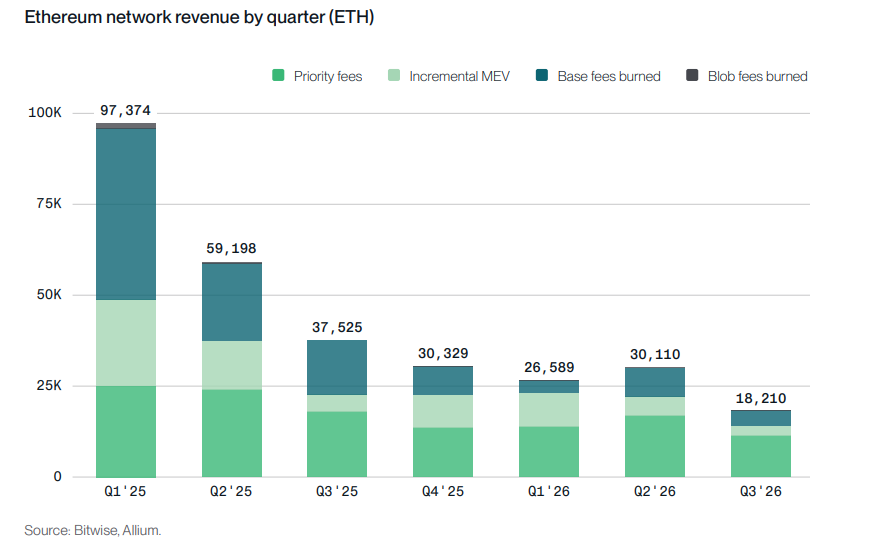
- •Ethereum's annualized gross staking yield fell to 2.63% from 2.81%, as quarterly network revenue dropped to 18,210 ETH, or an average of 198 ETH per day, due to lower transaction fees.
- •The Pectra upgrade enabled automatic restaking of consensus rewards and validator consolidation that reduced Ethereum's validator count from 1.1 million to 881,000, while Solana's staked supply rose to 69% even as its yield fell to a record low of 5.99%.
Ethereum staking reached an all-time high of 43.8 million ETH during the third quarter of 2026, according to Bitwise's staking report published on October 20. The total represents 35.9% of the network's supply, reflecting steadily expanding institutional participation. Under proof-of-stake, the staked share of supply is also the portion of the network's economic value committed to validating transactions, which is why participation records draw attention well beyond the yields themselves.
The report, however, identified a divergence between growing deposits and declining validator returns. Ethereum's annualized gross staking yield fell to 2.63%, down from 2.81% in the previous quarter. Solana exhibited a similar pattern, with 69% of its supply staked even as yields declined — a sign of shifting economics across major proof-of-stake networks. The inverse movement is structural: rewards are split across an ever-larger pool of staked tokens, so per-token returns compress as participation expands.
Institutional Demand and Network Upgrades Fuel Staking Growth
In the first nine months of 2026, Ethereum recorded a net inflow of 7.96 million ETH staked, six times the 1.31 million ETH staked over the same period last year. Institutional investors have been a major contributor, particularly BitMine. The Ethereum treasury company had staked 5.07 million ETH as of September 27, a sizable jump from 0.41 million ETH in December 2025. For corporate holders of this kind, staking turns otherwise idle treasuries into yield-generating positions, tying balance-sheet strategy directly to network participation.
Technical upgrades to the Ethereum network have also supported the surge. The Pectra upgrade, activated in May 2025, allows validators to automatically restake their consensus rewards. While execution rewards are not automatically restaked, the compounding of consensus rewards channels more ETH back into staking, increasing overall staked volume.
Pectra also enables the consolidation of multiple validators. According to the Bitwise report, this has lowered infrastructure costs while reducing the number of validators from 1.1 million to 881,000.
Ethereum is not the only network experiencing a staking surge. Solana's staked supply rose to 69%, up from 68% in the previous quarter, amounting to 440.5 million SOL. Elsewhere, the amount of HYPE actively staked on Hyperliquid dropped from 437.29 million to 436.47 million, while the average NEAR staked remained unchanged.
Yields Decline as Staked Volume Climbs
The rise in staked volumes across ETH and SOL has been matched by a corresponding decline in staking yields. Ethereum's annualized staking yield now stands at 2.63%, down from 2.81% in Q2.
Falling network revenue contributed to the yield drop. Ethereum generated just 18,210 ETH in revenue in Q3, averaging 198 ETH per day, despite transaction volume of roughly 199.32 million. In Q2, it averaged 331 ETH in daily revenue while processing only slightly more transactions.
The revenue decline is largely attributable to lower transaction costs on the network. As network capacity has increased, Ethereum has been able to handle the larger volume without significant pressure on blockspace. That fee-usage dynamic is the main channel through which staking yields are set on Ethereum, making the interplay between transaction growth and network revenue the key variable to track as usage patterns evolve.
Solana's annualized yield has also trended lower over the past year, falling to a new low of 5.99%. It stood at around 9.07% in Q2 of 2025 and 6.38% in Q2 of 2026. With Solana stakeholders having approved a faster disinflation schedule a few months ago, the network could see staking yields fall further once the proposal is activated.
This article is for informational purposes only and does not constitute financial or investment advice. Cryptocurrency staking involves price volatility, operational risks, potential penalties, and variable returns. Investors should conduct independent research and consult a qualified financial adviser before making investment decisions.
Source: The Market Periodical

