Ethereum Staking Explained: Rewards, Risks and How It Works
Key Takeaways
- •Ethereum's switch from Proof-of-Work to Proof-of-Stake, completed with the September 2022 merge, reduced the network's energy consumption by more than 99%.
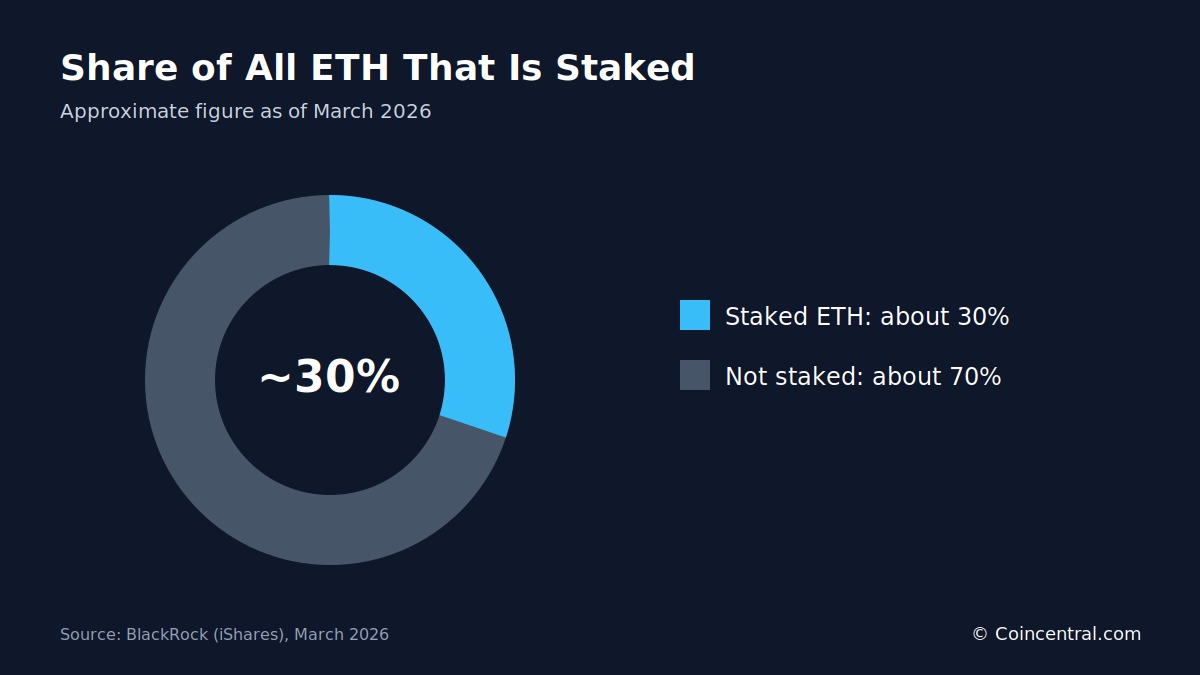
- •A full Ethereum validator requires 32 ETH, and approximately 30% of all ETH is currently staked while roughly 70% remains outside the staking system.
- •Current staking yields are estimated at about 2.5% to 3% annually, coming primarily from newly issued ETH, and the per-staker reward rate declines as more ETH enters the staking system.
- •Stakers can choose among solo staking, staking pools, staking-as-a-service, and staking-capable ETFs such as BlackRock's iShares Staked Ethereum Trust ETF (ETHB), each with different minimum deposits, fees, and security trade-offs.
- •Staking carries risks including slashing penalties, withdrawal delays ranging from days to potentially months, and uninsured custodial platforms, and staking rewards are not guaranteed.
Ethereum staking allows ether (ETH) holders to help operate the network by committing their coins as collateral. In return, validators can earn newly issued ETH and other rewards. The system replaced Ethereum’s former energy-intensive mining model.
This article draws on information from Investopedia, Kraken, Exodus and BlackRock. It examines how staking works, where rewards come from, the costs and waiting periods involved, and the risks that can reduce or eliminate returns. The figures are snapshots based on the dates provided by the sources. Rewards, fees and processing times change with network conditions and are not guarantees.
What Is Ethereum Staking?
Staking involves committing ETH to help validate transactions and add new blocks to the Ethereum blockchain. Validators check whether transactions comply with the network’s rules and are compensated in ETH for performing that work.
Ethereum moved from Proof-of-Work (PoW) to Proof-of-Stake (PoS). Under PoW, miners competed by using computing power. Under PoS, validators commit their own ETH instead. The change took place in two stages: staking deposits opened with the launch of the beacon chain in December 2020, and the merge of that consensus layer with the original execution chain in September 2022 switched off mining entirely. The transition reduced the network’s energy consumption by an estimated margin of more than 99%, addressing the principal environmental criticism of the mining model.
A full Ethereum validator requires 32 ETH. The network randomly selects validators to propose blocks, with selection odds tied to the amount of stake. BlackRock notes that a validator holding 1% of all staked ETH has a 1% chance of being selected to propose any given block.
The staked ETH serves as a financial guarantee that the validator will follow the rules. A validator that violates the protocol can lose part of its stake through penalties or slashing. This mechanism is intended to discourage dishonest or disruptive behavior.
BlackRock reports that approximately 30% of all ETH is currently staked, leaving roughly 70% outside the staking system. That proportion changes as holders deposit or withdraw ETH.
Investopedia describes staked ETH as being locked in a smart contract. It cannot be used or transferred until the validator requests its release and the network processes the withdrawal. That reduced liquidity is one of the central trade-offs of staking.
Sources of Staking Rewards
Kraken identifies three main sources of staking rewards. The first is consensus-layer rewards, which the protocol pays for attesting to blocks and, in some cases, proposing them. The second is priority fees, or optional tips paid by users who want transactions processed more quickly.
The third source is maximal extractable value, commonly called MEV. Validators can sometimes earn additional ETH by arranging transactions within a block to capture extra value. Kraken says MEV varies and may not materially affect the results of everyday stakers.
BlackRock divides staking rewards into two broad categories: newly issued ETH and transaction fees. Issuance is ETH created by the network and distributed to validators, and it represents the larger portion of total rewards.
With approximately 30% of ETH staked, BlackRock says a well-functioning validator earns about 2.75% annually from issuance. Transaction fees contributed an average of about 0.1% over the previous month. Fees previously represented a larger share of rewards but have declined.
As more ETH is staked, issuance increases at a slower rate. Consequently, the reward rate for each staker decreases as the total amount of staked ETH grows. Kraken describes the same relationship: a larger staking pool generally means a lower rate for each participant. With roughly 70% of ETH still outside the staking system, that inverse relationship frames what to watch: any additional supply entering the validator set pushes per-staker rates down rather than up, while fee activity, already shrunk from its earlier share, remains a second variable in the overall result.
BlackRock also distinguishes between the rate received by stakers and Ethereum’s overall issuance rate. Total ETH issuance is about 0.8% annually. Because all newly issued ETH goes to stakers while only part of the supply is staked, holders who do not stake experience modest dilution over time.
How Much Can You Earn by Staking ETH?
Investopedia reported that validators were earning about 2.8% on their stakes in July 2026. BlackRock cites an annual range of 2.5% to 3%. The estimates are broadly consistent.
Kraken provides a basic calculation: annual rewards equal the amount of ETH staked multiplied by the current annual percentage yield, or APY. The APY changes with the total amount of ETH staked across the network.
At a 2.8% rate, 1 ETH would generate approximately 0.028 ETH over one year. A validator operating with 32 ETH would generate about 0.896 ETH. These examples exclude fees, downtime and compounding.
Actual earnings depend on the total amount of ETH staked, validator uptime, the amount committed, platform fees, MEV and priority fees. Rewards are paid in ETH, so their value in dollars changes with the price of ETH.
Compounding also depends on the staking arrangement. Kraken says protocol-level rewards accumulate in a validator’s balance but do not compound unless they are staked again. Exodus says rewards through its service are earned daily and automatically restaked, allowing them to compound.
Kraken emphasizes that staking rewards are not guaranteed. Offline periods, changing network conditions and slashing can reduce the amount a staker receives.
Ways to Stake Ethereum and Minimum Requirements
Investopedia identifies three principal staking methods: solo staking, staking pools and staking-as-a-service. Each method balances control and convenience differently, and minimum deposits can vary significantly.
Solo staking requires 32 ETH, a dedicated computer and a reliable internet connection. Investopedia describes it as the most secure option because no third party holds the user’s coins, but it also involves the greatest technical workload.
Staking pools allow users to contribute any amount of ETH toward a combined 32 ETH validator. Rewards are distributed according to the pool’s rules, generally based on the amount contributed. Some providers accept 0.01 ETH or less, while some issue a token representing the user’s staked position.
With staking-as-a-service, users delegate ETH to a provider. Investopedia calls this the least secure route because participants must trust the provider to operate honestly and properly.
Exodus offers pooled staking through Everstake with a minimum of 0.1 ETH. Each additional stake must also be at least 0.1 ETH. Exodus says the arrangement is self-custodial and was audited by ChainSecurity, Ackee and Trail of Bits.
Exchanges and wallets provide additional access points. On an exchange, users typically create an account, complete identity verification, purchase ETH and select a staking program. Investopedia lists Ledger, Trezor and MetaMask among wallet options. On Coinbase, stakers receive cbETH, a token representing staked ETH.
Investopedia warns that crypto exchanges are not members of the Securities Investor Protection Corporation (SIPC). If a custodial exchange fails, customers could be treated as unsecured creditors and lose funds unless the exchange’s user terms provide otherwise.
BlackRock describes another route through the iShares Staked Ethereum Trust ETF (ETHB). The fund is designed to provide exposure to the price of ETH along with potential staking rewards through a conventional brokerage account. BlackRock says its related fund, ETHA, does not stake. Staking-capable ETF products are a recent addition to a category that opened when U.S. spot ether ETFs began trading in July 2024.
Hardware, Software and Fees
Operating a validator independently requires dedicated hardware. Investopedia estimates that a computer capable of running a full node cost between $300 and $1,500 in 2026, while noting that the total may be higher for upgraded components and replacement plans.
For better performance, Investopedia suggests a CPU such as an Intel NUC, 7th generation or newer, paired with 16GB to 32GB of RAM. It also recommends at least a 2TB solid-state drive and a stable, high-bandwidth internet connection. Because the blockchain continues to grow, storage requirements increase over time.
Staking requires far less computing power than mining, so the hardware may remain useful for an extended period. However, the setup still requires technical knowledge. Investopedia says solo stakers need basic coding skills, and some configuration steps require command-line work.
A solo validator generally installs an execution client, a consensus client and a validator client. The operator must then configure the node, generate keys and monitor logs, software updates and connectivity.
Platform-based staking involves different costs. Exodus says users pay a network transaction fee whenever they stake, unstake or claim rewards. These fees are generally higher than the cost of sending ETH and can sometimes be several times higher.
A validator fee is also deducted from rewards to cover the validator’s operating expenses. Kraken says platform fees differ by provider and recommends checking the fee structure before committing funds. Investopedia says fees can materially change overall returns.
Waiting Times and Withdrawals
Staked ETH is not immediately liquid. Withdrawals themselves only became available in April 2023, when the network’s Shapella upgrade unlocked unstaking for the first time since deposits began; until then, ETH could be staked but not released. Investopedia says Ethereum limits withdrawals to 16 per block, or 115,200 validator withdrawals per day. Releasing a stake can take several days.
BlackRock says the protocol also limits how quickly ETH can enter or leave the validator set for security reasons. Starting or ending a stake can take substantially longer during periods of high activity, with delays potentially extending to weeks or even months in extreme conditions.
Exodus provides an example of the process for beginning a stake. Its provider may pool ETH until it reaches 32 ETH, a step that can take up to five days. The stake then enters the activation queue, which the example lists as 12 days and 21 hours, or about 18 days in total when combined with the pooling period.
Unstaking involves additional stages. The Exodus example lists an exit queue of 20 days and seven hours, a sweep delay of 8.4 days, a fixed delay of about 27 hours and up to five days of processing. The guide states an overall estimate of about 30 days.
Adding the listed stages produces roughly 35 days, illustrating the uncertainty in such estimates. Exodus describes the figures as maximum estimates and says actual times vary with network conditions.
Some platforms also require users to claim unstaked ETH manually. Exodus says the ETH cannot be sent, swapped or restaked until the claim is completed. Kraken notes that liquidity depends on the staking method and the platform used.
Staking Risks and Penalties
Staking involves several risks. The price of ETH can decline, equipment can fail and accounts or platforms can be hacked. Staked ETH is also subject to withdrawal delays, which can prevent a user from selling quickly.
Penalties generally fall into two categories. The first covers routine performance failures, such as missed votes. Investopedia says a validator that misses source or target votes loses an amount equal to the rewards it would have earned. Missed head votes do not carry a penalty.
Short maintenance-related outages are permitted without a separate penalty. The network can bring the validator back into sync, but the operator does not receive rewards that would have been earned while offline.
Slashing is the more serious form of penalty. A validator can be slashed for signing two different blocks for the same slot, attesting to a block that surrounds another block, or voting twice for the same block. Investopedia says slashing is rare.
When a validator is slashed, 1/32 of its staked ETH is burned immediately. For a full 32 ETH validator, that equals 3.125% of the stake. A 36-day removal period then gradually removes the remaining stake, with a correlation penalty applied halfway through the process.
The correlation penalty increases according to the total amount of ETH slashed across all validators during the 36 days before the event. It is intended to discourage validators from coordinating behavior that could harm the network. The two-part process penalizes misconduct and prevents affected validators from immediately rejoining.
BlackRock provides historical figures indicating that validators have maintained a 99.7% uptime rate since staking began in December 2020, while 0.03% have ever been slashed. The largest realized loss was approximately 3% of a stake, and stakers earned about $10 billion in net rewards over that period. BlackRock cautions that past results may not be repeated.
Exchange and wallet users face additional counterparty and security risks. Investopedia warns that crypto assets are not insured and that there is usually no recourse for lost or stolen cryptocurrency. Kraken says platform staking can reduce exposure to slashing because the platform operates the validators.
Is Ethereum Staking Worth It?
The answer depends on the amount of ETH held, the expected rewards and the risks accepted. Investopedia notes that users can run a node without staking, but they will not receive staking rewards. Kraken says staking may suit long-term holders who do not plan to sell soon and can tolerate crypto price volatility.
BlackRock stresses that staking does not materially change exposure to ETH’s price. The price remains the primary driver of returns. Staking adds ETH-denominated rewards, but also introduces liquidity restrictions and the possibility of penalties.
The available yield estimates are similar. Investopedia reported about 2.8% for July 2026, while BlackRock cites 2.5% to 3% annually and approximately 2.75% from issuance. Fees, uptime and the chosen method determine the amount a staker ultimately retains.
Investopedia recommends considering deposit requirements, fees, cybersecurity, service quality, customer support, waiting periods, coding ability and hardware costs. The same source says larger firms generally maintain stronger standards than smaller startups.
Ethereum staking offers a modest ETH-denominated yield in exchange for locked funds, technical or platform risk and variable processing times. Solo staking provides the most control but requires the most work. Pools, wallets and exchanges reduce the entry barrier, while adding their own trust, fee and operational considerations.
Investopedia and Kraken both advise researching a staking method before using it. No crypto arrangement is entirely safe, and staking rewards are not guaranteed.
Sources
How to Stake Ethereum (Investopedia)
Ethereum staking rewards explained (Kraken Learn)
Staking Ethereum (ETH) FAQ (Exodus)
Ethereum staking explained: risks, rewards, and how it works (BlackRock iShares)

