Ethereum Staking Demand Outpaces Exits as Entry Queue Surges Past 2.48 Million ETH
Key Takeaways
- •Ethereum staking entries exceeded exit requests by 13.6 times on September 20, with around 2.48 million ETH waiting to enter the validator set.
- •New validators faced estimated activation waits of 43 to 45 days because the network's churn mechanism processes roughly 57,600 ETH of changes per day.
- •About 41 million ETH, representing roughly 33.5% to 34% of total supply, was already staked across an estimated 885,000 to 900,000 validators.
- •The Pectra upgrade raised the maximum compounding validator balance from 32 ETH to 2,048 ETH and enabled exits through withdrawal credentials, helping operators consolidate stakes.
- •Market commentators tracked technical ETH levels, including a possible pullback near $2,089 and a needed weekly close above $2,550, while noting the queue imbalance alone does not guarantee a price move.
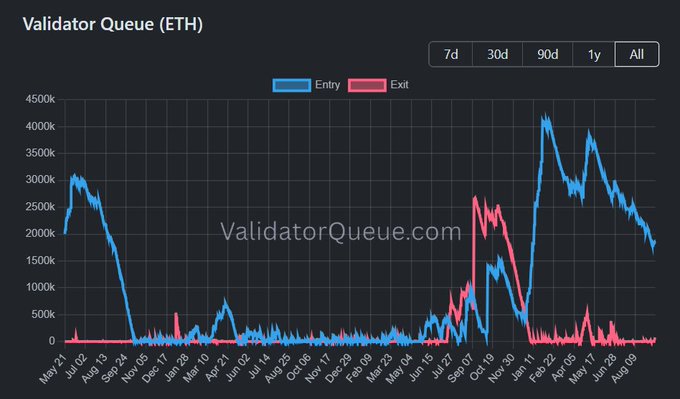
Ethereum staking demand outpaced exit requests by 13.6 times on September 20, network queue data showed, with roughly 2.48 million ETH waiting to enter the validator set while the withdrawal queue held a much smaller balance.
Staking is the mechanism through which ETH holders commit funds to validators, the operators whose software proposes and attests blocks under Ethereum's proof-of-stake rules, and a queued deposit only begins validating once it clears the entry line.
New validators faced waits exceeding 40 days as entries moved through protocol limits, with the backlog translating into estimated activation waits of 43 to 45 days.
The gap follows an earlier September peak in pending deposits and contrasts sharply with quiet exit conditions. It shows that more ETH had been submitted for validation than queued for removal at the measured time; it does not confirm why each individual holder chose to stake or withdraw.
Overall, Ethereum staking had already locked roughly 41 million ETH, equal to about 33.5% to 34% of total supply, while the network supported an estimated 885,000 to 900,000 validators. The entry queue sits within a broader trend of rising validator participation. Large operators, including BitMine, contributed to new staking demand, and the Pectra upgrade gave users additional flexibility to consolidate their stakes.
Entry Queue Runs 13.6 Times Larger Than Exits
Ethereum staking entries reached about 2.48 million ETH during September, making entries the dominant side of the network's validator flow, a backlog that translated into an estimated 43 to 45 day wait for activation. Earlier in the year, the queue had peaked at roughly 3.4 million ETH in May. By late September it stood near 1.8 million ETH, implying an estimated 32 day wait.
The exit queue showed the opposite pattern. It fell to zero ETH at one point in July. In September 2025, exits had totaled roughly 2.67 million ETH, and by early January 2026 exit demand had declined by more than 99.9%, reflecting the reported queue trend. The comparison highlights how quickly pending validator activity can change.
Churn Limits Slow Movement in Both Directions
Staking entries and exits must both pass through Ethereum's churn mechanism. The network permits roughly 256 ETH of validator changes per epoch, or close to 57,600 ETH per day, a cap that slows rapid shifts in either direction and prevents large flows from being processed at once. At that pace, a backlog of roughly 2.48 million ETH lines up with about 43 days of processing time, which is how the estimated 43 to 45 day activation window arises. The Validator Queue tracker describes churn as a consensus protection measure rather than a market control.
The rate limit means a sharp rise in exit requests cannot immediately unlock all deposited ETH. Validators must clear the exit queue before their balances become withdrawable, and the withdrawal process also includes a sweep period, so final timing varies as the network processes available balances.
Pectra Reshapes Validator Consolidation
The Pectra upgrade raised the maximum balance for a compounding validator from 32 ETH to 2,048 ETH and allowed exits to be initiated through withdrawal credentials. These changes can help operators consolidate validators, although they do not remove the queue. Validator totals therefore do not necessarily equal the number of separate staking entities, which also complicates comparisons across monthly network snapshots.
Market Levels in Focus as Validator Share Grows
With validator participation expanding, market commentators are tracking key ETH price levels. Staking removes ETH from direct validator balances but does not erase all trading liquidity. Liquid-staking tokens and exchange products can still give holders market exposure, although a growing validator share changes the immediately accessible supply profile. The queue imbalance alone does not guarantee a price move.
Trader Tardigrade said ETH formed a local top after bouncing from the $1,510 area, identifying the 0.5 Fibonacci retracement near $2,089 as a possible pullback level. The view presents a technical scenario rather than a confirmed market outcome, and it depends on the price retaining its wider recovery structure.
Another market commentator, Ted, said ETH needs a weekly close above $2,550, a level that could place the $2,900 to $3,000 range in focus. The market still needs to establish a close above that zone; a rejection below it would leave the stated upside levels unconfirmed.
Staked ETH cannot enter or exit the validator set immediately, and new staking demand also takes time to activate. With limits applying in both directions, validator supply changes tend to unfold across days or weeks rather than single trading sessions. The queue itself remains the metric to watch: inflows persistently above the daily churn cap stretch activation waits, while a draining backlog shortens them.
This article first appeared on Blockonomi.

