Eum's Record Staking Level Has a Hidden Cost for Holders
Key Takeaways
- •Ethereum's staked share reached a record 35.9% of total supply even as validator counts fell to 881,000 from roughly 1.1 million, due to consolidations under EIP-7251, which allows up to 2,048 ETH per validator.
- •Ethereum's Q3 yield decline of 0.18 points splits between stake growth, which accounts for about 0.08-0.10 points, and a 40% drop in daily fees and MEV to 198 ETH.
- •Solana's yield fell 0.39 points to 5.99% primarily because its issuance component dropped 0.53 percentage points under a disinflation schedule, partially offset by a 33% rise in transaction fees.
- •After adjusting for dilution from newly issued tokens, staking grows an Ethereum holder's share of supply by roughly 1.7% annually and a Solana holder's by about 2.2%, while an unstaked SOL holder's share shrinks about 3.5%.
- •Ethereum deposit queues shortened to about 25 days by the end of Q3, and the proposed EIP-8061 would raise the daily exit cap from 57,600 ETH to roughly 247,000 ETH.
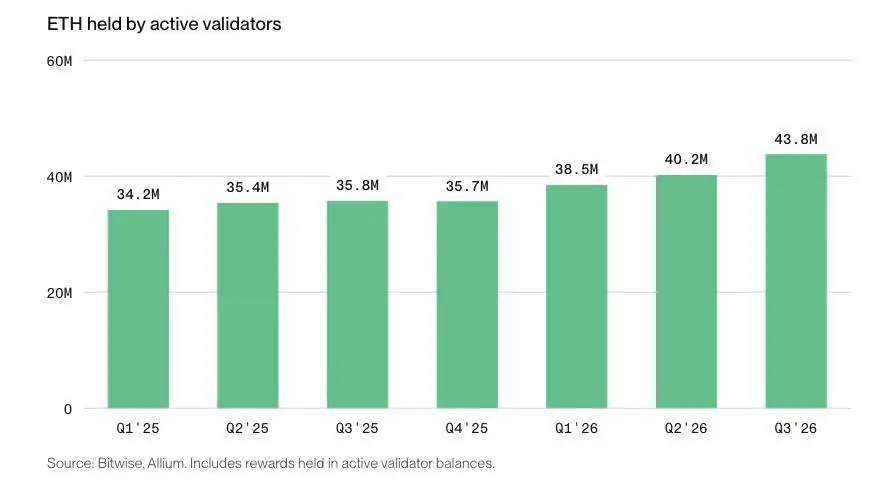
Ethereum validators now hold 35.9% of all ETH, the highest share in the network's history, according to Bitwise's latest staking report. Staking is how holders commit tokens to validators that secure a proof-of-stake network and earn rewards; it went live on Ethereum in December 2020, and the network completed its move to proof-of-stake in September 2022. The network's annualized staking yield slipped to 2.63% in Q3 from 2.81% in Q2, while Solana's fell from 6.38% to 5.99%. Behind those figures sits a less visible cost: most of the yield paid to stakers arrives as newly issued tokens, diluting the very supply it rewards.
What Bitwise Reported
Asset manager Bitwise measures both networks' yields on a gross basis, before validator commissions or operator fees.
Validator counts fell on both chains over the quarter, for opposite reasons. Ethereum's count dropped from roughly 1.1 million to 881,000 as operators merged validators under EIP-7251, which raised the maximum balance per validator to 2,048 ETH; the ETH behind those records stayed staked. On Solana, the count fell from 696 to 659 as smaller operators left under cost pressure.
Stake Growth Explains About Half of Ethereum's Decline
Ethereum pays no fixed reward rate. Under the rules set out in its protocol documentation, the base reward per staked ETH scales with the inverse square root of all ETH staked. Total issuance rises as stake grows, but more slowly than the stake itself, so every new deposit lowers the rate paid on the rest.
Active validator balances rose 8.8% over the quarter, from 40.24 million ETH to 43.80 million. On a square-root curve, an increase of that size trims the issuance rate by roughly 3-4%, depending on whether quarter-end or average balances are used. Applied to Ethereum's yield, that accounts for about 0.08-0.10 points of the 0.18-point decline.
The rest tracks a drop in what users paid. Network fees and MEV (the value validators can capture by choosing which transactions to include and in what order) averaged 198 ETH per day in Q3, down 40% from 331 ETH in Q2, and part of that total is burned rather than paid to validators. Higher gas limits after the Fusaka upgrade added capacity, so users competed less for block space. Bitwise found that the average cost of four common transaction types fell 67% from a year earlier. Priority fees and MEV contributed 0.10 points of the Q3 yield.
Solana's Drop Came from Issuance, Not Fees
Solana's rate moved for a different reason. Its issuance follows a disinflation schedule that currently cuts the inflation rate by 15% per year until it reaches a 1.5% floor. Issuance accounts for almost 90% of Solana's gross staking yield, so that schedule sets the direction of rewards.
Bitwise's breakdown shows the issuance component fell 0.53 percentage points in Q3: fewer new tokens were created, and they were spread across 3.1% more stake, now 440.5 million SOL. Fees moved the opposite way. Users paid 33% more SOL to transact, and block rewards and Jito tips added 0.14 points, leaving a net decline of 0.39 points.
What a Holder Actually Keeps
Bitwise's yields are measured before anyone takes a cut. A validator may charge a commission, a staking pool may take a service fee, and a fund may keep part of its holdings unstaked while charging its own expenses. In an ETF, rewards often build into the value of each share rather than being paid out in cash, as covered in CoinDoo's explainer on how staking rewards reach an ETF investor.
The second deduction is less visible. Most of the yield on both networks consists of newly created tokens, and those tokens enlarge the total supply. A staker's share of the network therefore grows by less than the headline rate, while a holder who does not stake sees their share shrink.
Rough math: yield after dilution
- Ethereum ≈ 1.7%. Issuance paying 2.53% on 35.9% of supply adds new ETH equal to about 0.9% of total supply per year. A 2.63% yield then grows a staker's share of all ETH by about 1.7% annually. Fee burns would lift that slightly; operator fees would reduce it.
- Solana ≈ 2.2%. Issuance paying roughly 5.3% on 69% of supply expands total SOL by about 3.7% per year. A 5.99% gross yield then grows a staker's share by about 2.2%, before commission. An unstaked holder's share shrinks by about 3.5%.
These estimates are drawn from Bitwise's Q3 figures. Results shift with stake levels, burns, and commissions, and exclude any change in token price.
Getting In and Out
New ETH deposits waited about 25 days to start earning at the end of Q3, down from roughly 70 days in February. Exits are capped at 57,600 ETH per day across the network, so queues can stretch when many holders leave at once; a proposed change, EIP-8061, would raise that limit to about 247,000 ETH per day, by Bitwise's estimate. Liquid staking tokens offer a faster route, because they can be sold while the underlying ETH stays staked, though a seller in a hurry may have to accept a price below the ETH they represent.
Both Networks Are Rethinking Issuance
On Solana, faster cuts are already approved. In August, validators passed SGP-0002, which doubles the annual disinflation rate to 30% keeping the 1.5% floor. It cleared with 67.00% support, 0.33 points above the threshold, and has no activation date yet. Once live, it would bring Solana to that floor in about 2.8 years instead of 5.7.
Ethereum's version of the debate is less advanced. EIP-8363 would burn a rising share of consensus rewards as more ETH is staked, reaching 76% at 50 million ETH. Supporters say holders should not be diluted to fund an ever-larger security budget, while critics warn that thinner rewards would push out small operators. On September 7, the Ethereum Foundation's protocol team declined to recommend it for the planned Hegotá upgrade, saying a change to issuance needs wider community discussion.
A record stake shows how much ETH and SOL is locked up. For a holder weighing whether to stake, the figures that decide the outcome are the reward left after costs, the portion paid in new tokens, and the time needed to get out. From here, the items to watch are the activation date for SGP-0002, which has yet to be set; where Ethereum's wider issuance discussion leads after the September 7 decision; and whether EIP-8061 moves from proposal to implementation.
This article is provided for informational purposes only and does not constitute financial or investment advice. Staking rewards are variable, and token-price losses can exceed rewards earned.

