Ethereum Dips Below $2,400 as Hot US Inflation Fuels Selling and Long Liquidations
Key Takeaways
- •Ethereum dropped approximately 5.3% over 24 hours to trade near $2,370, slipping below the $2,400 mark after stronger-than-expected US inflation data unsettled crypto markets.
- •September CPI showed headline inflation of 3.7% year over year and core inflation of 2.6%, both above forecasts, reviving expectations of additional Federal Reserve monetary tightening.
- •The probability of a Fed rate hike at the October meeting rose from 22% to 35% per CME FedWatch, while a stronger dollar and higher Treasury yields added pressure on risk assets.
- •CoinGlass data recorded $293.98 million in ETH liquidations within 24 hours, with long positions absorbing 90% of losses, following roughly $120 million in long liquidations earlier in the week.
- •Ethereum trades below its 50-day EMA at $2,498 and 20-day EMA at $2,563 with weak momentum readings, and a decisive break below the $2,355 support zone could open downside targets at $2,204 and $1,971.
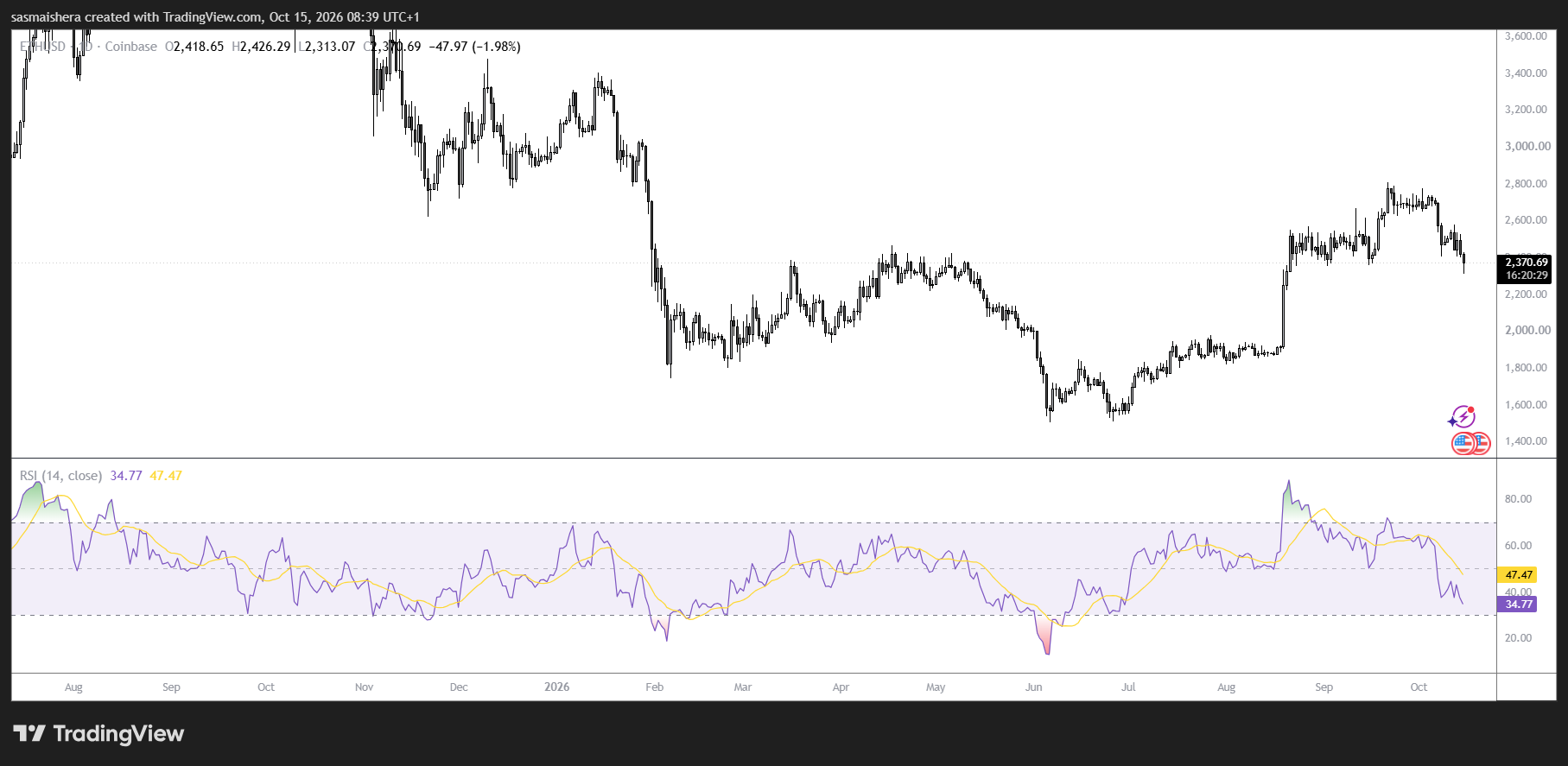
Ethereum slipped below $2,400 on Thursday, extending a retreat that gathered pace after stronger-than-expected United States inflation data unsettled cryptocurrency markets and reignited concerns about further monetary tightening. The second-largest cryptocurrency traded near $2,370 at the time of the report, losing approximately 5.3% over the previous 24 hours.
Hot Inflation Print Revives Rate-Hike Concerns
The Consumer Price Index is among the most closely watched US inflation gauges, serving as a key input into Federal Reserve policy decisions. September's CPI rose 0.6% month over month, matching expectations but accelerating from August's 0.4% increase. Annual headline inflation reached 3.7%, above the 3.6% forecast and up from the previous reading of 3.4%.
Core inflation, which excludes food and energy prices, also exceeded expectations, rising 0.3% on the month and 2.6% year over year, compared with forecasts of 0.2% and 2.5%, respectively.
The figures heightened concerns that persistent inflation could prompt additional monetary tightening from the Federal Reserve, weakening demand for risk assets such as cryptocurrencies. US Treasury yields and the dollar strengthened in the wake of the release, creating further headwinds for Ethereum.
The 10-year Treasury yield climbed to 5.32% before easing toward 5.22%, while the US Dollar Index moved above 102.80 for the first time since April 2025, according to the report. Higher Treasury yields increase the relative appeal of interest-bearing assets, raising the opportunity cost of holding cryptocurrencies, while a stronger dollar can weigh on dollar-denominated crypto prices.
Rate expectations repriced in parallel. CME FedWatch figures cited in the report show the probability of a Federal Reserve rate increase at its October meeting rising from 22% to 35%. That shift reinforced expectations of tighter financial conditions, leaving Ethereum vulnerable to further selling. The Fed's October meeting is the next scheduled checkpoint for those expectations.
Long Positions Absorb Most Liquidation Losses
Ethereum's decline also forced leveraged traders out of their positions. CoinGlass data shows $293.98 million in ETH liquidations over the previous 24 hours, with long positions accounting for 90% of the total — an indication that traders positioned for higher prices absorbed most of the losses. Liquidations occur when an exchange automatically closes a leveraged position because its collateral no longer covers the required margin.
The latest liquidations followed Tuesday's volatile session, which wiped out approximately $120 million in Ethereum longs. Successive rounds of long liquidations underscore the strain on bullish leveraged positions, as forced selling can amplify a price decline when falling collateral values trigger further position closures.
Potential selling pressure is also building outside the derivatives market. Ethereum's exchange netflow has remained positive since Sunday, continuing a pattern observed during the previous week, according to CryptoQuant data cited in the report. Positive netflow means more ETH is entering exchanges than leaving them. Such movements can signal that holders are preparing to sell, although deposits alone do not confirm that sales have occurred.
Combined with the rising long liquidations, the trend leaves Ethereum facing pressure from both leveraged positioning and potential spot-market supply.
Resistance Stacked Below $2,563
Ethereum's daily chart maintains a bearish near-term bias, with the price trading below its 50-day Exponential Moving Average at $2,498 and its 20-day EMA at $2,563. Exponential moving averages give greater weight to recent prices and are widely used as dynamic reference levels for trend and momentum. The 50-day EMA marks the first recovery hurdle. Above it, horizontal resistance at $2,548 and the 20-day EMA form a further barrier to sustained gains. A through this area would bring $2,636 into focus, followed by resistance near $2,781.
Momentum remains weak. The 14-day Relative Strength Index stands around 38, while the Stochastic Oscillator is near 7, indicating oversold conditions. Those readings could support a pause or a short-term rebound, but they do not confirm a reversal of the downtrend.
The source analysis identifies the recent close near $2,432 as an immediate reference, although ETH's quoted price of about $2,430 places it marginally below that mark. Further down, horizontal support at $2,355 closely aligns with the 100-day EMA at $2,353, creating an important support zone.
Holding that area would preserve a longer-term technical cushion despite the weak short-term outlook. A decisive break beneath it could expose the next downside levels at $2,204 and $1,971.
For now, Ethereum's recovery prospects depend on buyers stabilizing the price and reclaiming overhead resistance as inflation concerns and selling pressure persist.
This article was first published by CoinJournal.

