Ethereum Whales Pull ETH Off Exchanges as On-Chain Activity Rebounds
Key Takeaways
- •ETH gained 18.5% in July 2026, marking its strongest monthly performance of the year, while trading near the $1,900 range.
- •Over 500,000 new smart contracts were deployed on Ethereum during the final week of July 2026, driven by negligible gas fees that made on-chain operations economically viable again.
- •One whale withdrew 112,000 ETH for staking on the Beacon Chain, while Bitmine staked 150,120 ETH, locking up over 87% of its treasury holdings.
- •The Ethereum validator exit queue held just 6.6 ETH awaiting withdrawal compared to over 2.4 million ETH queued for staking, indicating substantially more ETH being locked than unlocked.
- •Tokenized real-world assets such as PAX Gold and ONDO emerged among the most active tokens on Ethereum alongside stablecoins, reflecting growing experimentation with tokenized commodities and treasury-backed instruments.
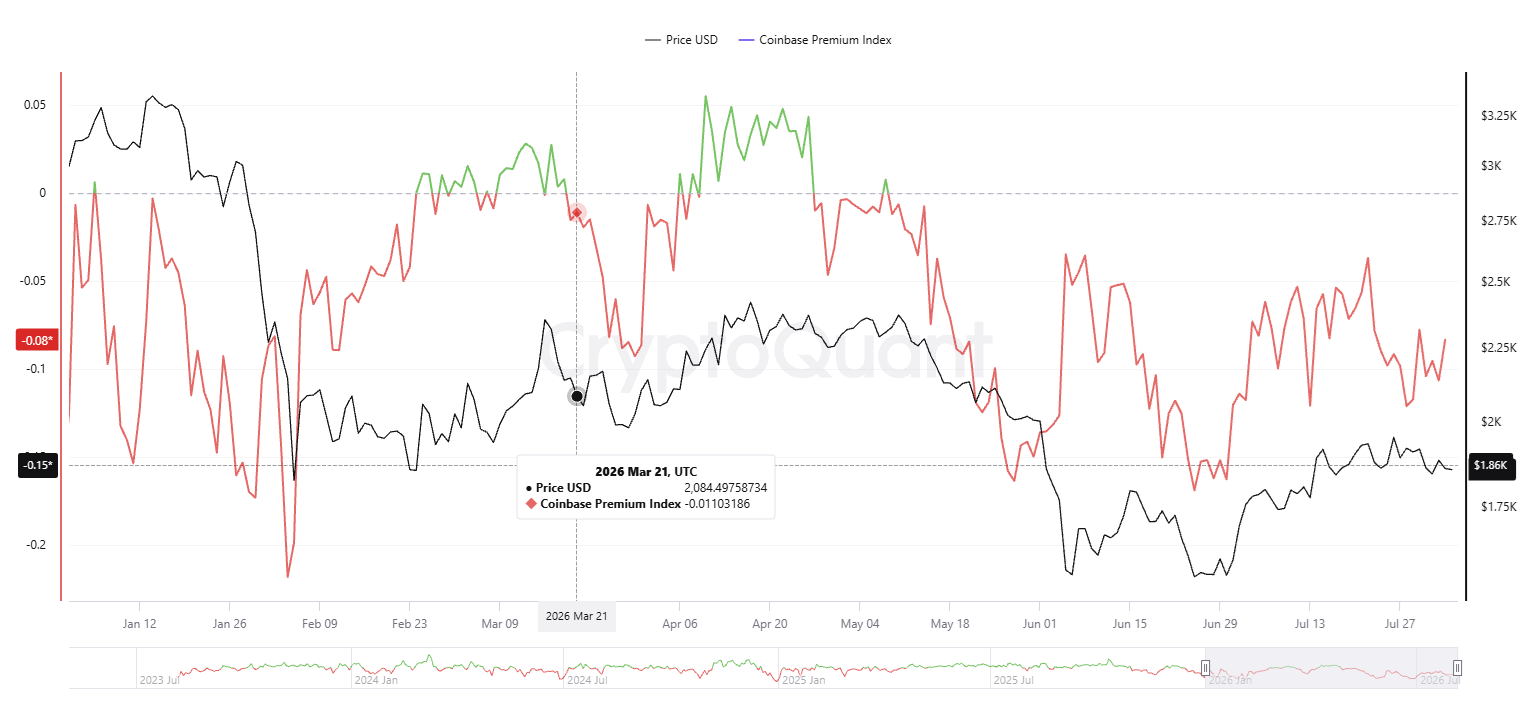
Ethereum's ETH token is undergoing a notable usage shift, transitioning from exchange-based speculation toward on-chain activity. Whale accumulation and global demand continue to expand, even as exchange reserves contract — a dynamic that reduces the amount of ETH readily available for sale on trading platforms, tightening liquid supply even if it does not guarantee price appreciation.
Demand for ETH is moving away from US-based trading and speculation, redirecting toward growing global demand and on-chain utility. The Coinbase premium index, a key signal of decreased US demand, has been mostly negative throughout 2026, according to CryptoQuant data. ETH open interest also remains nearly flat at $11.37B, indicating weaker appetite for speculative trading, per Coinalyze.
ETH trades close to the $1,900 range, recently easing to $1,889.80. While showing few immediate signs of a rally, ETH posted an 18.5% gain in July — its strongest monthly performance year to date.
Rising demand for on-chain activity coincides with signs of recovery in DeFi lending. ETH remains one of the most robust collateral assets for DeFi protocols, helping retain liquidity within the ecosystem. This dynamic has produced premium ETH prices on Binance relative to Coinbase, as global projects acquire ETH and withdraw it from Binance while expanding staking and other on-chain activities. Institutional demand from the US slowed through the summer of 2026, with limited appetite from digital treasury companies — a contrast with the prior cycle when corporate ETH accumulation made headlines.
ETH On-Chain Demand and Activity Rise
Ethereum saw increased new contract deployment in the second quarter of 2026. Over 500K new contracts were deployed in the final week of July alone, according to Token Terminal. A primary driver of this activity is Ethereum's extremely low gas prices, which have made on-chain operations viable again. When transaction costs fall to negligible levels, the breakeven threshold for deploying and operating new applications drops sharply, enabling smaller builders and niche projects that would be uneconomical during high-fee periods.
Contract deployers rose to 14.9K by the end of July, per Token Terminal data. DeFi contracts represented the busiest category based on ETH burns, while the SeaDrop NFT contract was among the most active as of August 3. Unnamed contracts and new project deployments also accelerated.
Ethereum continues to serve as a settlement layer for tokens, tokenized securities, wrapped BTC, and other assets. Layer-2 activity has slowed, with stablecoins migrating back to Ethereum — a shift that suggests the base layer's improved fee environment is reducing the cost advantage that L2 networks held for payment and settlement use cases.
The on-chain activity signals an attempt to revive decentralized crypto opportunities. Retail traders continue to seek these venues without being dominated by whales or market makers. Although the recovery remains modest, it demonstrates that crypto activity can still return to on-chain liquidity venues.
Among the most active tokens on Ethereum were DAI, SHIB, CRO, PAX Gold, ONDO, and the stablecoin USDT — reflecting a blend of legacy usage and a new shift toward tokenized real-world assets (RWA). The appearance of PAX Gold and ONDO alongside major stablecoins underscores growing experimentation with tokenized commodities and treasury-backed instruments, categories that major financial institutions have explored throughout 2025–2026.
Whales Accumulate ETH but Remain Cautious
ETH is seeing demand for accumulation, staking, and exchange withdrawals. Simultaneously, whales remain more bearish than retail traders, yet over the past month they have shown clear accumulation behavior.
One whale withdrew 112K ETH and began sending it to the staking Beacon Chain contract, as reported by Lookonchain. Separately, Bitmine staked 150,120 ETH, locking up over 87% of its treasury holdings, according to another Lookonchain post.
The Ethereum validator exit queue is nearly empty, with just 6.6 ETH awaiting withdrawal. Meanwhile, over 2.4M ETH is queued to be staked and begin earning rewards. This asymmetry means substantially more ETH is being locked for staking than unlocked for withdrawal — a metric worth monitoring as an indicator of conviction among large holders, since staked ETH cannot be sold without first passing through the exit queue.

