Ethereum Captures Only 4.9% of Its Own Fee Revenue as Layer 2s Reshape Value Flow
Key Takeaways
- •Ethereum's L2 rollups process approximately 1,270 user operations per second — a 41.6x scaling improvement over mainnet's 20.4 UOPS — yet ETH trades roughly 60% below its all-time high.
- •Following EIP-4844, daily L1 fees collapsed from over $30 million to approximately $500,000, causing ETH to capture only 4.9% of the $1.79 billion in Q2 2026 L1 fee revenue.
- •The Glamsterdam upgrade, designed to introduce parallel transaction processing and reduce gas fees by an estimated 78%, has been delayed to late 2026 due to scope creep and technical challenges.
- •Ethereum holds approximately $15 billion in tokenized real-world assets, and BlackRock has filed for a staked ETH ETF that could reposition ETH as a yield-bearing institutional asset.
- •The ETH/BTC ratio has declined to approximately 0.027 near five-year lows, while a 17-day outflow from spot ETH ETFs removed roughly $708 million, signaling institutional de-risking.
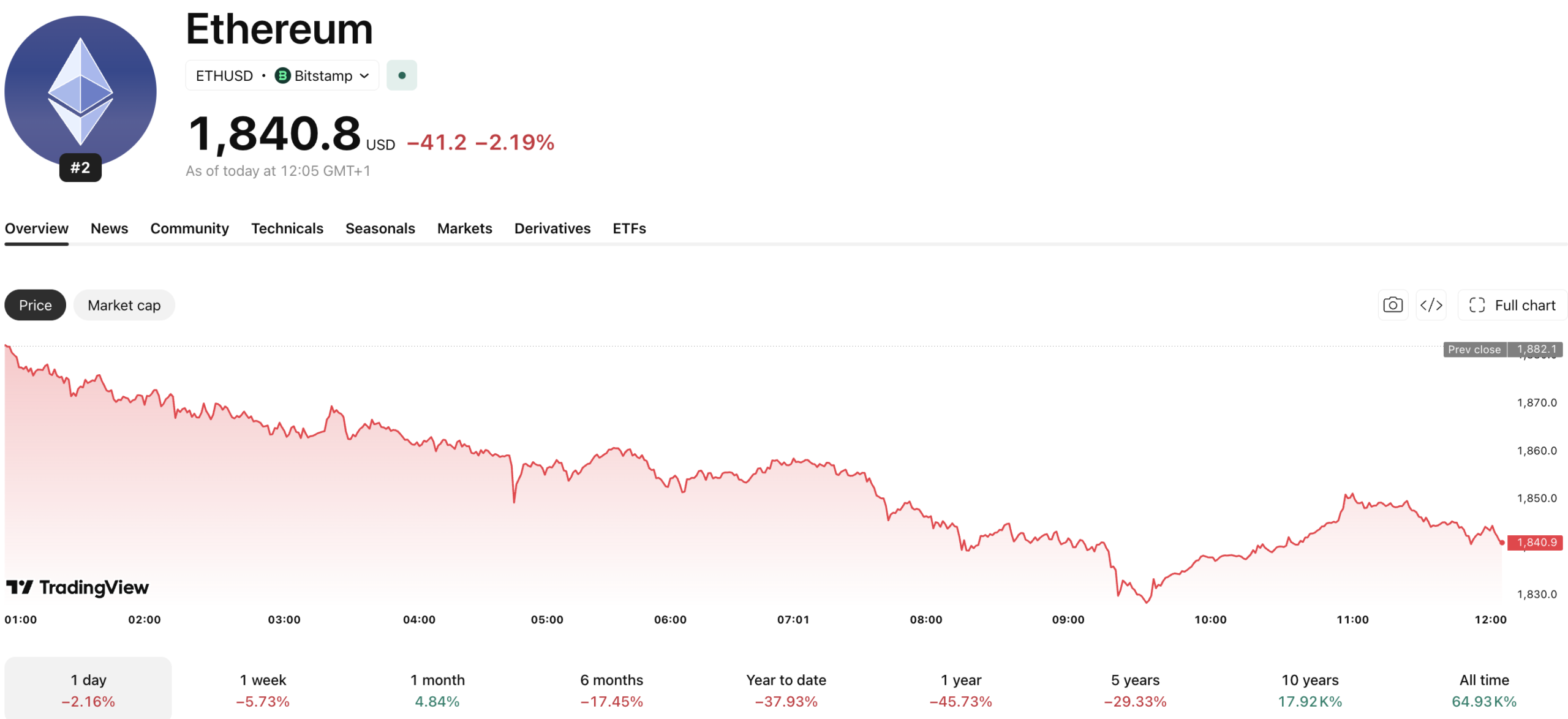
Ethereum is demonstrating remarkable scaling metrics, with rollups processing approximately 1,270 user operations per second and over $17 billion in tokenized assets settled on-chain. Despite these achievements, ETH continues to trade below $2,000 — roughly 60% below its all-time high — with ETH dominance at 10.4%, the lowest level since mid-2021.
➥ Ethereum is scaling faster than ever, yet $ETH is still trading below $2,000
As someone who actually holds ETH, I think this disconnect is the most important debate in the ecosystem right now.
Q2 numbers were not terrible, but they exposed a structural weakness:
– Ethereum… pic.twitter.com/ke8X3XcEiI
— Tanaka (@Tanaka_L2) July 31, 2026
Analysts note that the ETH/BTC ratio has declined to approximately 0.027, nearing five-year lows. This has raised questions about whether the current level represents a temporary cycle low or whether Ethereum's scaling strategy has permanently decoupled network usage from ETH's value capture.
Analyst Tanaka highlighted a critical issue: Ethereum L1 generated roughly $1.79 billion in fees during Q2 2026, yet ETH captured only about 4.9% of that value. While Real Economic Value — a metric capturing total economic throughput across both L1 and L2 layers — rose 7% quarter-over-quarter, it fell 68% year-over-year, suggesting that the post-EIP-1559 fee-burn thesis that underpinned ETH's "ultrasound money" narrative may now be obsolete.
What the 4.9% Fee Retention Rate Reveals About the L2 Decoupling Problem
The 4.9% value capture figure originates from a strategic architectural decision following EIP-4844, which introduced proto-danksharding — temporary data blobs that enable Layer 2 (L2) networks to post compressed data to Ethereum L1 at substantially reduced costs. This was the operational centerpiece of Ethereum's rollup-centric roadmap, formalized in late 2020, which deliberately offloaded execution to L2s while positioning the base layer as a settlement and data-availability backbone.
This shift produced a dramatic decline in daily L1 fees — from over $30 million to approximately $500,000 — and reduced ETH burns to roughly 100 ETH, resulting in a slight inflationary shift in Ethereum's annual supply growth. Under EIP-1559's base-fee burn mechanism, high L1 congestion had previously driven ETH supply deflationary during peak periods, creating the "ultrasound money" investment narrative that now faces significant erosion.
L2 rollups now handle approximately 1,270 user operations per second, compared to just 20.4 on Ethereum mainnet, representing a scaling factor of 41.6x. For example, Robinhood Chain processes about 96.2 UOPS, while Coinbase's Base L2 generated over $94 million in profit but contributed only $4.9 million back in blob fees. This architecture contrasts with Solana's monolithic approach, where execution, consensus, and data availability are handled on a single chain — capturing all fee revenue on-chain but operating under different scaling trade-offs.
Tanaka's analysis characterizes this period as margin compression rather than structural failure, arguing that Ethereum is accepting lower short-term revenue to broaden its ecosystem. The recent seven-day blob fee burn reflected only about 0.22 ETH, highlighting diminished returns for ETH holders.
The Glamsterdam upgrade was designed to address these issues through parallel transaction processing and a projected 78% reduction in gas fees. Parallel execution would represent a significant architectural shift for Ethereum's L1, bringing it closer to the concurrent processing model used by high-throughput chains. However, delays stemming from scope creep and technical challenges have pushed its delivery to late 2026, prolonging the current period of underperformance.
Institutional Settlement Layer: Tokenized RWAs and the Stablecoin Market
Tanaka's revised bull case for Ethereum contends that its competitive advantage has shifted from low transaction fees to institutional liquidity, settlement credibility, and a concentration of tokenized financial assets.
As of late July 2026, Ethereum holds approximately $15 billion in tokenized RWAs, while the stablecoin market — valued at roughly $299.4 billion — is predominantly settled on Ethereum L1. The RWA figure builds on established institutional adoption: BlackRock's BUIDL tokenized treasury fund launched on Ethereum in 2024, signaling that major asset managers view the network as viable infrastructure for tokenized product issuance.
On-chain analysis indicates that Ethereum's dominance in total value locked (TVL), stablecoin issuance, and institutional infrastructure remains robust despite Solana's growth in DeFi.
The Pectra upgrade in 2026 enhanced validator user experience and network security without addressing fee capture. Separately, BlackRock's filing for a staked Ethereum ETF could position ETH as a yield-bearing asset rather than merely a speculative token, building on the SEC's 2024 approval of spot ETH ETFs and extending the trend of traditional finance deepening its engagement with Ethereum-based products.
Tanaka identified three conditions necessary to validate the settlement layer thesis: L2 demand making blob space valuable, active on-chain turnover for stablecoins and RWAs, and institutions using ETH as reserve collateral. While none of these are guaranteed, the traction observed in stablecoins and RWAs supports the view that accumulating ETH at current prices is worthwhile.
ETH Price Analysis: The 0.027 ETH/BTC Ratio and Sub-$2,000 Structure
$ETHBTC is showing signs of being BROKEN OUT, in similar fashion to 2017's breakout just before that MONSTROUS RUN & ALT SEASON!
Another humongous move could be in its early stages, right here and right now…
(Ethereum vs. Bitcoin) pic.twitter.com/kCGDu1LcZl
— JAVON MARKS (@JavonTM1) August 2, 2026
ETH declined approximately 27% in Q1 2026, while Bitcoin fell 20%, marking one of the widest quarterly ETH/BTC divergences in recent periods, per TradingView data. The ETH/BTC ratio, currently at 0.027–0.030, is near five-year lows and below the 200-week moving average.
As of June 30, ETH was trading in a bearish channel on the two-hour chart, with key demand around $1,509. A 17-day outflow from spot ETH ETFs removed approximately $708 million from products such as ETHA and FETH, indicating institutional de-risking.
The current ETH/BTC level of 0.028–0.030 is considered critical, as previous alt seasons have historically begun with a sustained ETH/BTC rally — a pattern that has not materialized in 2026.
If the Glamsterdam upgrade achieves its objectives and the staked ETH ETF clears regulatory review, it could shift institutional perception of ETH toward a yield-bearing asset. Until then, ETH price remains discounted relative to network activity, with holders focused on the gap between Ethereum's infrastructure and ETH's value capture. The key indicators to monitor include blob fee trends as L2 adoption scales, Ethereum's annualized supply growth rate, and whether institutional RWA issuance continues to concentrate on Ethereum rails.

