Ethereum's Updated Roadmap Prioritizes Privacy, Quantum Security, and a Leaner Protocol
Key Takeaways
- •Ethereum's updated roadmap heavily prioritizes strong privacy, post-quantum security, censorship resistance, and a leaner protocol architecture.
- •The network plans to transition away from the Ethereum Virtual Machine to a RISC-V-based instruction set architecture to achieve quantum safety.
- •Upcoming privacy features include FOCIL in the 2027 Hegota hardfork and transaction-obscuring wormholes projected for around 2029.
- •STARK proofs and AI are now considered central components of Ethereum's long-term scalability and privacy strategy.
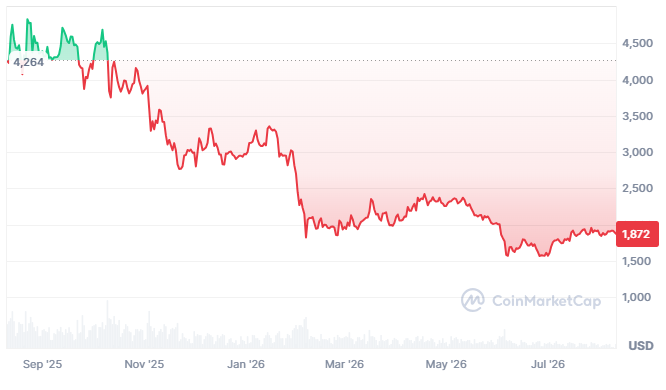
- •ETH currently trades near $1,870, closely mirroring its price from three years ago and underscoring a disconnect between technical progress and token valuation.
Ethereum co-founder Vitalik Buterin has detailed how the network's development roadmap has evolved significantly over the past three years, with privacy, post-quantum security, censorship resistance, and a leaner protocol architecture now taking center stage.
Buterin compared Ethereum's earlier development priorities with its current direction, noting that while some long-standing objectives remain, newer technologies have grown in importance. The updated roadmap places stronger emphasis on privacy, quantum-safe cryptography, and protocol resilience. Developers are also exploring technologies such as STARK proofs and alternative execution architectures as part of the longer-term redesign.
Meanwhile, ETH continues to face downward pressure in the market. The token traded around $1,870 during the latest session, placing it near the same range recorded three years earlier.
Privacy Upgrades and the Path to Quantum Safety
According to Buterin, one of the most notable shifts in the latest roadmap is the heightened focus on privacy. He noted that the roadmap now centers heavily on strong privacy, with upgrades such as keyed nonces and recent roots. Some aspects of FOCIL (Fork-Choice Enforced Inclusion Lists) are planned for the Hegota hardfork in 2027.
Looking further ahead to around 2029, the network has additional upgrades on the roadmap, including a lean privacy pool and wormholes. Wormholes would allow Ethereum users to transact without disclosing their full transaction history. The privacy push aligns with a broader industry trend, as on-chain analytics tools have made transaction data increasingly traceable, prompting other blockchain projects to pursue zero-knowledge and privacy-preserving technologies.
Quantum safety also occupies a major position in the roadmap. Sufficiently powerful quantum computers could theoretically break the cryptographic signatures currently securing blockchain networks, a concern that has led standardization bodies such as NIST to accelerate work on post-quantum cryptography standards. The network is planning a broad range of upgrades to prepare for a post-quantum future. Notably, Ethereum plans to achieve these goals by becoming leaner, swapping its Ethereum Virtual Machine (EVM) architecture for leanISA and RISC-V, an open-standard instruction set architecture already widely adopted in the semiconductor and embedded systems industries.
Buterin noted that AI and STARKs — technologies that were not as mature in 2023 — are now central to the network's evolution. STARKs, or Scalable Transparent Arguments of Knowledge, enable cryptographic proof systems that allow computations to be verified without revealing underlying data, making them a key building block for both scalability and privacy.
The roadmap signals Ethereum's trajectory toward greater maturity. Buterin outlined the network's future priorities in a statement:
"Ethereum will be quantum-safe. Ethereum will put users' privacy first. Ethereum will be secure. Ethereum will be censorship-resistant. Ethereum will be highly performant and scalable while satisfying the above. And Ethereum will be Lean."
ETH Trades Near August 2023 Levels
Ethereum's current price places it remarkably close to where it traded three years ago. CoinMarketCap's historical snapshot showed ETH at $1,847.12 on August 11, 2023, with a market capitalization near $221.9 billion at the time.
ETH now trades only slightly above that historical level despite major changes to Ethereum's technology and ecosystem. The comparison underscores the divergence between network development and token-price performance. Ethereum has continued to advance scalability, account functionality, security, and its long-term cryptographic architecture. However, ETH remains far below its 2025 record and has not reflected those upgrades through sustained price appreciation.
Buterin's latest roadmap suggests Ethereum's priorities are becoming increasingly defined. The network is moving toward stronger privacy, post-quantum security, censorship resistance, and a leaner architecture while continuing to pursue scalability. The market impact of those developments remains uncertain, but the technical direction indicates Ethereum is preparing for security challenges that extend well beyond the current market cycle.

