Meta AI Outlines Ethereum's Path to Potential New Highs Amid Staking Squeeze and Regulatory Shifts
Key Takeaways
- •The SEC and CFTC jointly approved staking within registered funds on March 17, 2026, allowing 70% to 95% of ETF holdings to generate staking yields.
- •Meta AI sets a base-case ETH price target of $4,500 with a stretch target of $12,000, contingent on institutional staking demand materializing at scale.
- •Ethereum's live Pectra upgrade raised validator caps to 2,048 ETH via EIP-7251 and enabled smart contract functionality for standard wallets through EIP-7702.
- •The CLARITY Act is identified as the single most influential variable for ETH's trajectory, with analyst forecasts spanning $3,175 to $7,500 depending on its passage.
- •ETH currently trades just under $1,900 with an RSI of 53.95, reflecting neutral momentum after stabilizing above $1,800 following a June low near $1,530.
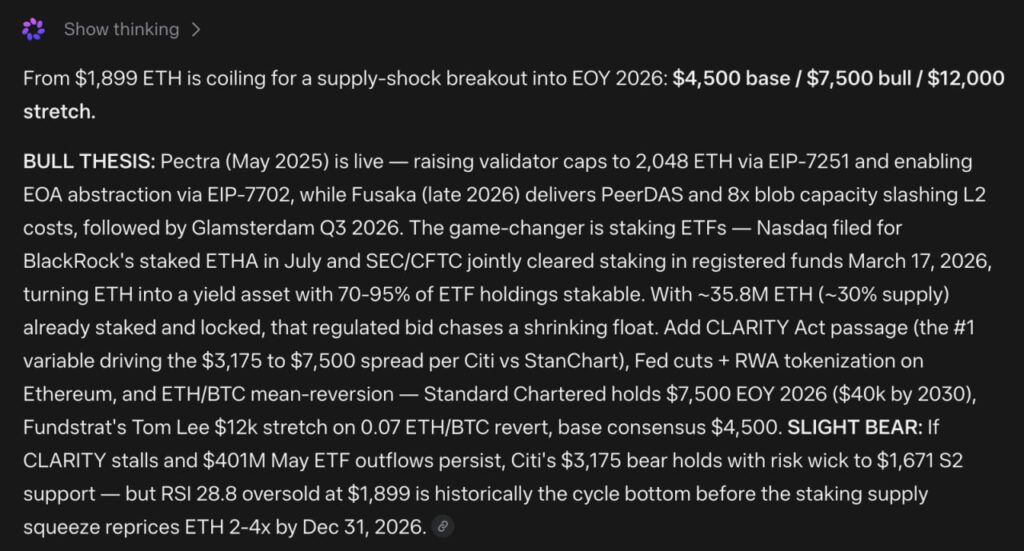
Approximately 30% of all ETH is currently staked and locked, while a regulated bid pursues the remaining supply. Meta AI projects that this supply squeeze could break the market open, with a price trajectory starting from $1,899 setting a base case at $4,500, a bull case at $7,500, and a stretch target of $12,000. The logic is straightforward: when a shrinking circulating float meets rising institutional demand through regulated vehicles, the equilibrium price shifts—but only if the demand materializes at scale.
Ethereum's Pectra upgrade is already live, raising validator caps to 2,048 ETH via EIP-7251 and enabling externally owned account (EOA) abstraction through EIP-7702. The higher cap reduces the number of validator keys that large staking operations must manage, lowering operational overhead for institutional participants. EIP-7702, in turn, brings programmability to standard wallets—a long-requested developer feature aimed at simplifying the user experience by allowing ordinary accounts to execute smart contract logic. The Fusaka upgrade follows in late 2026, introducing PeerDAS and eight-fold blob capacity designed to reduce Layer 2 costs. PeerDAS (Peer Data Availability Sampling) allows nodes to verify data availability without downloading full datasets, which is what enables the blob expansion without proportionally increasing node hardware requirements. Glamsterdam is scheduled for Q3 2026.
Meta AI identifies staking ETFs as the most significant catalyst among these developments. Nasdaq filed for BlackRock's staked ETHA ETF in July. On March 17, 2026, the SEC and CFTC jointly approved staking within registered funds, effectively transforming ETH into a yield-bearing asset with 70% to 95% of ETF holdings eligible for staking. This matters because it gives traditional finance participants exposure to staking yields without self-custody or technical overhead—a structural change in how ETH supply reaches the market, since staked ETH is locked and cannot be sold without an unbonding period.
The passage of the CLARITY Act is cited as the single most influential variable, driving a price projection spread from $3,175 to $7,500 across analyst forecasts. The bill, which aims to draw clearer jurisdictional lines between securities and commodities regulators for digital assets, carries outsized weight because regulatory ambiguity has been a persistent drag on institutional allocation—clarity on classification would remove a primary barrier to larger capital pools entering the ETH market. Federal Reserve rate cuts, real-world asset (RWA) tokenization, and ETH/BTC mean-reversion round out the bullish setup.
The bear scenario carries a specific trigger. If the CLARITY Act stalls and the $401 million in May ETF outflows persist, the $3,175 bear case remains in play. That downside path includes a risk wick to $1,671 support. Meta AI contends, however, that the current price zone is historically consistent with cycle bottoms, preceding a 2x to 4x repricing by December 31, 2026.
Ethereum Price Outlook: Shrinking Float Meets Institutional Staking Demand
ETH's chart has trended downward since September. The asset peaked near $4,950 before steadily losing ground. November saw price decline from $4,000 toward $2,850. February delivered the steepest drop, cutting ETH from $3,000 to approximately $1,700. A spring recovery rebuilt toward $2,450 by May, but June erased those gains entirely, marking a low near $1,530.
July reversed the tone. Price has since held a base above $1,800 and currently trades just under $1,900. The latest close registered at $1,899.66, down 0.49% or $9.43 on the day. The session ranged from $1,896.52 to $1,929.93.
Support levels sit at $1,850, followed by $1,671 and $1,530 at the June bottom. Resistance appears at $1,930, then $2,000 and $2,200. The RSI reads 53.95 with its signal line marginally higher at 54.27—a gap of roughly one-third of a point, effectively flat. Both readings sit just above the midline, indicating neutral momentum in a market that has ceased declining but has not yet begun climbing.
Meta AI's base case requires more than a doubling from current levels. The staking squeeze it describes would need to materialize as tangible demand before $2,000 becomes a floor rather than a ceiling.
LiquidChain: A Layer 3 Solution to Cross-Chain Fragmentation
The cross-chain tax remains one of the most widely accepted inefficiencies in crypto—accepted not because it is unavoidable, but because no one has eliminated it. Isolated liquidity pools cannot interact with one another. Bridges that handle routine volume tend to fail during peak congestion. Slippage is extracted before a transaction even reaches its destination.
The infrastructure connecting Bitcoin, Ethereum, and Solana was never designed as a unified system. It accumulated incrementally, built by separate teams lacking shared architecture or intent to function cooperatively. The resulting friction is the inevitable byproduct of systems never meant to interoperate. Prior patches have failed because the root problem is architectural, not implementational.
LiquidChain addresses this at Layer 3, operating above all three networks and consolidating their isolated liquidity into a single unified execution environment. A single deployment can reach Bitcoin, Ethereum, and Solana simultaneously, eliminating fragmented codebases and bridging overhead.
The project targets four specific failure points: the Unified Liquidity Layer collapses liquidity silos; Single-Step Execution removes multi-transaction cost overhead; Verifiable Settlement eliminates trust assumptions that create counterparty risk; and the Deploy-Once model enables a single codebase to reach all target networks.
The LiquidChain presale is currently live at $0.01454 per $LIQUID token, with over $900,000 raised to date.

