Meta AI Price Model Sees Ethereum at $4,800 Base Case by End of 2026
Key Takeaways
- •BitMine Immersion now holds 4.42 million ETH, equal to 3.66% of Ethereum's supply, with over 2 million ETH staked and validator entry queues stretched to 54 days.
- •Meta AI's model sets a base-case ETH target of $4,800 by the end of 2026, within a projected range of $4,200 to $5,500, from a current price of about $2,472.
- •The Fusaka upgrade went live on December 3 with PeerDAS, lifting blob capacity roughly eightfold, and Ethereum has since recorded all-time-high daily transactions with fees near lows and 128 million Layer 2 transactions.
- •Fidelity has filed to stake up to 100% of FETH, and approval would extend staking yield to regulated ETF holders, strengthening institutional products against direct ownership.
- •If ETF staking is denied again and BitMine slows its purchases, the model sees ETH declining to $1,900 to $2,100.
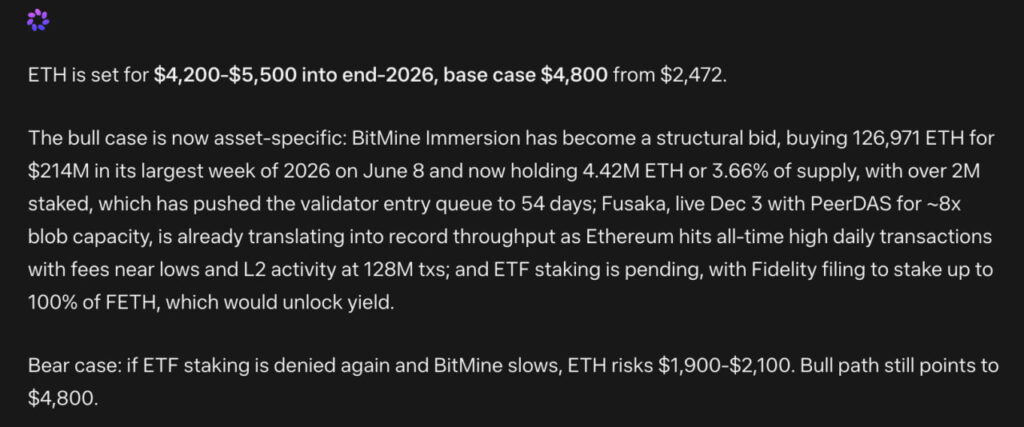
One buyer now controls 3.66% of all Ethereum, and that concentration sits at the heart of the latest Meta AI price prediction. The model projects ETH reaching $4,200 to $5,500 into the end of 2026, with a base case of $4,800 from a current price of $2,472.
BitMine Immersion has become a structural bid rather than an occasional one. On June 8, the company bought 126,971 ETH for $214 million, its largest week of 2026. Holdings now total 4.42 million ETH, of which more than 2 million ETH is staked — a level of activity that has pushed the validator entry queue out to 54 days.
That matters because Ethereum’s supply story is no longer just about price action. A large holder buying and staking at this scale reduces immediately available float, while the network’s growing validator queue shows how demand for staking is feeding back into participation constraints. Protocol upgrades form a second pillar. The Fusaka upgrade went live on December 3 with PeerDAS, lifting blob capacity by roughly eight times. That added capacity is showing up in usage: Ethereum has hit all-time-high daily transactions with fees near lows, and Layer 2 activity has reached 128 million transactions.
Yield is the third leg. ETF staking remains pending, with Fidelity filing to stake up to 100% of FETH. Approval would unlock staking yield for regulated holders, changing who can justify owning the asset and giving institutional products a clearer path to compete with direct ownership.
The bear case pairs two failures. If ETF staking is denied again and BitMine slows its buying, ETH risks a decline to $1,900 to $2,100. Absent that scenario, the model's bull path still points to $4,800.
Ethereum Price Prediction: Meta AI Points to a Supply Squeeze
The chart shows how far sentiment fell. Ethereum traded above $4,400 last September and lost more than half of its value within five months. February 2026 was the capitulation, taking ETH down to $1,740 in days. A recovery built from March through May toward $2,400 failed, and June sent the price back to $1,500. July and August rebuilt a base near $1,900, and that floor held for six weeks before last week's vertical candle broke it open.
The move is now holding rather than fading. Ethereum closed at $2,472.9, up $10.1 for a gain of 0.41%, with a session range from $2,424.9 to $2,532.3. The analysis reads the flat close after a 30% run as constructive. Resistance sits at $2,532.3, then $2,600, then the $2,800 shelf from January. Support runs through $2,424 and $2,200, with the $1,900 base standing as the structural line.
RSI reads 79.39 against a signal line at 65.03. The 14-point gap is elevated without reaching the extremes seen elsewhere this month. The signal line has climbed since July rather than sitting flat — a slower build that suggests accumulation preceded the breakout instead of arriving with it. If this shelf holds, the validator queue keeps tightening, which the analysis identifies as the mechanism carrying ETH toward $4,800.
Ethereum Squeezes Supply While LiquidChain Targets Liquidity Trapped Between Chains
Ethereum's bull case increasingly depends on less ETH being available while more capital competes for it. LiquidChain is targeting a different inefficiency: the large pools of liquidity that already exist but remain fragmented across separate networks. Bitcoin, Ethereum, and Solana each command deep capital and active users, yet moving between them still means bridges, duplicated deployments, added fees, and broken liquidity paths.
LiquidChain is building a single execution layer designed to connect all three, allowing one deployment to reach multiple ecosystems without rebuilding the same application chain by chain. That positions it as a broader infrastructure bet on where DeFi activity moves next, rather than a wager on one asset's supply squeeze alone. The project's presale is currently priced at $0.01454, with just over $920,000 raised. At that stage, it takes far less capital to materially reprice the project than it does to move an established large-cap network.

