Ethereum Price Falls as Spot Ether ETFs Record Worst Month Ever
Key Takeaways
- •U.S. spot Ether ETFs recorded more than $1.6 billion in October outflows, their worst monthly performance since launching in July 2024, surpassing the previous record of over $1.42 billion set in November of last year.
- •Ether traded near $2,250 on Oct. 31, extending its slide from roughly $2,807 in September as ETF withdrawals persisted for a sixth straight week, including $155.7 million in single-day outflows on Friday.
- •Ethereum's on-chain metrics deteriorated, with total value locked dropping to $43 billion from a $170 billion peak last year, real-world asset value falling to $30.2 billion, and stablecoin supply declining 1.29% to $141 billion.
- •The Federal Reserve left rates unchanged but signaled a possible increase at its December meeting, a near-term catalyst for risk appetite since cryptocurrencies have generally underperformed during rate-hiking periods.
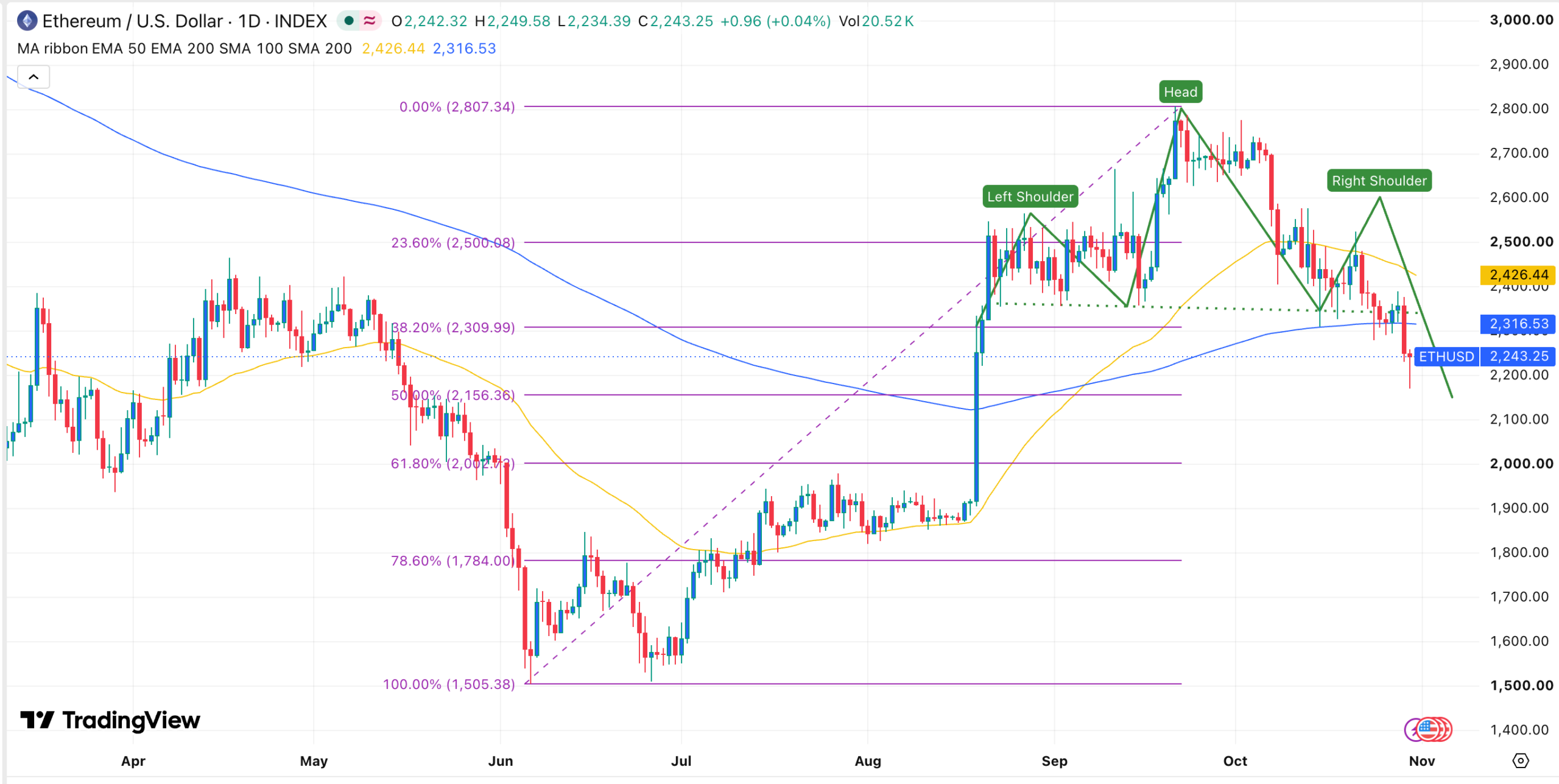
- •Technical charts display a bearish head-and-shoulders pattern, with a break below $2,168 confirming the downside case toward $2,000 and a move above $2,300 invalidating the bearish outlook.
Key points
- Ethereum remained near $2,250 on Oct. 31 as withdrawals from U.S. spot Ether exchange-traded funds deepened.
- Spot ETH ETFs recorded more than $1.6 billion in outflows in October, their worst monthly performance on record.
- Ethereum has formed a head-and-shoulders pattern, although the potential $2,000 downside target remains conditional.
Ethereum’s price continued its sharp decline in October, remaining near $2,250 on Oct. 31. U.S. spot Ether funds recorded $155.7 million in outflows on Friday, according to Farside Investors.
The retreat coincided with weaker decentralized finance deposits and deteriorating network metrics, while technical indicators pointed to further downside. However, the potential move toward $2,000 remains conditional on additional price weakness.
Spot ETH ETFs record worst month ever
U.S. investors withdrew more than $1.6 billion from Ethereum exchange-traded funds in October, marking the worst monthly performance for the products since their launch in July 2024. The previous record for monthly outflows was set in November last year, when the funds lost more than $1.42 billion.
Ethereum ETFs have experienced outflows for six consecutive weeks. BlackRock’s EYAHA was the most affected, followed by Grayscale’s ETH, Grayscale’s ETH, and BlackRock’s ETHB. Each of the funds lost millions of dollars in assets over the past several weeks.
Ethereum’s performance was weaker than that of several other crypto assets. Bitcoin ETFs recorded $615 million in outflows, most of them on Friday, as investors reacted to the Binance hack that affected coins worth more than $6.3 billion. Binance said that everything was safe and that it would cover the losses using its large reserves.
By contrast, spot XRP ETFs attracted more than $18.8 million in October and have recorded outflows in only one month since their inception. Solana ETFs lost more than $143 million in assets during the month.
ETF outflows are historically viewed as a bearish factor because they indicate that large retail and institutional investors expect an asset’s price to decline over time. The funds were created to give conventional brokerage and retirement accounts direct exposure to Ether, which is why their flow data is widely watched as a barometer of institutional demand for the asset.
Ethereum retreat coincides with weaker network metrics
Ethereum’s decline has occurred alongside weakness across other major cryptocurrencies. Bitcoin has fallen from $87,200 in October to $77,225, while the total value of all tokens has decreased from nearly $3 trillion to $2.7 trillion.
One factor cited for the broader decline is the Federal Reserve’s indication that it could raise interest rates in the coming months. The central bank left rates unchanged at its latest meeting, but officials signaled that an increase could come at the December meeting.
That outlook was reinforced by U.S. economic data showing that the economy expanded by 3.4% in the third quarter. Ethereum and other cryptocurrencies have generally underperformed during periods when the Federal Reserve raises interest rates, making the December meeting one of the nearest scheduled catalysts for risk appetite.
Ethereum’s key network metrics have also weakened. The total value of real-world assets, or RWAs, on the network fell to $30.2 billion. The amount of stablecoins using Ethereum declined by 1.29% over the last seven days to $141 billion. Total value locked, or TVL, dropped to $43 billion from a high of $170 billion last year. These measures act as broad gauges of on-chain activity, with TVL tracking deposits in decentralized finance protocols and stablecoin supply often read as a proxy for dollar liquidity on the network.
Ethereum price prediction: technical analysis
On the daily chart, ETH has remained under pressure for several months, falling from $2,807 in September to approximately $2,240. The chart shows a head-and-shoulders formation, a commonly recognized bearish reversal pattern.
Ethereum has fallen below the 38.2% Fibonacci retracement level, the 50-day moving average, and the Supertrend indicator. The technical setup suggests that the token could continue declining, potentially reaching the psychological $2,000 level.
The bearish view would receive further confirmation if ETH falls below $2,168, its lowest level in October. Conversely, a move above the key resistance level of $2,300 would invalidate the bearish outlook. Taken together, the $2,168 support and $2,300 resistance give traders clear reference points for the coming sessions, while the Federal Reserve’s December meeting and the weekly ETF flow reports offer the next fundamental cues.
This article is informational and does not constitute financial advice. Cryptocurrency prices are volatile, and investors can lose capital.
Source: The Market Periodical

