Ethereum Holds Near $2,376 as Whale Liquidation Risk Increases
Key Takeaways
- •Santiment recorded 169,770 ETH in-day exchange outflows on Oct. 24, the largest daily withdrawal in more than four months, though such transfers do not alone confirm a shift in demand.
- •Two early Ethereum holders sold a combined 4,000 ETH, including one investor who sold 3,000 ETH for about $7.23 million, roughly 128 times his original $18.83 per-coin purchase price.
- •CryptoQuant's Ethereum Futures Taker CVD continued to favor sellers, showing market sell orders exceeded market buys in the derivatives market.
- •ETH traded below the $2,385.62 support after failing to sustain a recovery toward $2,540.68, with bearish Parabolic SAR and MACD readings leaving $2,300 as a potential next downside test.
- •Lookonchain flagged 93,184 ETH in whale long positions worth about $214 million facing liquidation levels at $2,256.45 and $2,226.53, roughly 5% and 6% below the current price.
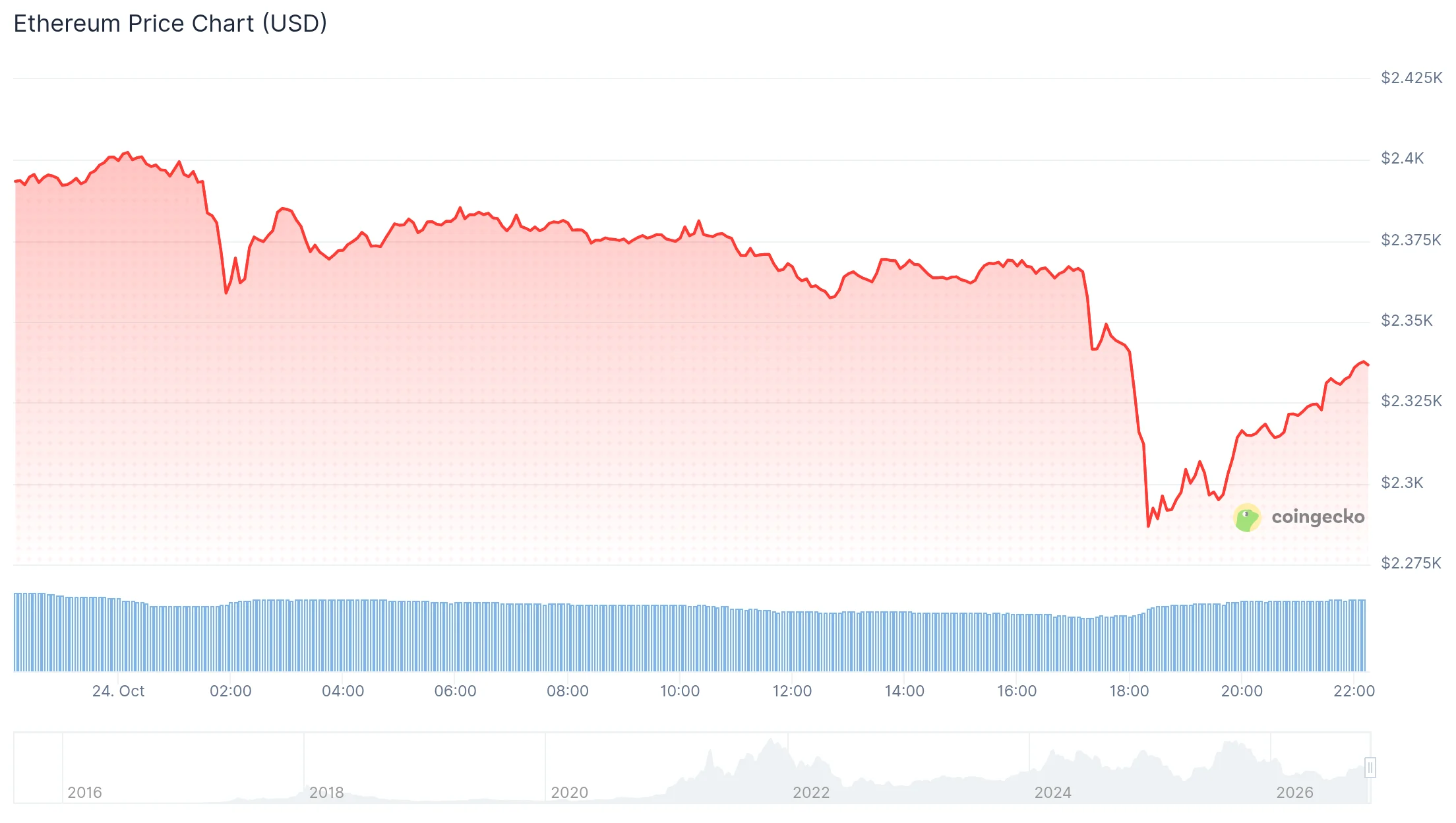
Ethereum traded near $2,376.62 on Oct. 24 as exchange outflows provided a potential supply-side support signal while derivatives data, technical indicators and whale leverage continued to point to downside risks.
Santiment reported that 169,770 ETH left exchanges in a single day, the largest daily outflow in more than four months. The data was discussed in a post by Santiment. A similar outflow episode on June 5 was followed by roughly 223,800 ETH in net withdrawals and the formation of an ETH price bottom. However, that historical sequence does not establish that another rebound will occur.
Exchange outflows can reduce the amount of ETH immediately available for sale on trading venues. They can also reflect transfers to private wallets or other activity rather than new purchases. As a result, a single day of netflows does not show who moved the coins or why, and it cannot by itself confirm a change in market demand. Exchange balances are tracked as a proxy for immediately tradeable supply, which is why sharp netflow swings tend to draw attention when price is testing key technical levels, as ETH is at the $2,385 area.
Early Holder Sales Counter the Outflow Signal
Long-term investor selling offered a counterpoint to the exchange withdrawal data. Lookonchain reported that one Ethereum investor sold 3,000 ETH for approximately $7.23 million. The investor had reportedly purchased the coins nine years ago at $18.83 each, making the reported sale worth about 128 times the original purchase price. The transaction was highlighted by Lookonchain.
A second early Ethereum holder, described as an initial coin offering participant, sold 1,000 ETH. That investor had originally purchased 100,000 ETH at about $0.31 per coin. Together, the two early holders sold 4,000 ETH — a small fraction of the 169,770 ETH single-day outflow, a scale difference worth keeping in mind when weighing early-holder selling against the supply withdrawn from exchanges.
The sales show that some long-term holders are taking profits while exchange balances decline, but they do not demonstrate broad selling across the entire holder base. They also weaken the argument that exchange withdrawals alone confirm a bullish shift in market conditions.
Futures Selling and Technical Indicators Keep Pressure on ETH
CryptoQuant’s Ethereum Futures Taker CVD continued to favor sellers. The metric measures the cumulative difference between aggressive market buy and sell orders across ETH futures. A seller-dominant reading indicates that market sell orders exceeded market buys during the measured period, pointing to derivatives pressure without forecasting each individual price move.
The daily chart showed ETH below the $2,385.62 support level after it failed to sustain a recovery toward $2,540.68. The price remained near $2,376.62, and repeated attempts to stabilize around support had not produced a convincing rebound.
Parabolic SAR remained above the market price at $2,509.93. The MACD also maintained a bearish crossover, with its histogram at negative 8.90. Those readings left $2,385 as a level that buyers needed to reclaim. If ETH does not recover that level, $2,300 could become a subsequent downside test. The indicators added to the selling pressure, while the exchange outflow data provided a potential supply-side counterpoint. The signals measure different types of market activity and can occur at the same time.
Whale Long Positions Face Liquidation Levels
Lookonchain also flagged 93,184 ETH in whale long positions valued at approximately $214 million. It identified liquidation levels at $2,256.45 and $2,226.53 — roughly 5% and 6% below the current price, respectively. In leveraged derivatives markets, liquidation is the automatic closure of a position once price reaches the point where its margin no longer meets the exchange’s requirements, so for long positions those thresholds sit below the market. A decline through either level could force the positions to close, potentially adding sell orders to an already weak market. Liquidation figures, however, do not guarantee that the positions will be liquidated or that ETH will reach either level.
The liquidation prices identify where traders face risk rather than predicting a future move. For now, the market is balancing reduced ETH availability on exchanges against sales by early holders, futures-market selling and the possibility of forced closures in leveraged whale positions. The reference points to watch are the ones already on the chart: whether buyers can reclaim $2,385.62, whether $2,300 comes into play, and whether price approaches the flagged whale liquidation levels at $2,256.45 and $2,226.53.
The post “Ethereum Price Holds Near $2,376 as Whale Liquidation Risk Grows” appeared first on Blockonomi.

