Ethereum Layer 2 Networks Drive Surge in Transactions and DeFi Activity
Key Takeaways
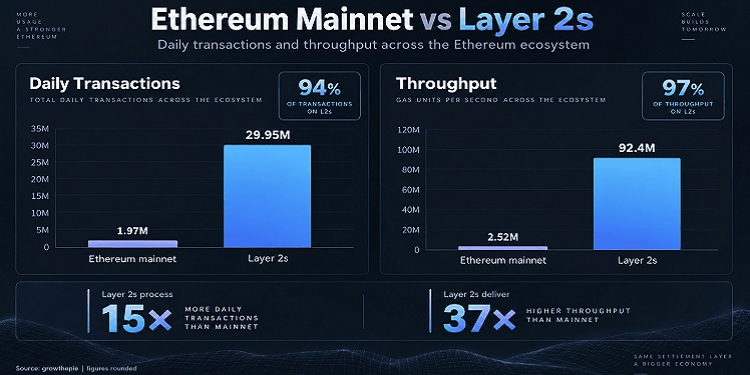
- •Ethereum Layer 2 networks process approximately 94% of transactions and 97% of total throughput across the Ethereum ecosystem, handling nearly 30 million daily transactions versus about 1.97 million on the mainnet.
- •Layer 2 networks accounted for roughly 99% of DeFi transactions over the past 30 days, with Uniswap alone recording more than 57 million Layer 2 transactions.
- •Base leads Layer 2 networks with about $14.51 billion in secured value, followed by Arbitrum at roughly $12.47 billion, while Robinhood Chain grew more than 150% in 30 days to reach about $2.8 billion.
- •Ethereum's mainnet retains the bulk of ecosystem capital, holding approximately $162 billion in stablecoins and nearly $49 billion in DeFi total value locked.
- •Ether traded near $2,500 after recovering from approximately $2,390 earlier in the week, supported by continued inflows into Ethereum exchange-traded funds.
Momentum is building across Ethereum’s broader ecosystem as Layer 2 networks and decentralized finance tokens outperform several major crypto sectors, with blockchain activity continuing to migrate from the mainnet to scaling networks.
Market trader Daan Crypto highlighted the trend, noting that Ethereum, Layer 2 networks and DeFi were among the strongest-performing major sectors over the previous week, excluding smaller memecoins. The performance suggests the move may reflect a broader shift in market positioning rather than a short-lived rally among alternative crypto assets.
Layer 2 networks are scaling solutions built on top of Ethereum that bundle transactions off the mainnet while ultimately anchoring their data and security to it, allowing users to transact at lower cost. That design has driven much of the ecosystem’s growth since Ethereum’s 2024 Dencun upgrade sharply reduced the data costs of running such networks.
Recent blockchain data indicates that Ethereum’s scaling networks now process about 94% of all transactions across the combined Ethereum Layer 1 and Layer 2 ecosystem. That growing share provides a fundamental backdrop for the recent strength in Layer 2 and DeFi-related tokens.
Ethereum Layer 2 networks are now processing nearly 30 million transactions per day, compared with less than 2 million on the Ethereum mainnet, underscoring how rapidly activity has migrated to scaling networks.
L2 Networks Handle 97% of Ecosystem Throughput
According to data from GrowthePie, Ethereum Layer 2 networks processed approximately 29.95 million transactions per day, while the mainnet handled about 1.97 million.
The gap is even more pronounced when measuring computational throughput. Layer 2 networks account for approximately 97% of total throughput across the Ethereum ecosystem, processing around 92.4 million gas units per second compared with about 2.52 million on Ethereum’s mainnet.
Capital is also flowing increasingly into major Layer 2 networks. Base, the network developed by Coinbase, currently secures approximately $14.51 billion, representing about 41% of the value secured across Ethereum’s Layer 2 ecosystem. Arbitrum follows with roughly $12.47 billion.
Robinhood Chain has also recorded substantial growth, reaching about $2.8 billion in secured value after rising more than 150% over a 30-day period. The network, built with Arbitrum’s technology stack and launched by the trading platform Robinhood, has benefited from rising tokenized-asset activity. The increase in network activity has coincided with stronger performance among related tokens. ARB, for example, recently gained more than 120%, with accelerating activity around Robinhood Chain contributing to the broader market narrative.
DeFi Activity Moves to L2s as Capital Stays on Mainnet
The shift toward Layer 2 networks is particularly pronounced in decentralized finance. Over the past 30 days, Ethereum Layer 2 networks processed approximately 337 million DeFi transactions, accounting for about 99% of combined DeFi transaction activity across Ethereum’s mainnet and scaling networks.
Uniswap, the ecosystem’s largest decentralized exchange, was among the most heavily used applications, recording more than 57 million Layer 2 transactions during the period. The figures show that users are increasingly conducting routine DeFi activity on networks built to reduce the costs and congestion associated with Ethereum’s mainnet.
Transaction activity and capital distribution, however, remain significantly different. Ethereum’s mainnet continues to hold the majority of the ecosystem’s liquidity, with approximately $162 billion in stablecoins compared with about $12 billion across Layer 2 networks.
Ethereum’s institutional data hub also places decentralized finance total value locked on the mainnet at close to $49 billion. This suggests that Layer 2 networks have become the primary venue for transaction activity, while the mainnet continues to serve as the principal location for capital and settlement, a pattern consistent with how rollup-based scaling was designed to operate.
Ethereum Maintains Institutional Momentum
Ether was trading near $2,500 after recovering from approximately $2,390 earlier in the week. Institutional demand has remained another factor supporting the broader ecosystem, with Ethereum exchange-traded funds extending an inflow streak as demand for crypto investment products returned.
The data points to an increasingly complementary Ethereum structure in which Layer 2 networks handle the bulk of transactions and computational activity, while the mainnet remains the ecosystem’s dominant capital and settlement layer.
That division is helping shape market performance across Ethereum-related assets. Rather than relying solely on gains in Ether, investors are increasingly focused on infrastructure and applications that benefit from the expansion of on-chain activity.
Continued growth in Layer 2 transaction volumes, rising secured value, and strong DeFi usage could strengthen Ethereum’s position as a multi-layer blockchain ecosystem. At the same time, the significant concentration of stablecoins and DeFi capital on the mainnet shows that scaling networks have yet to replicate Ethereum’s role as the primary liquidity and settlement hub.
The widening use of Layer 2 networks could provide a structural foundation for continued growth in Ethereum’s DeFi and scaling sectors as activity increasingly separates into high-throughput execution and mainnet-based settlement.
