Ethereum Price Holds $2,200 Support as Glamsterdam Testnet Delay Extends
Key Takeaways
- •Ethereum developers delayed the Hoodi testnet fork for the Glamsterdam upgrade after researchers identified applications that could fail under two proposed gas-accounting changes, EIP-8037 and EIP-8038.
- •The pause concerns only testnet scheduling, and Ethereum's live mainnet continues to operate normally while the Foundation works with auditors including ChainSecurity and Dedaub to review eight identified invariants.
- •US spot Ethereum ETFs recorded roughly $365.2 million in weekly outflows, marking a sixth consecutive week of withdrawals.
- •ETH traded near $2,235, holding above the $2,200–$2,250 support zone that trader Ted Pillows says could drive a move to $2,350–$2,400 if intact or put $2,000 in view if broken.
- •Ethereum's total value locked fell to about $43.2 billion from nearly $50 billion earlier in the month, pointing to reduced capital deployment across the network.
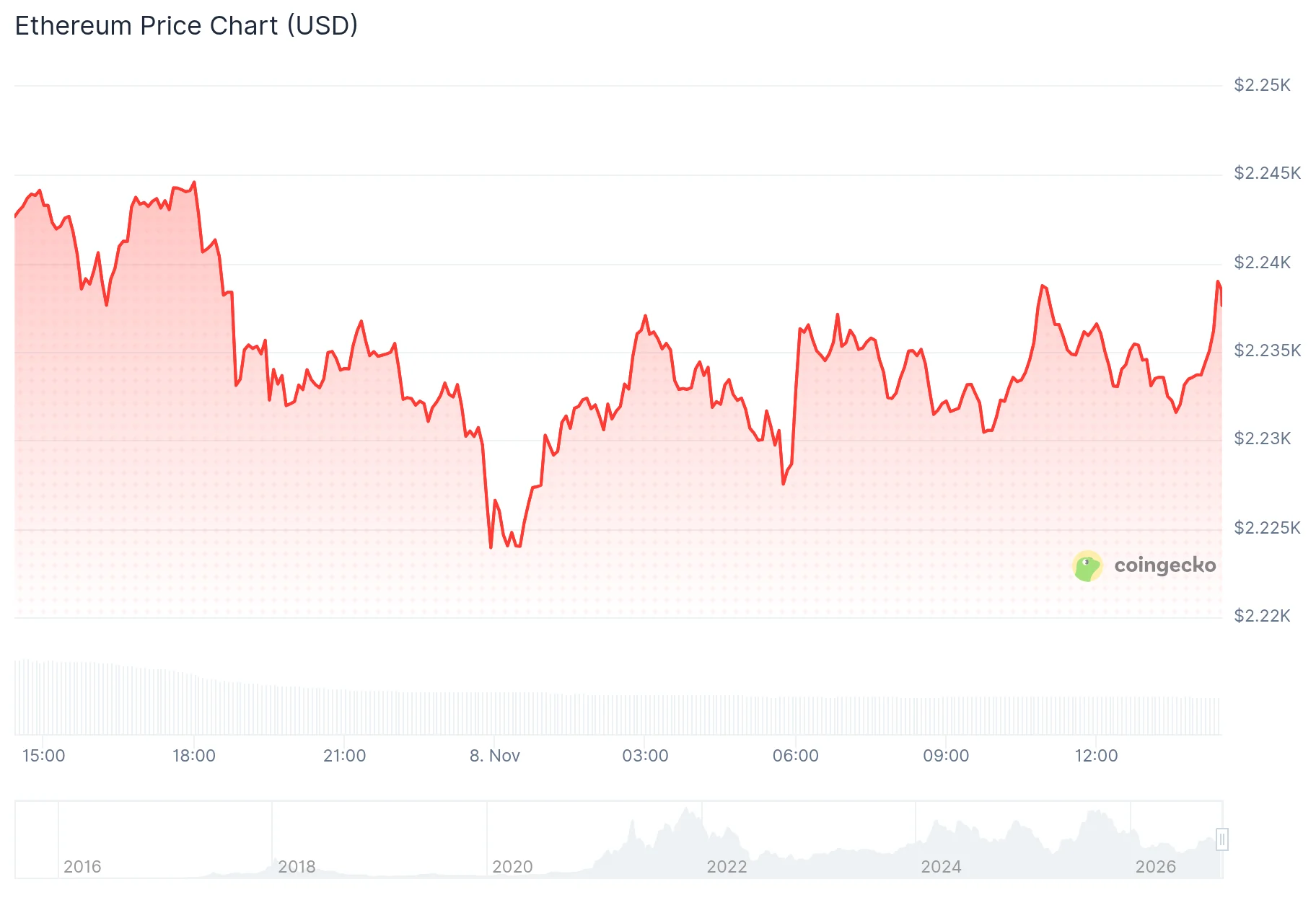
Ethereum (ETH) traded near $2,235 over the weekend, holding just above a key support band as developers paused the next step of the network's Glamsterdam upgrade. The Ethereum Foundation said it will not fork the Hoodi testnet until teams address compatibility issues tied to two proposed gas-accounting changes. The pause gives developers more time to examine those risks, and it concerns test scheduling rather than Ethereum's live network, which continues to operate normally.
Researchers found that certain applications could fail once the proposals change how gas is calculated, prompting the delay. Meanwhile, US spot Ethereum ETFs extended a difficult stretch of withdrawals, leaving traders watching the $2,200 to $2,250 support area closely.
Glamsterdam Delay Over Gas Accounting Risks
AllCoreDevs, the developer group coordinating Ethereum's protocol work, delayed the Hoodi fork after testing identified potentially vulnerable projects. Those applications rely on gas-related invariants — conditions that developers expect to remain true throughout contract execution — that the protocol changes could invalidate. When an invariant breaks, contracts built on the assumption may behave in ways their authors never anticipated.
Two Ethereum Improvement Proposals drive the change. EIP-8037 separately meters and raises the cost of creating new state, while EIP-8038 updates the cost of accessing existing state. Together, the proposals aim to align gas charges with the work required by Ethereum's current state, supporting a rise in the gas limit without ignoring state growth. Gas is the unit Ethereum uses to price every operation on the network, so a higher gas limit would let each block process more activity — a long-standing scalability goal that depends on getting this accounting right.
For deployed contracts, the exposure may lie outside core business logic. Fixed gas stipends, hardcoded gas limits, and remaining-gas assumptions could produce unexpected results once the new rules take effect. In practice, a transaction could fail outright, an integration could misprice execution costs, or security checks could behave differently than designed. Earlier developer guidance had already flagged those three areas as the most likely trouble spots.
The Ethereum Foundation has published guidance on the issue and is working with ChainSecurity, Dedaub, and other auditors to assess the fallout. Researchers have identified eight invariants for review, and the published repository offers explanations, examples, and prompts for project-level checks. Teams are being asked to test their contracts and supporting infrastructure before Hoodi receives a revised activation date.
The re-pricing work applies to test environments and future deployment planning; it does not alter Ethereum mainnet today. Testnets such as Hoodi exist for exactly this kind of rehearsal: upgrade code is activated under realistic conditions so flaws surface and get corrected before the changes reach the main chain. Node operators are expected to follow revised client release notes once a replacement Hoodi schedule emerges. The added scrutiny is intended to protect applications before the protocol changes reach users on the live network. Hegota development continues in parallel while Glamsterdam receives extra scrutiny.
The next signals are clearly defined: fixed specifications, fixes for the exposed applications, and a fresh Hoodi test. Ethereum's price does not track development schedules, but a clear audit outcome could remove a layer of uncertainty hanging over the asset.
Price Tests $2,200 as ETF Outflows Continue
On the daily chart, ETH traded close to $2,235, below the $2,781 resistance area, after falling from roughly $2,809 in September. The token remained beneath both its 50-day and 100-day exponential moving averages and stayed below the Supertrend indicator, a reading that signals persistent downside momentum on that timeframe.
Fund flows added to the pressure. US spot Ether ETFs, which began trading in 2024, package ether into regulated funds that trade on stock exchanges, making their daily flows a widely watched gauge of demand for ether exposure. Farside Investors recorded $99.9 million in aggregate outflows from US spot Ethereum ETFs on Thursday, followed by another $93.3 million on Friday, bringing the week's total to roughly $365.2 million — a sixth consecutive week of withdrawals. The figures measure fund subscriptions and redemptions rather than a direct forecast for Ethereum's price.
Onchain conditions have softened alongside fund demand. Ethereum's total value locked, a standard measure of assets deposited across the network's decentralized applications, stood near $43.2 billion, down from almost $50 billion earlier this month, while stablecoin value on the chain — the dollar amount of stablecoins circulating on Ethereum — stood near $135 billion, also below its year-to-date highs. These metrics can move quickly, but together they point to reduced capital deployment across the network.
Trader Ted Pillows identified $2,200 to $2,250 as a key support zone for Ether. He expects a move toward $2,350 to $2,400 next week if support holds, while a decisive break below the zone would keep $2,000 firmly in view. For now, Ethereum's price remains caught between that technical level and an unresolved testnet timetable.
Source: Blockonomi

