Ethereum Reaches $2,546 as ETF Inflows and Short Covering Fuel the Rally
Key Takeaways
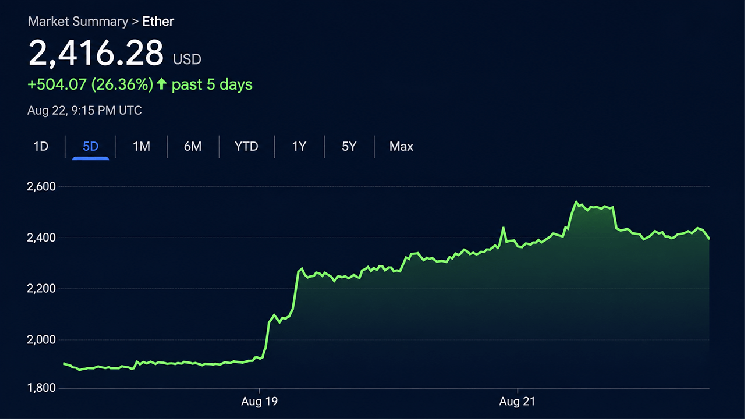
- •Ethereum rose about 17.5% on Aug. 19 and extended the move to an intraday peak of $2,546.78 on Binance before pulling back later in the week.
- •Spot Ethereum ETFs recorded about $697 million in net weekly inflows, led by BlackRock's ETHA, with total ETF assets rising toward $14.3 billion.
- •Exchange-held ether fell about 15% from early June to mid-August, while more than 42 million ETH, or roughly 33.7% of supply, is staked.
- •Ethereum accounted for $264.92 million of the $1.21 billion in crypto liquidations over 24 hours, reflecting heavy losses for leveraged traders.
- •Options open interest leaned toward calls, but recent trading volume favored puts, suggesting some traders sought downside protection after the rally.
Ethereum Reaches $2,546 as ETF Inflows and Short Covering Fuel the Rally
Ethereum ($ETH) changed hands near $2,435 late Saturday at 5 p.m. EDT, easing back from its intraday peak after a powerful advance. The move broke ethereum out of the mid-$1,800s to low-$1,900s band where it had been pinned for much of mid-August. The cryptocurrency's share of the broader crypto market, known as dominance, is now approaching 11%.
A Breakout From the Range
The surge began in earnest on Aug. 19, when $ETH climbed roughly 17.5% in a single session, opening near $1,917 and closing above $2,250. Follow-through buying over the next two sessions carried the price as high as $2,546.78 on Binance. Daily trading volume repeatedly ranged between $25 billion and $33 billion over the course of the run.
Bitcoin also rallied, with exchange rates placing it around $77,300 at 5 p.m. EDT on Saturday. Ethereum, however, moved faster this week, strengthening its performance relative to bitcoin. The distinction matters: traders were not simply allocating across crypto indiscriminately. Capital also rotated into the network that underpins many stablecoins, tokenized assets and decentralized finance (DeFi) applications — the lending, trading and exchange protocols that run on public blockchains rather than through traditional intermediaries.
Spot Ethereum ETFs Draw Heavy Inflows
Spot ethereum exchange-traded funds (ETFs) recorded approximately $697 million in net inflows for the week, according to the latest data from sosovalue, a crypto fund-flow tracker. The funds attracted roughly $189 million on Aug. 19, $221 million on Aug. 20 and $185 million on Aug. 21 — their hottest stretch since October 2025.
BlackRock's ETHA absorbed the bulk of the demand, while Grayscale Mini ETH and Fidelity's FETH also joined the buying. Total assets under management in spot Ethereum ETFs climbed toward $14.3 billion, equivalent to about 4.85% of Ethereum's market capitalization. Cumulative inflows since launch approached $12.2 billion. Spot ethereum ETFs have traded in the United States since July 2024; because they let investors hold exposure through ordinary brokerage accounts without self-custody of tokens, their weekly flows are widely followed as a gauge of institutional participation.
Shrinking Exchange Balances Tighten Supply
The rally arrived in a market holding less $ETH on exchanges. Exchange-held ethereum declined about 15% from early June to mid-August, falling from roughly 7.7 million $ETH to 6.54 million $ETH. Separately, more than 42 million $ETH — approximately 33.7% of the supply — is locked in staking.
Staking is the process by which holders commit $ETH to help run and secure the Ethereum network in exchange for potential rewards. Coins that are staked or withdrawn from exchanges are not necessarily locked away from sellers, but they shrink the inventory immediately available to traders. Aggressive buying against a thinner float can produce much larger price moves.
Futures Positioning and a Heavy Liquidation Event
Ethereum futures open interest, the value of active futures contracts, stood at $31.81 billion, or 13.06 million $ETH, according to statistics collected from coinglass.com. Binance controlled the largest share at $8.77 billion, followed by CME at $3.29 billion — the regulated Chicago exchange whose futures are a common entry point for institutional traders — Gate at $2.55 billion and Bybit at $2.21 billion.
Open interest rose 0.13% over the last hour and 0.35% in the past four hours, while sitting 1.60% lower over the last 24 hours. The combination indicates fresh positioning is still creeping into the market of the second-largest crypto asset even after the earlier rally flushed other traders out. Futures can turbocharge both gains and losses because traders frequently use borrowed exposure.
The toll from ether's climb was brutal. Liquidation statistics from coinglass.com show $ETH accounted for $264.92 million of the $1.21 billion in crypto liquidations recorded over 24 hours. The market-wide flush hit 234,707 derivatives traders, with long positions representing $727.13 million and shorts $481.62 million. $ETH derivatives posted the largest wipeouts of the day.
A liquidation occurs when an exchange automatically closes a leveraged position after losses burn through the trader's collateral. $ETH's hefty share of the carnage underscores how violently derivatives markets repriced during the run. Earlier short covering — traders who had bet against ethereum buying the token back to close out those positions — poured fuel on the rally, while the latest figures show leveraged traders on both sides remained vulnerable to sudden reversals.
Options Positioning Leans Toward Calls
Ethereum options data this weekend showed a more bullish tilt among positions still open. Calls represented 58.41% of options open interest, or 1.60 million $ETH, while puts accounted for 41.59%, or 1.14 million $ETH, on Saturday afternoon.
Fresh trading painted a more defensive picture. Put options represented 56.09% of 24-hour options volume, compared with 43.91% for calls — a pattern that could reflect traders scrambling for protection after the octane-fueled rally rather than simply betting prices are headed lower. Options give buyers the right, but not the obligation, to buy or sell an asset at a predetermined price.
The largest listed options positions included ether calls at $3,200 per coin, along with strikes at $2,200, $2,500, $3,000 and $3,500 on Deribit. The busiest contracts clustered around near-term puts, including a Deribit $2,100 put expiring Sept. 25 and several Bybit put contracts expiring Aug. 23. The positioning highlights trader focus on whether $ETH can defend this week's gains.
Overbought Momentum Cuts Both Ways
Daily relative strength index (RSI) readings of 78 to 88 are commonly considered overbought, and that may be the case this weekend. The RSI measures the speed and size of recent price changes. A lofty reading does not guarantee a sell-off, but it often means a rally has run hard enough to attract profit-taking or trigger sideways consolidation.
Traders are eyeing $2,400 to $2,450 as the first meaningful support zone, followed by $2,300. A clean break above the $2,546 to $2,550 high would bring $2,600 to $2,800 into play. A slide below $2,300, however, could crack open the door toward $2,150 to $2,200.
Macro Liquidity and Policy Sweeten the Setup
The rally arrived alongside a broader rebound in appetite for risk. The U.S. Treasury doubled long-duration bond buybacks to $4 billion per operation — repurchases of outstanding longer-dated debt that reduce the supply sitting in the market — helping cool yields and lift risk-sensitive assets. Political signals surrounding the proposed Clarity Act, which would clarify how U.S. law treats digital assets by dividing oversight between the SEC and the CFTC, also chipped away at regulatory uncertainty.
Those tailwinds can disappear quickly. Sustaining the move requires ETF flows to stay positive, broader markets to keep embracing crypto assets, and ethereum to defend its newly established support levels.

