Ethereum Gas Fees Explained: Why They Rise and How to Pay Less
Key Takeaways
- •Under EIP-1559, introduced in August 2021, Ethereum fees consist of a protocol-set base fee that is burned and a user-chosen priority tip paid to validators, with more than 4.52 million ETH removed from circulation since the upgrade launched.
- •The base fee adjusts by up to 12.5% per block depending on whether the previous block was full or below its 50% target, with gas prices updating roughly every 12 seconds.
- •Ethereum's gas limit doubled from 30 million in 2021 to 60 million, and Layer 2 migration left mainnet blocks only 25% to 35% full, pushing base fees down to about 0.05 gwei by April 2026.
- •The March 2024 Dencun upgrade added blob transactions through EIP-4844, cutting Layer 2 data costs by 10 to 100 times and enabling Layer 2 networks to handle over 90% of Ethereum's transaction volume.
- •Gas fees historically spiked during demand surges, averaging 480 gwei during DeFi Summer 2020 and reaching $53 per transaction during the May 2021 NFT boom.
Every action on Ethereum carries a cost. That cost is called gas, and it is always paid in ETH. In April 2026, a simple ETH transfer on the main network cost about $0.01, according to Dwellir. In 2020, average gas prices reached 480 gwei during a rush of trading activity. The gap between those two points is enormous, and the mechanics behind it are worth understanding for anyone who uses the network.
Drawing on data from seven sources, this article explains how gas fees are constructed, why they rise, and what has pushed them down. It closes with practical steps for paying less.
What Gas Is and Why Ethereum Needs It
Gas is the unit that measures how much computing work a transaction requires. Sending ETH is light work. Swapping tokens, minting an NFT, or running a smart contract is far heavier.
Ethereum.org describes gas as the fuel of the network, much like the gasoline a car burns. Every step of computation must be paid for, which protects the network from spam and from code stuck in endless loops. Britannica compares gas fees to a highway toll, with one key difference: the Ethereum road is run by many decentralized operators rather than a single owner. Ledger adds that gas turns limited block space into a market, where space goes to those willing to pay.
Gas fees also pay validators, the operators who process transactions and add blocks to the chain. Since September 2022, Ethereum has used proof of stake, and validators must lock up at least 32 ETH as a bond, according to Ledger. The company notes that this staked ETH, not the fees, is the main source of network security, although priority fees still add to what validators earn. Ethereum.org adds another important detail: the fee is charged whether a transaction succeeds or fails.
Gas prices are quoted in gwei. One gwei is one billionth of an ETH.
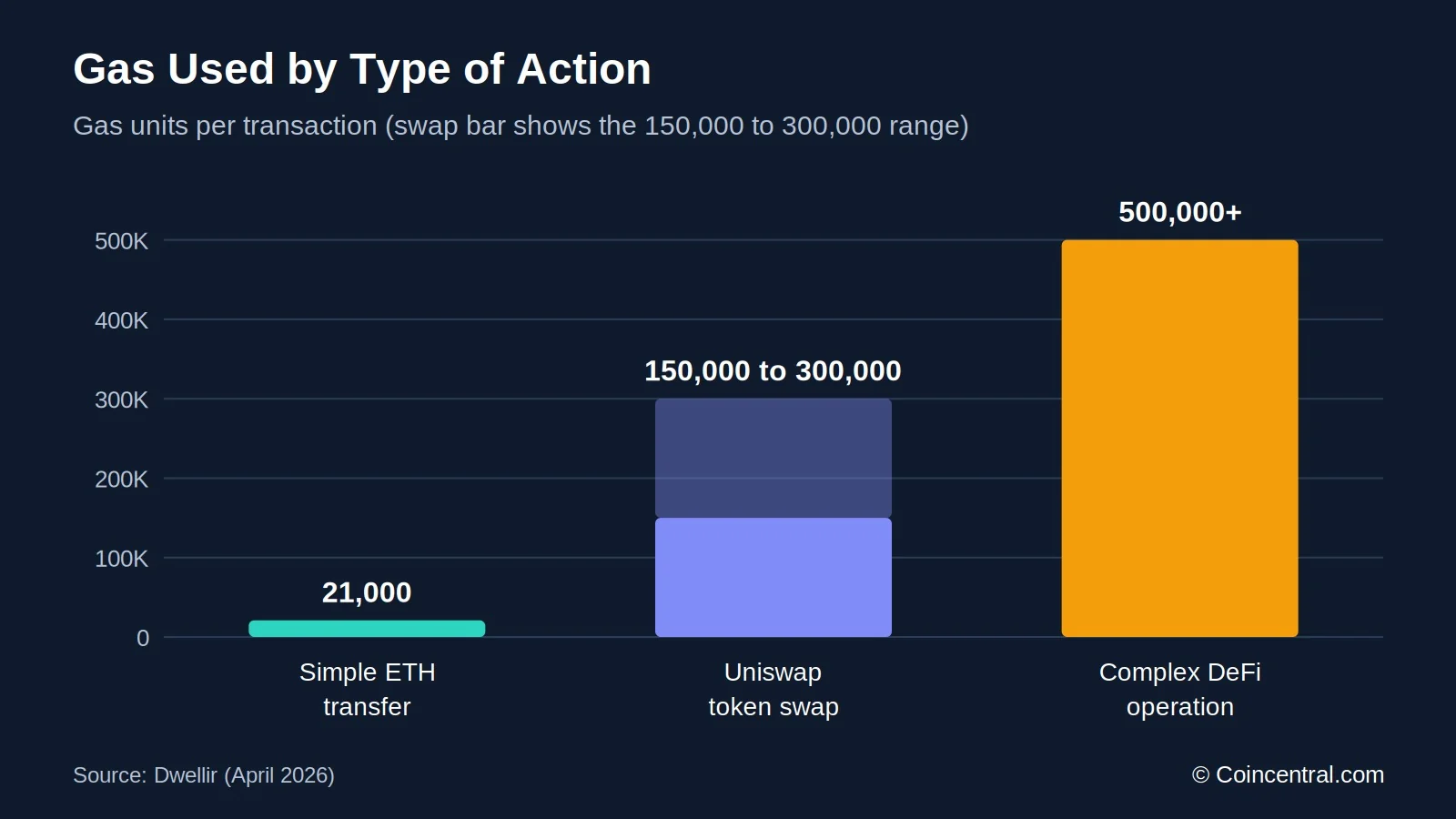
Each operation on the Ethereum Virtual Machine carries a fixed gas cost. According to Dwellir, an ADD instruction costs 3 gas, reading a storage slot for the first time in a transaction costs 2,100 gas, and writing a new value to storage costs 20,000 gas or more. Total gas use therefore depends on what a transaction actually does. A simple ETH transfer always consumes 21,000 gas, a Uniswap token swap uses 150,000 to 300,000 gas, and complex DeFi actions can exceed 500,000.
How Gas Fees Are Calculated
Before August 2021, Ethereum used a first-price auction. Users named a price, and miners picked the highest bids. Dwellir says users had no reliable way to guess the right price, so they often overpaid or waited.
The London upgrade in August 2021 introduced EIP-1559, which split the gas price into two components: a base fee set by the protocol and a priority fee chosen by the user.
The base fee is set by the protocol rather than by users, and it is burned — removed from circulation and paid to no one. Dwellir reports that more than 4.52 million ETH has been burned this way since EIP-1559 launched. The priority fee is a tip that goes to the validator, and a higher tip makes a transaction more attractive. Ethereum.org cautions that a transaction paying only the base fee is valid but unlikely to be picked up. Users can also set a max fee, the most they will pay per unit of gas. They pay only the base fee plus the tip, and any unused portion of the max fee is refunded.
Ethereum.org illustrates the math with an example. Jordan sends 1 ETH to Taylor. The transfer uses 21,000 gas, the base fee is 10 gwei, and Jordan adds a 2 gwei tip. The fee is 21,000 × (10 + 2), or 252,000 gwei, which equals 0.000252 ETH. Jordan is charged 1.000252 ETH, Taylor receives exactly 1 ETH, the validator collects a 0.000042 ETH tip, and 0.00021 ETH is burned.
Blockscout presents a similar case with a 20 gwei base fee and a 2 gwei tip. The fee comes to 462,000 gwei, or 0.000462 ETH, of which 420,000 gwei is burned.
In practice, most wallets handle both numbers automatically. Ledger's wallet app, for example, offers slow, medium, and fast options based on current network conditions.
Gas Limits, Refunds and Failed Transactions
The gas limit is the maximum amount of gas a user is willing to spend on a transaction, and it works as a safety cap. A standard ETH transfer needs a limit of 21,000 units.
Ethereum.org offers two scenarios. With a limit of 50,000 on a simple transfer, the transaction uses 21,000 and the remaining 29,000 is returned. With a limit of 20,000, the transaction fails at validation, is rejected before it ever enters a block, and uses no gas.
A different outcome occurs when a transaction runs out of gas partway through. The EVM reverts any changes, but all of the gas provided is still spent on the work completed. Ledger confirms that failed transactions still cost gas and cannot be refunded. The company lists the most common causes of failure: a gas limit set too low, a smart contract that reverts, a failed balance check, and a swap that goes past its slippage tolerance.
Blockscout highlights a common mix-up. Raising the gas limit does not make a transaction faster. The limit is only a ceiling — it is the priority fee that affects speed.
Developers often pad gas estimates with a buffer. Dwellir suggests 20% to 25% for standard transactions and 30% or more for complex multi-call operations. Because unused gas is refunded, the buffer costs nothing if the transaction succeeds.
Why Gas Fees Rise: The Base Fee Rule
Block space is limited, so fees rise when more people want in. Each block has a target size equal to half of the gas limit, and when demand is high a block can grow to twice the target, according to Ethereum.org.
The base fee reacts to the size of the last block. It rises by up to 12.5% when a block is full, stays flat at the target, and falls by up to 12.5% when a block is empty. Ethereum.org notes that gas prices update roughly every 12 seconds.
Ethereum.org's example uses a 36 million gas limit and a starting base fee of 100 gwei, and it shows how quickly costs compound. If blocks stayed full, the base fee would reach 2,705.6 gwei by block 30 and 28,531.3 gwei by block 50. By block 100, it would pass 10 million gwei.
That compounding is exactly why long spikes are rare. Prices climb to a level where users simply stop paying, and Ethereum.org says extended runs of full blocks are unlikely. Blockscout describes the process as an auction for block space that settles every few seconds. The work in a transfer never changes, but the competition changes its price — which is why the same transfer can cost cents in the morning and several dollars in the afternoon.
Demand spikes tend to follow known events. Ledger lists popular NFT mints, sharp market swings and liquidations, token launches and airdrop claims, and bursts of DeFi activity. In those moments, users also raise their tips to compete for space.
One early case was CryptoKitties. The game launched in November 2017 and caused heavy congestion and very high fees, according to Ethereum.org, pushing developers to look for ways to scale the network — a search whose outcome, the Layer 2 ecosystem, is covered below.
Timing also matters. Dwellir reports that prices tend to be lowest from 02:00 to 05:00 UTC on weekends, and usually highest from Tuesday to Thursday between 14:00 and 18:00 UTC, when US and European users overlap.
Complex applications add to the cost as well. Ethereum.org notes that smart contract apps running many operations use more gas, and a poorly written contract used by many people can deepen congestion.
Fee History: From 480 Gwei to Pennies
Before 2020, Ethereum gas fees were usually a few cents but spiked often, according to Investopedia. After January 2020, fees rose and frequently went above $20 as more users joined.
DeFi Summer in 2020 pushed average gas prices to 480 gwei, Dwellir reports. The NFT boom in May 2021 drove the average transaction fee to $53.
EIP-1559 arrived in August 2021 and made fees easier to predict, though it did not lower them by itself. The sustained declines came later, from the added capacity and Layer 2 migration behind 2026's low fees, which the next section explains. The Merge in September 2022 moved Ethereum to proof of stake, and fees afterward ranged from a few dollars up to $30, Investopedia says. The publication adds that The Merge was not designed to fix high fees; it was one of several updates that together are expected to lower costs over time.
Ethereum.org says scaling upgrades are meant to address high fees over time, naming Layer 2 scaling as the main plan to lower gas costs and let the network handle thousands of transactions per second.
By April 2026, the picture had changed. Dwellir says base fees were around 0.05 gwei and average base fees sat below 0.1 gwei, with fees down by more than 90% year over year on some measures. The figures reported across these sources come from different measures and dates, so they serve as reference points rather than one continuous data series.
Why Fees Are Low in 2026
Two changes explain most of the drop. First, Ethereum's gas limit grew from 30 million in 2021 to 60 million now, according to Dwellir, doubling the space in each block. Second, many users moved to Layer 2 networks. Dwellir says mainnet blocks are now about 25% to 35% full, against a 50% target.
When blocks fall below the target, the base fee drops by up to 12.5% each block. After many such blocks, fees reach very low levels — which is how the base fee fell to about 0.05 gwei. At that level, a simple ETH transfer costs about $0.01 and a token swap costs $0.25 to $0.39. These figures shift with the price of ETH and the size of the tip.
The ETH price itself plays a role. Fees are paid in ETH, so the same amount of gas costs more in dollars when ETH is worth more. The dollar figures above depend on the ETH price at the time Dwellir measured them. For comparison, Dwellir's worked example uses a 12 gwei base fee and a 2 gwei tip: at $2,500 per ETH, a 21,000-gas transfer costs about $0.74 under those conditions.
Ethereum.org stresses that fees rise when demand goes past block space, which means today's low levels depend on demand staying light on the main chain. Dwellir also notes that the fee formula still applies, so applications still need accurate estimates. For anyone watching where fees head from here, block fullness is the number to track: while blocks sit below the 50% target, the same rule that once compounded fees upward works in the opposite direction.
Layer 2 Networks Compared With Ethereum Mainnet
Layer 2 networks run transactions off the main chain, then post compressed data back to Ethereum. Ledger names Arbitrum, Optimism, Base, and zkSync as examples.
Fees on a Layer 2 have two parts, according to Dwellir. One is the cost of running the transaction on the Layer 2 itself, which is low. The other is the cost of posting data to Ethereum, which makes up the larger share.
The Dencun upgrade in March 2024 added blob transactions through EIP-4844. Blobs use a separate fee market and are pruned after about 18 days. Dwellir says the change cut Layer 2 data costs by 10 to 100 times.
Layer 2 networks now handle most of Ethereum's transaction volume — often more than 90%, per Dwellir. The same source says moving an app to a Layer 2 cuts fees by more than 90% for most uses, and security still comes from Ethereum. For everyday users, that shift means the price tag they actually encounter is usually set on a Layer 2, with mainnet gas acting mainly as the data-posting cost that Dwellir identifies as the larger share of each Layer 2 fee. Blockscout adds that fees on Layer 2 networks work the same way at the unit level; they are simply smaller because the data is compressed. Actual costs vary with network load, the ETH price, and the blob fee market.
How to Reduce Your Gas Fees
Users cannot avoid gas fees on Ethereum, but they can lower them. Ledger, Ethereum.org, and Investopedia suggest several habits:
- Time your transactions. Ledger says fees are often lower late at night and on weekends in major time zones. Ethereum.org adds that the network is generally cheaper when North America is asleep.
- Wait a few minutes. Gas prices update about every 12 seconds, and Ethereum.org says waiting a short time when fees are high can lower the cost.
- Check a gas tracker. Per Investopedia, Etherscan shows live base and priority fees in gwei, along with the day's high, low, and average. Britannica also names ETH Gas Station.
- Use a Layer 2. For swaps, stablecoin transfers, and DeFi, Ledger calls a Layer 2 the most cost-effective choice for most everyday actions.
- Pick a slower speed. If a transfer is not urgent, a slower setting and a smaller tip can save money over time, says Ledger.
- Batch actions. Combining actions into fewer transactions means fewer signatures and less total gas, according to Ledger.
- Set a sensible gas limit. A limit that is too low can cause a failed transaction, and the gas used is not refunded.
Developers can cut costs for their users as well. Dwellir lists several code changes that reduce gas use. Storage packing delivers the largest savings, because the EVM reads and writes in 32-byte slots. Batching ten transfers into one call saves 189,000 gas in base costs alone, Dwellir says. And for data that is only read off-chain, emitting an event costs far less than writing to storage.
Britannica makes a final point: small fees add up. Frequent trading or heavy DeFi use can build a large total over time. Unlike the mostly predictable fees at stock brokerages, gas fees can spike.
What the Data Shows
Gas fees follow demand. The base fee rises by up to 12.5% per block when blocks are full and falls when they are not. In April 2026, light demand on the main chain and a doubled gas limit kept fees near their lowest levels in years. They are far below the peaks of 2020 and 2021 — but the rules that set them have not changed.
Sources
- Investopedia: Understanding Ethereum Gas Fees: Their Role and Calculation
- Ethereum.org: Gas and fees
- Ethereum.org: Network fees
- Dwellir: Ethereum Gas Fees Explained: How They Work, What EIP-1559 Changed, and How to Query Them
- Ledger Academy: Ethereum Gas Fees Explained: What They Are and How They Work
- Encyclopaedia Britannica: Ethereum Gas Fees: The Cost of Doing (Crypto) Business
- Blockscout: Gas and Fees, Explained
Original article: Ethereum Gas Fees Explained: Why They Rise and How to Reduce Them via CoinCentral.

