Ethereum Foundation Says AI Is a More Urgent Threat Than Quantum Computing
Key Takeaways
- •The Ethereum Foundation now considers artificial intelligence a more immediate security risk to Ethereum than quantum computing and has doubled the size of its protocol security team.
- •AI could break the elliptic curve cryptography securing Ethereum and Bitcoin by discovering substantially better algorithms, without requiring any advance in quantum hardware.
- •Ethereum plans to adopt hash-based cryptography, a transition affecting transaction authorization, validator security, and layer-2 data verification across the entire network.
- •Researcher Justin Drake warned in October that existing signature schemes could become vulnerable within months in a worst-case scenario, urging migration of funds to addresses whose public keys have never been exposed.
- •The Foundation will reassess its timeline in January 2027, weighing Drake's proposed December 2028 quantum-resistance deadline against the existing December 2029 target.
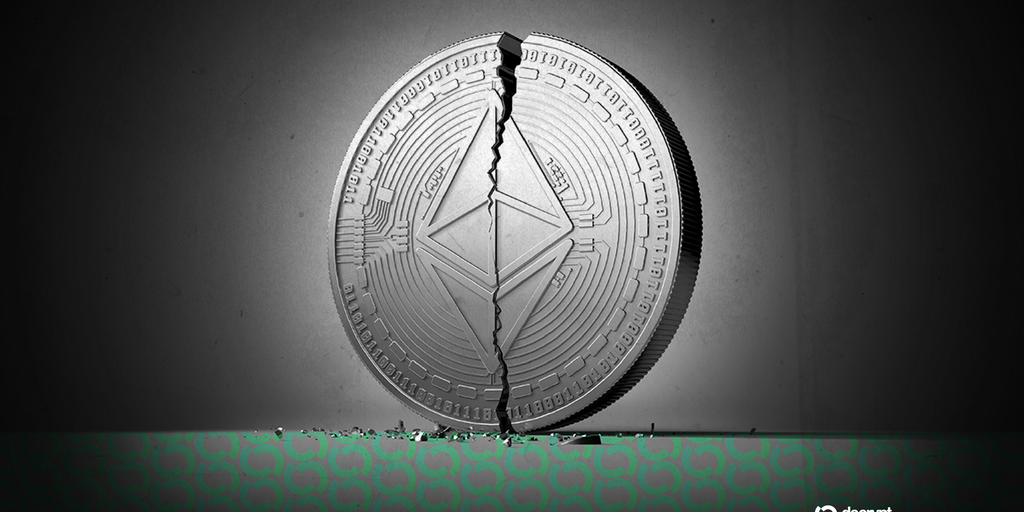
The Ethereum Foundation has identified artificial intelligence as a more immediate security risk to the network than quantum computing, doubling the size of its protocol security team and making the strengthening of Ethereum's cryptography its highest priority. The organization warns that AI could undermine the mathematical foundations underpinning Ethereum before quantum computers become powerful enough to do so.
"The EF has been planning mitigations to the threat posed by quantum computers," Kev Wedderburn wrote in a blog post published Monday, adding that "recently AI emerged as a more urgent risk."
For years, the crypto industry has worried about Q-Day—the hypothetical moment when quantum computers become powerful enough to break the cryptography protecting digital assets. AI introduces a different problem: what if someone discovers a mathematical shortcut that makes such a machine unnecessary?
Bitcoin and Ethereum both rely on elliptic curve cryptography to authenticate transactions. Its security depends on mathematical problems that are relatively easy to solve in one direction but prohibitively difficult to reverse using known algorithms. An AI capable of discovering substantially better algorithms could change that equation without requiring any breakthroughs in quantum hardware. Standards bodies have already begun preparing for the quantum version of this problem: the US National Institute of Standards and Technology finalized its first post-quantum cryptography standards in 2024, including one built on hash-based signatures—the same family of primitives Ethereum is now proposing to adopt.
Ethereum Foundation researcher Justin Drake raised this possibility in October, warning that existing signature schemes could become vulnerable within months rather than years under a worst-case scenario. He recommended that the industry start preparing for an orderly migration of funds to addresses whose public keys have never been exposed. That framing reflects how the underlying cryptography works: a public key generally stays hidden until an address sends funds for the first time, which is why accounts that have never transacted would be the natural starting point for any migration.
The Foundation's latest announcement comes just days after Anthropic mathematician Levent Alpöge and Claude produced a proof of the Riemann Hypothesis, a mathematical problem that had remained unsolved since 1859. The proof does not break Bitcoin or Ethereum's cryptography, but it illustrates how quickly AI is becoming useful in areas of mathematics previously considered beyond its capabilities.
There are already more practical examples in crypto. In May, a security researcher working with Anthropic's Claude Opus 4.8 discovered a vulnerability in privacy-focused cryptocurrency Zcash that could have allowed attackers to create counterfeit coins without leaving an obvious trace on the blockchain. The bug had survived roughly four years of scrutiny by cryptographers.
Changing Ethereum's Locks
Ethereum's proposed solution involves moving away from elliptic curves and adopting hash-based cryptography to protect wallets, transactions, and the network's underlying infrastructure. Hash functions turn data into fixed-length digital fingerprints that are designed to be extremely difficult to reverse, and their security relies on fewer structural mathematical assumptions than elliptic curve schemes. Ethereum already depends on secure hash functions, making them an attractive foundation for its new security architecture.
The transition would affect how users authorize transactions, how validators secure the network, and how Ethereum verifies data submitted by layer-2 networks—in effect touching every type of participant on the network.
Developers are also pursuing formal verification, a technique that uses mathematical proofs to demonstrate that software behaves according to its specifications. Ironically, AI could help accelerate that work. The Foundation has been deploying AI agents against its own infrastructure since earlier this year, successfully identifying software vulnerabilities before malicious actors could exploit them.
The security overhaul comes at a cost. Ethereum developers will need to rethink some planned features, and larger cryptographic signatures could increase hardware requirements for people running their own nodes. The effort could also prove harder than Ethereum's 2022 Merge, the network's transition to proof of stake.
Development group Ethlabs has already withdrawn its proposal to introduce faster block production in the upcoming Hegotá upgrade, freeing up engineering resources to pursue an ambitious target of making Ethereum resistant to both threats in 2027.
The Foundation previously established December 2029 as its internal deadline for achieving quantum resistance across Ethereum's base layer. Drake proposed bringing that target forward to December 2028 at the recent Devcon conference in Mumbai. The Foundation plans to reassess its timeline in January 2027, with developers already testing early implementations of the new cryptographic infrastructure. That January review will be the first scheduled opportunity for the Foundation to weigh Drake's proposed December 2028 target against the existing December 2029 deadline.

