Ethereum Bull Case Strengthens as ETF Inflows, Lower Fees, and Bullish Fractal Align
Key Takeaways
- •Ethereum's median mainnet transaction fees decreased by more than 99% between January 2024 and March 2026, falling from over $2 to under $0.02.
- •U.S. spot Ethereum ETFs secured $244.9 million in net inflows for the week ending August 7, extending a five-week positive streak and bringing cumulative inflows to roughly $11.46 billion.
- •Market analyst Crypto Patel's fractal analysis suggests that if current support levels hold, Ethereum could potentially target a long-term price expansion toward the $10,000 to $16,000 range.
- •The broader institutional footprint includes growing tokenization activities by major firms like BlackRock and JPMorgan, supported by a stablecoin market valued at $148 billion.
Ethereum is drawing renewed market attention as three measurable trends converge: substantially cheaper network usage, strengthening institutional inflows, and an improving technical structure. Together, these developments provide a clearer framework for evaluating whether the current recovery is supported by factors beyond short-term price action.
At press time, ETH traded near $1,914, remaining well below previous cycle highs and distant from the long-term price targets circulating among analysts. However, recent data on network costs, throughput, and U.S. spot ETF flows offers stronger factual backing for the bullish thesis.
Ethereum Fractal Maps $4K Resistance and $10K–$16K Target
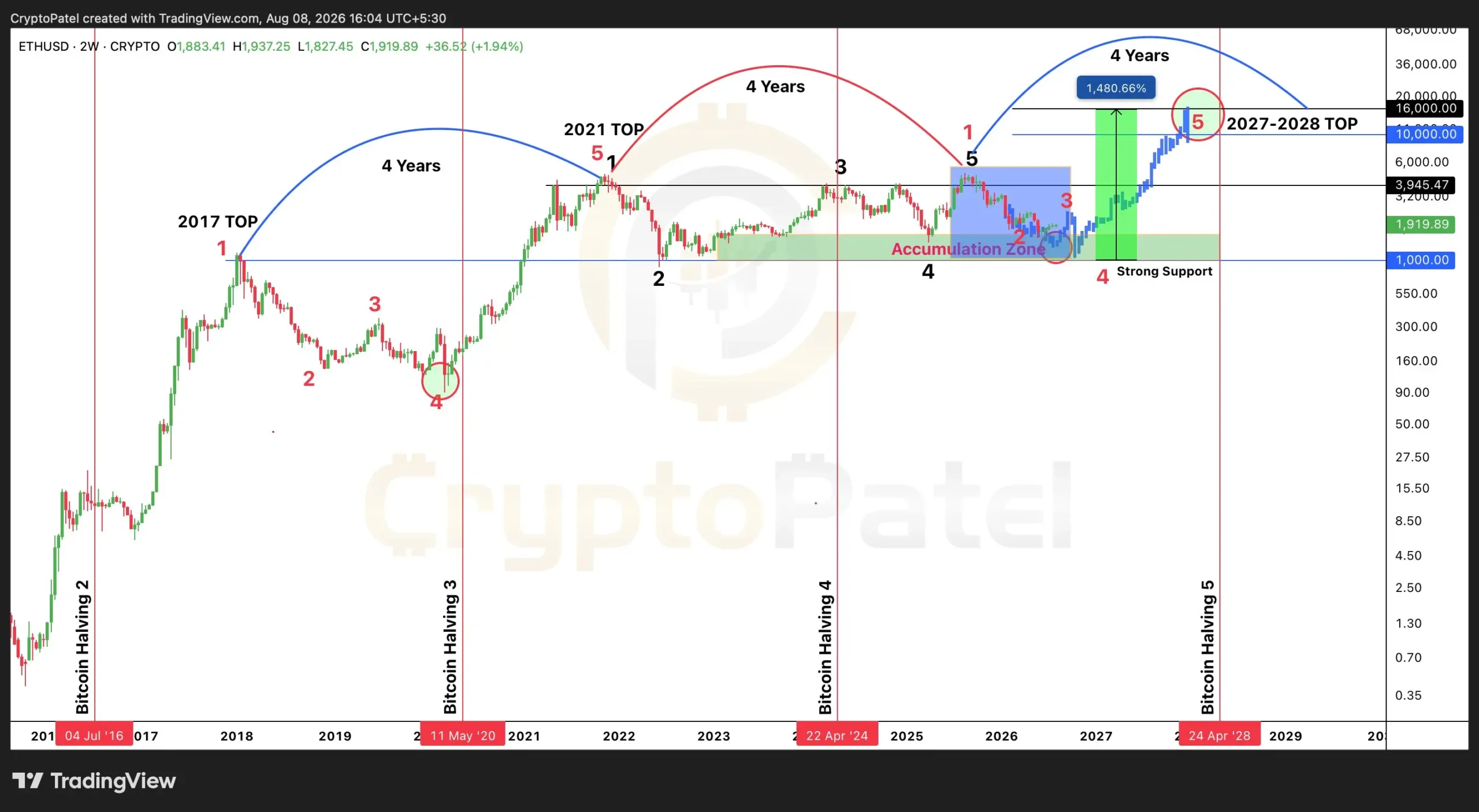
Market analyst Crypto Patel's long-term chart places Ethereum within a roughly four-year expansion pattern associated with earlier Bitcoin halving cycles. According to Patel, the latest correction held within a historically significant accumulation zone, helping preserve the broader technical structure.
Building on that setup, the chart identifies $1,000 to $1,500 as a major support range, while resistance sits near $4,000. If the structure continues to hold, Patel's fractal also maps a potential Wave 5 expansion toward $10,000 to $16,000.
Source: X
From Ethereum's price near $1,914, a move to $10,000 would require an increase of approximately 422%, while reaching $16,000 would represent roughly 736% upside. Patel described the scenario as a fractal-based projection rather than a guaranteed price forecast. The outlook therefore remains dependent on technical confirmation rather than expectation alone. For the bullish structure to stay intact, ETH would need to continue forming higher highs and higher lows while holding above its broader support range.
Ethereum Mainnet Fees Plunge 99% as Throughput Doubles
The technical structure is developing alongside a sharp reduction in transaction costs. Data presented by BMNR Bullz, citing Ambrosia & Mizrach, showed median mainnet fees falling dramatically. According to the report, Ethereum's median transaction fee dropped from more than $2 in January 2024 to below $0.02 by March 2026 — a reduction exceeding 99%. Mainnet throughput roughly doubled over the same period.
ETHEREUM MAINNET FEES HAVE FALLEN MORE THAN 99%
From January 2024 through March 2026, Ethereum's median mainnet transaction fee fell from more than $2 to below $0.02.
At the same time, mainnet throughput roughly doubled.
Median fee: $2 → $0.02 Reduction: 99% … pic.twitter.com/Q4T2sDOd4U
— BMNR Bullz (@BMNRBullz) August 8, 2026
Median fees across Layer 2 networks also declined by approximately 95% during the period. These L2 cost reductions align with Ethereum's multi-year rollup-centric roadmap, which received a major boost from the Dencun upgrade in March 2024. Dencun introduced proto-danksharding (EIP-4844), a mechanism designed to lower data availability costs for Layer 2 rollups by using temporary data blobs instead of permanent calldata storage. Together, these figures indicate that the network processed more activity while users paid substantially less for blockspace. Sustained low fees and higher throughput are relevant because they directly affect Ethereum's competitiveness relative to alternative Layer 1 blockchains that have historically marketed themselves on low-cost, high-throughput execution.
Ethereum ETFs Extend Inflow Streak to Five Straight Weeks
Institutional demand has strengthened through U.S. spot ETF products. SoSoValue data shared by BMNR Bullz showed $244.9 million in weekly net inflows through August 7, marking a fifth consecutive positive week. This followed approximately $273.3 million in net outflows during the week ending June 26.
Source: X
Subsequent weekly inflows reached about $84.4 million, $105.4 million, $103.9 million, $27.4 million, and $244.9 million. Cumulative U.S. spot Ethereum ETF net inflows stood at roughly $11.46 billion. Spot Ethereum ETFs began trading in July 2024 after SEC approval, making this cumulative figure a measure of institutional adoption over roughly two years of product availability. Whether the five-week inflow streak signals a durable shift in allocation patterns, as opposed to a cyclical response to price recovery, will be visible in subsequent flow data.
The broader institutional footprint extends beyond fund flows. BMNR Bullz also cited BlackRock and JPMorgan tokenization activity, a 52.5% tokenized-ETF share, and $148 billion in stablecoins. Tokenization of traditional financial assets on public blockchains has grown as a distinct institutional use case, with major asset managers issuing tokenized money market funds and treasury bill products. The combination of ETF inflows, stablecoin issuance, and tokenized securities points to overlapping demand streams that are measurable independently of spot price action.

