Ethereum Fees Fell 51% Year-on-Year While Activity and Staking Hit Record Highs, Bitwise Reports
Key Takeaways
- •Ethereum’s dollar-denominated network revenue fell from about $131 million in the second quarter of 2025 to roughly $64 million in the second quarter of 2026.
- •Ethereum processed 203.9 million transactions during the quarter, up from 121.1 million a year earlier.
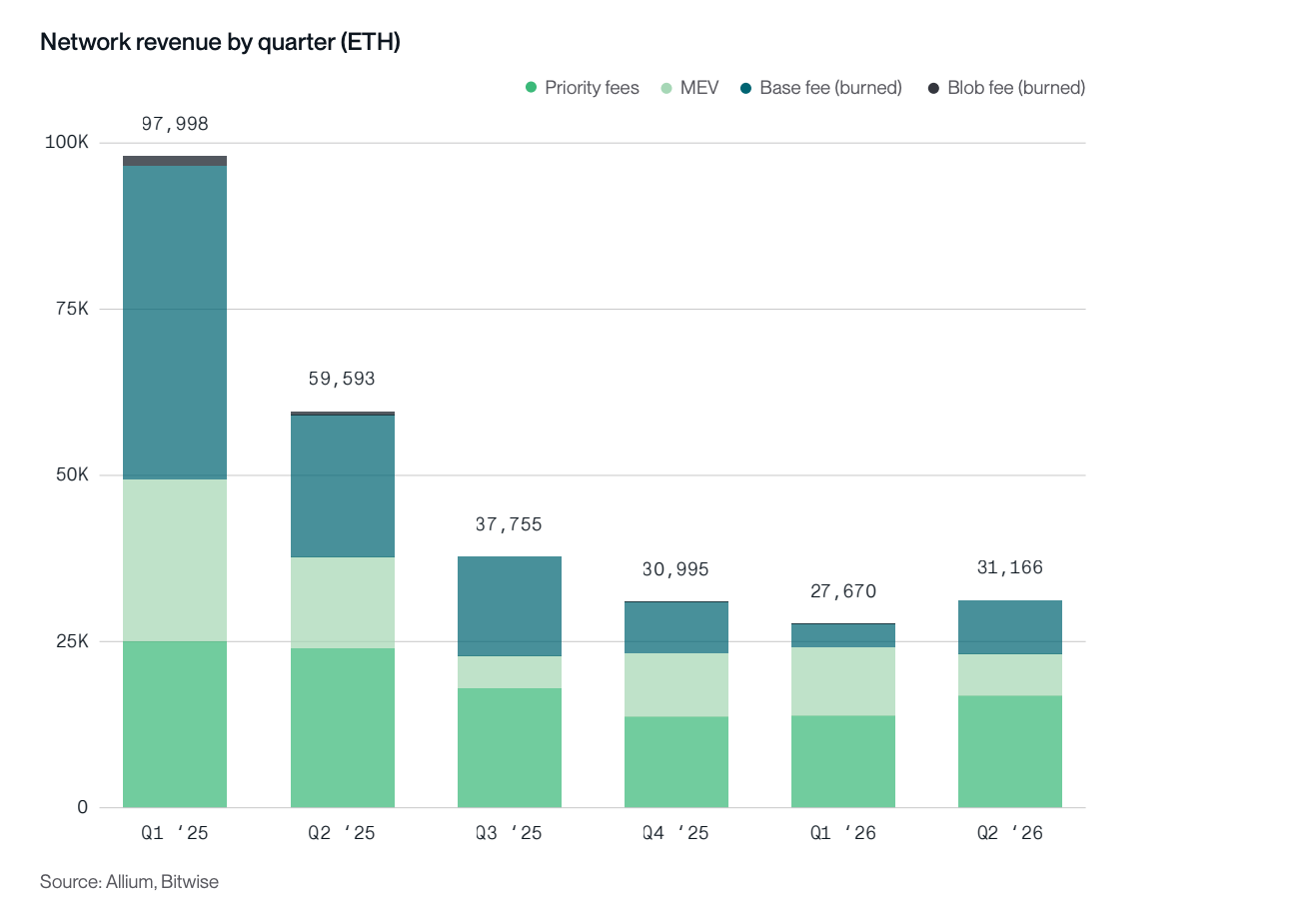
- •Revenue measured in ETH increased from 27,670 ETH in the first quarter to 31,166 ETH in the second quarter, marking the first quarterly rise in over a year.
- •Active Ethereum stake reached a record 40.2 million ETH, equal to about 33% of total supply.
- •Bitwise said similar trends appeared on Solana and Avalanche, where activity increased while dollar-denominated fee revenue declined.
Ethereum (ETH) network fee revenue fell 51% year-on-year to roughly $64 million in the second quarter of 2026, even as transaction activity surged and staking climbed to a new all-time high, according to a Bitwise report.
The asset manager attributed the decline to cheaper and more abundant blockspace rather than any waning interest in the network. Notably, when measured in ETH rather than US dollars, quarterly fee revenue actually rose for the first time in over a year. For Ethereum users, lower fees can make routine transfers, decentralized finance activity, and application interactions less costly, while fee revenue remains one of the key metrics analysts track when assessing network demand.
Activity Rises as Dollar Revenue Drops
Ethereum's network revenue stood at approximately $131 million in the second quarter of 2025. A year later, that figure had fallen to near $64 million — a sharp decline in dollar terms.
Usage, however, moved in the opposite direction. Ethereum processed 203.9 million transactions during the quarter, a substantial increase from 121.1 million a year earlier. Network throughput rose from 15 transactions per second to 26. This improvement coincided with Ethereum's block gas limit being raised to 60 million, increasing the amount of transaction computation that can fit into each block.
"The divergence between revenue and activity is the theme of the quarter. While fees fell, usage climbed," the Bitwise report stated.
Researchers at Bitwise explained that the gap stems from protocol-level design choices. By making blockspace cheaper and more plentiful, the network enabled users to pay less per individual transaction even as overall usage grew.
Dollar Decline Partly Reflects ETH Price Movement
The headline USD figure masked an important shift beneath the surface. Denominated in ETH, revenue increased from 27,670 ETH in the first quarter to 31,166 ETH in the second quarter. That represented the first quarterly increase in over a year. The dollar total declined primarily because the price of ETH weakened during the period.
Staking followed a similar upward trajectory. Active stake reached a record 40.2 million ETH, equivalent to approximately 33% of the total supply, amid continued institutional inflows. Ethereum staking is central to the network's proof-of-stake security model, with validators locking ETH to participate in block validation and earn protocol rewards.
Broader Industry Trend
The pattern of falling fees alongside rising activity extended beyond Ethereum. Solana (SOL) processed 9.8 billion non-voting transactions, near its all-time high, yet still saw dollar-denominated revenue decline. Avalanche (AVAX) handled 236 million transactions on its C-Chain, a significant increase from 58 million a year earlier.
Across these networks, the common driver was lower congestion rather than weaker adoption — reduced competition for blockspace translated directly into lower per-transaction costs for users. The figures underscore a broader shift in major smart-contract networks toward higher capacity and lower transaction costs, making raw fee revenue less useful on its own without corresponding activity, throughput, and token-denominated measures.

