Ethereum Drops 6% to $2,220 as Glamsterdam Upgrade Faces Delay Over Gas-Accounting Risks
Key Takeaways
- •Ethereum declined roughly 6% to around $2,220, and more than $210 million in leveraged positions were liquidated within 24 hours, including about $179 million in long positions.
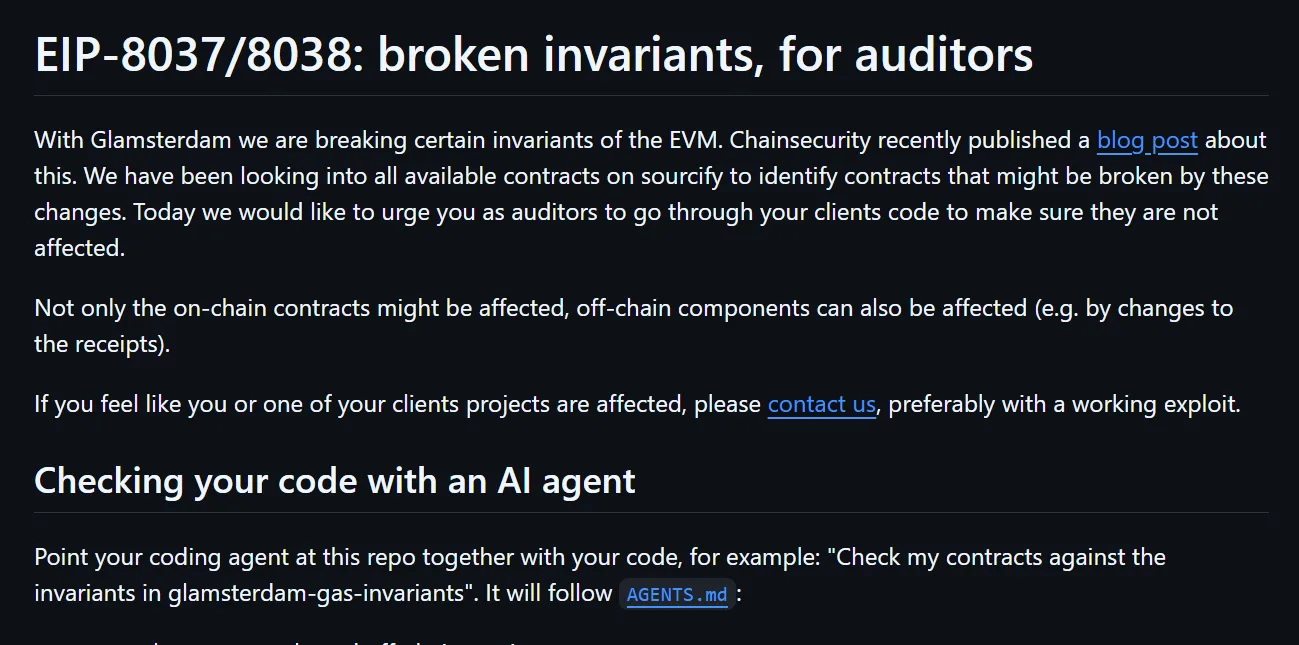
- •The Ethereum Foundation delayed Glamsterdam's activation on the Hoodi testnet after ChainSecurity identified eight smart-contract assumptions that the EIP-8037 and EIP-8038 gas-accounting changes could invalidate, with no new activation date announced.
- •US spot Ethereum ETFs recorded nearly $100 million in net outflows on November 5, including $75.2 million from BlackRock's ETHA and $22 million from ETHB.
- •Developers have started additional security reviews alongside auditing firms ChainSecurity and Dedaub and published a GitHub repository documenting the eight affected assumptions while requesting feedback from the ecosystem.
- •Asian equities sank on November 6 as semiconductor shares plunged, with the KOSPI closing down 6.02%, the Nikkei 225 down 5.96%, and Taiwan's TAIEX down 4.51%.
Ethereum (ETH) fell roughly 6% to around $2,220 as a broad market selloff swept through cryptocurrencies, while developers delayed the network's Glamsterdam upgrade after auditors flagged gas-accounting compatibility risks. The sell-off wiped out more than $210 million in leveraged Ethereum positions, and US spot Ethereum ETFs recorded nearly $100 million in outflows on November 5.
Asian Equities Sink as Semiconductor Shares Plunge
Losses in Asian stock markets deepened on Friday, Nov. 6, as semiconductor shares plunged across South Korea, Japan and Taiwan. South Korea briefly halted trading after the KOSPI fell more than 8% intraday, though the index recovered part of its losses to finish 6.02% lower. Japan's Nikkei 225 closed down 5.96%, while Taiwan's TAIEX declined 4.51%.
The declines followed a sharp retreat on Wall Street on Nov. 5, when investors reassessed artificial intelligence infrastructure spending. Bitcoin also traded below $76,000 during the broader sell-off in risk-sensitive assets.
Glamsterdam Delayed Over Smart Contract Risks
The Ethereum Foundation announced on November 6 that developers would delay Glamsterdam's activation on Hoodi after security firm ChainSecurity identified several projects that could face vulnerabilities following the upgrade. The concerns involve EIP-8037 and EIP-8038, which introduce changes to Ethereum's gas accounting system by adjusting transaction costs for creating blockchain state and accessing existing state. Because gas accounting determines the cost of operations across the network, revisions of this kind are typically vetted on a public testnet before any mainnet activation is scheduled.
ChainSecurity identified eight assumptions that existing smart contracts may rely on during transaction execution. The changes could invalidate these assumptions and cause some contracts to behave differently. Some contracts expect failed operations to consume specific amounts of gas; under the revised rules, additional gas could remain available, allowing certain transactions to continue when developers expected them to fail.
Ethereum's All Core Developers group decided to postpone the Hoodi hard fork until the concerns are addressed. The Foundation has not announced another activation date, leaving the upgrade's timeline tied to the outcome of the compatibility reviews now underway. The announcement was published on the Ethereum Foundation blog.
Developers Begin Security Reviews
Ethereum developers have started additional security checks alongside auditing firms ChainSecurity and Dedaub. The reviews will examine existing applications and determine whether the proposed changes require adjustments.
The Foundation also published a GitHub repository explaining the eight affected assumptions. Developers can use the examples and testing instructions to identify compatibility problems within their projects. Feedback has been requested from smart contract developers, auditors and infrastructure providers, as the Foundation's internal reviews cannot cover every application operating on Ethereum.
Meanwhile, development of Ethereum's next Hegota upgrade continues uninterrupted. Glamsterdam's broader technical plans include changes to block processing, gas pricing and transaction execution.
Liquidations Mount as ETF Outflows Rise
Ethereum traded near $2,220 on November 6 after losing its earlier recovery toward $2,450. The decline followed widespread selling across cryptocurrency markets and US technology stocks, with Bitcoin dropping toward $75,500 during the downturn. Investors reduced exposure to risk assets amid concerns about technology spending, borrowing costs and economic conditions.
According to CoinGlass, Ethereum liquidations exceeded $210 million within 24 hours, with long positions totaling about $179 million as leveraged traders faced forced closures. Such closures occur when exchanges automatically wind down leveraged positions after price moves erode the margin backing them. Lookonchain also covered the sell-off in a post on X.
US spot Ethereum ETFs recorded nearly $100 million in net withdrawals on November 5, meaning redemptions outpaced new creations that day. BlackRock's ETHA experienced $75.2 million in outflows, while ETHB registered another $22 million. CryptoQuant data also showed Ethereum derivatives open interest declining toward $11.4 billion. The figure stood near $16 billion in late September, indicating a reduction in outstanding derivatives positions.
ETH Tests $2,200 Support
Attention now centers on the $2,200 support level following the latest decline. ETH previously struggled to maintain momentum near $2,450 before sellers pushed prices lower, and technical indicators continue to reflect weak buying activity.
The Relative Strength Index, a momentum gauge read on a 0-to-100 scale, stood at 38.65, below the neutral 50 level but above the oversold threshold of 30. The MACD indicator, which tracks trend momentum by comparing moving averages, recorded a reading of -59.79, compared with its signal line at -60.77. Both readings remained negative despite a slightly positive histogram.
Ethereum faces immediate resistance around $2,350, followed by the $2,450 region. A recovery above these levels would bring the $2,500 resistance area into focus. Conversely, a sustained decline below $2,200 would expose support near $2,100 and $2,000.
This article provides market information, not investment advice. Stock and cryptocurrency prices can move sharply, and past performance does not predict future returns.
Source: The Market Periodical

