Ethereum Derivatives Hold $30.59 Billion in Futures Exposure as Long Liquidations Outpace Shorts
Key Takeaways
- •Ethereum futures open interest stood at $30.59 billion, or 12.63 million ETH, as of October 17 after a 0.42% daily decline, with Binance holding the largest venue share at $8.73 billion.
- •Liquidations skewed toward longs, with 3,222 long positions closed against 2,181 shorts over 24 hours and 2,651 longs against 876 shorts in the most recent 12-hour window, while positive funding near 0.0053 kept longs paying shorts.
- •Calls accounted for 61.75% of Ethereum options open interest, but 24-hour put volume of 420,513 ETH narrowly exceeded call volume of 414,521 ETH, reflecting balanced near-term flow.
- •Max pain levels diverged by exchange ahead of the October 30 expiry, with Deribit and Binance near $2,500 and OKX around $2,650, while Deribit's December 25 $3,200 call was the largest single position at 69,667 ETH.
- •CME options exposure contracted to roughly 50,000 ETH by October, down from more than 500,000 ETH earlier in 2026, marking a reduced institutional footprint alongside larger crypto-native futures markets.
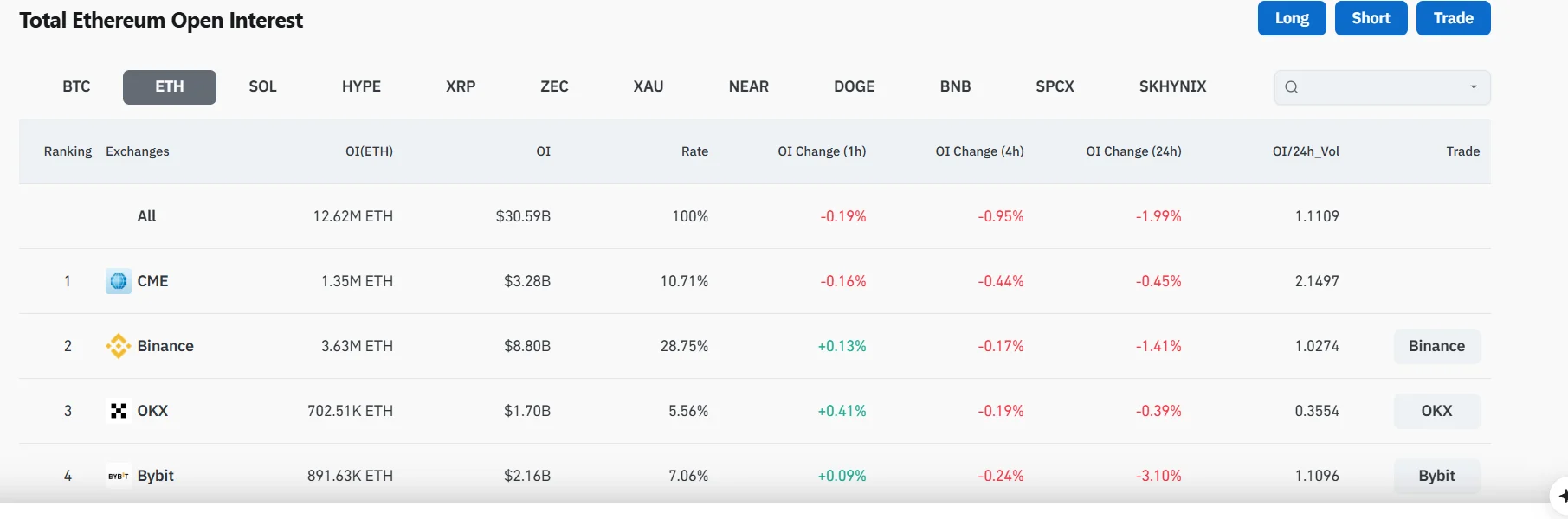
Ethereum derivatives carried $30.59 billion in futures open interest as of October 17, even as the aggregate futures book slipped 0.42% over the previous 24 hours, Blockonomi reported. The broader picture is mixed: options positioning remains tilted toward calls, but liquidations over both 24-hour and 12-hour windows struck more longs than shorts, and positive funding rates kept leveraged longs paying shorts.
ETH moved between $2,324 and $2,575 during the week and changed hands near $2,428 intraday on October 17. Calls accounted for 61.75% of outstanding options contracts, yet 24-hour put volume narrowly exceeded call volume — a combination that reflects substantial but divided positioning rather than one clear directional signal. The distinction matters because calls can serve hedging strategies, while elevated leverage leaves positions more vulnerable during sharp price moves.
Futures Open Interest Slips From $30.59 Billion
Outstanding Ethereum futures totaled 12.63 million ETH, valued at $30.59 billion, after a 0.42% daily decline. Open interest tracks active contracts rather than completed trades, so it measures capital still exposed to future price changes; on its own, it does not identify market direction. Its scale still matters for market mechanics: the larger the leveraged book, the more positions stand exposed to automatic closure when prices move sharply.
Binance held the largest share of the reported futures rankings at $8.73 billion, or 28.55% of the total. MEXC followed with $3.25 billion, narrowly ahead of CME at $3.24 billion. Hyperliquid carried $2.61 billion, Bybit $2.15 billion, and Bitget $2 billion, leaving liquidity spread across centralized platforms, a regulated exchange, and a perpetuals decentralized exchange (DEX).
Exchange-level trends were uneven. MEXC added 6.49% to its open interest and Bitget grew 1.22%, while Bitunix fell 11.27%, BingX lost 7.57%, Hyperliquid declined 1.70%, and CME contracted 1.11% — a pattern of selective rather than broad leverage growth. Dollar-denominated open interest can also shift with ETH's price even when contract quantities change less, a caveat when comparing venues.
Liquidations Skew Toward Longs
Despite the large aggregate book, recent liquidation data favored shorts. The market recorded 3,222 long liquidations against 2,181 short liquidations over 24 hours. The imbalance was wider in the most recent 12-hour window, with 2,651 longs liquidated against 876 shorts. Liquidations themselves are mechanical events: exchanges forcibly close leveraged positions when margin can no longer cover losses, and long liquidations mark long positions unwound as prices fall. Positive funding near 0.0053 meant longs continued paying shorts to maintain their positions. Funding is the periodic payment exchanged between holders of perpetual futures — derivative contracts without expiry dates — designed to keep their prices tethered to spot.
Options Book Tilts Toward Calls, but Flow Is Balanced
Ethereum options carried 1.59 million ETH in calls against 983,689 ETH in puts, giving calls a 61.75% share of open interest. The newest flow was nearly balanced, however: 24-hour volume reached 414,521 ETH in calls and 420,513 ETH in puts. The put–call volume split is a widely watched gauge of short-term positioning, though it captures fresh flow rather than accumulated exposure.
A call-heavy book does not prove that every holder expects an immediate rally. Traders can use calls to hedge short exposure or structure spreads. Put activity near spot remained visible, with Bybit's $2,100 and $2,200 puts leading several high-volume contracts, while $2,500 calls traded actively on Binance and Bybit.
Deribit's December 25 $3,200 call held the largest individual position at 69,667 ETH. The exchange's $2,200 call held 51,016 ETH, and an October 30 $2,600 call held 38,043 ETH. These positions span multiple price levels and expiries and do not amount to a single outright bullish view.
Max Pain Readings Diverge by Exchange
Options max pain levels differed across venues. For the October 30 expiry, Deribit and Binance pointed to $2,500, while OKX stood near $2,650. For December 25, Deribit showed $2,200, OKX $2,300, and Binance $2,500. Max pain is a theoretical payout-minimizing level, not a market-wide price target. With the October 30 expiry less than two weeks from the data date, that cross-venue spread serves as a reference point for how options books stand heading into settlement.
CME Options Footprint Contracts
CME options exposure had declined toward 50,000 ETH by October, down from above 500,000 ETH earlier in 2026. Its dollar position readings fell to near $10 million after exceeding $70 million in late 2025, leaving Ethereum derivatives divided between a reduced institutional options footprint on CME and larger crypto-native futures markets.
Taken together, the data depict a market carrying substantial open exposure and call-tilted options positioning, with recent liquidation and funding metrics weighing on leveraged longs — but without a unified directional signal.
Source: Blockonomi

