Ethereum Classic Price Outlook for 2026–2030: Network Development, Risks and Market Scenarios
Key Takeaways
- •Ethereum Classic continues to secure its network with Proof of Work, distinguishing it from Ethereum, which completed its transition to Proof of Stake in September 2022.
- •ETC's theoretical maximum supply is approximately 210.7 million tokens under the ECIP-1017 monetary policy, whose 5M20 schedule reduces block rewards by 20% every five million blocks.
- •Historical data shows ETC fell to roughly $0.45 in July 2016 before peaking at $176.16 in May 2021, and a return to that high would imply a market valuation near $28 billion.
- •The proposed Olympia upgrade would redirect base transaction fees to an on-chain treasury rather than burn them, meaning it would not automatically make ETC deflationary.
- •Ethereum Classic experienced documented 51% attack incidents in 2019 and 2020, underscoring the importance of hashrate and mining security to its long-term viability.
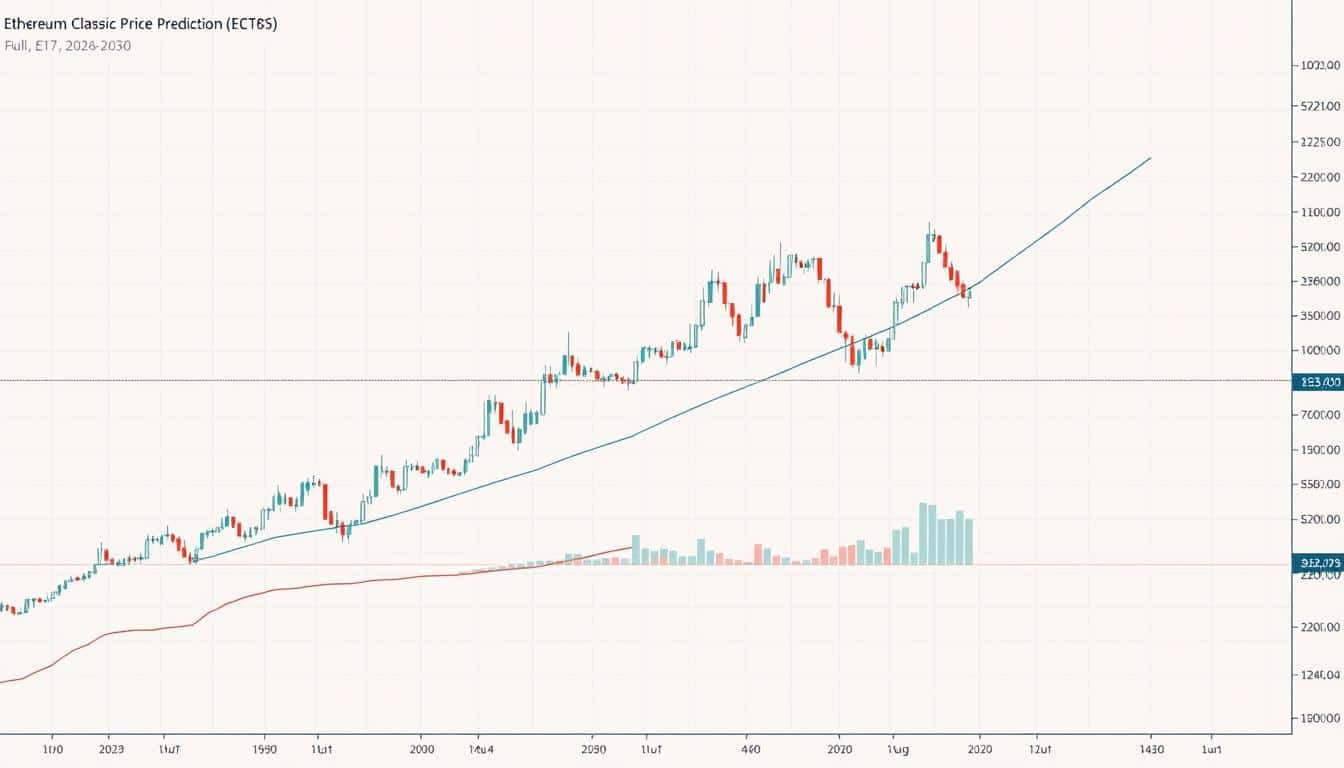
Ethereum Classic (ETC) remains a distinct smart-contract blockchain because it continues to use Proof of Work while Ethereum uses Proof of Stake. Its price outlook for 2026–2030 will depend on broader cryptocurrency-market conditions, network adoption, mining economics, monetary policy, ecosystem development and regulatory changes.
As of November 11, 2026, ETC traded at approximately $6.71. Its market capitalization was around $1.07 billion, based on a circulating supply of approximately 158.98 million ETC. The network’s theoretical maximum supply is approximately 210.7 million ETC. These figures are market-data references and can change continuously.
A sustained recovery would require stronger network activity, healthy miner participation, improved ecosystem development and renewed demand for Proof-of-Work smart-contract platforms. Competition from other networks, security concerns, regulatory changes and weakness across the broader cryptocurrency market could limit growth. Individual price targets should not be treated as guaranteed outcomes; bullish, neutral and bearish scenarios provide a more appropriate framework for examining ETC through 2030.
Ethereum Classic in Brief
Ethereum Classic is an open-source, decentralized blockchain that supports smart contracts and decentralized applications. Its native cryptocurrency, ETC, is used to pay transaction fees and reward miners that secure the network.
The project originated from the original Ethereum blockchain and continued operating after the controversial DAO incident and the 2016 Ethereum hard fork. Ethereum Classic and Ethereum subsequently developed separate communities, technical roadmaps and monetary policies. Ethereum Classic retained the original chain’s emphasis on transaction immutability and decentralized operation. That stance is often summarized by the phrase “code is law”: the principle that recorded blockchain history should stand as written, even when individual transactions stem from errors or exploits.
Ethereum Classic supports transaction payments, smart-contract execution and mining incentives. Unlike Ethereum, which completed its transition to Proof of Stake in September 2022, Ethereum Classic continues to use Proof of Work. That difference is central to the network’s identity and may be relevant to users and market participants who prefer a mining-based security model. The distinction became especially visible in 2022, when Ethereum’s move away from mining redirected significant graphics-card hash power toward other Proof-of-Work networks, including Ethereum Classic.
Ethereum Classic Compared With Ethereum
The two networks share historical origins and similar smart-contract capabilities, but they are separate blockchains. Ethereum Classic appeals to users who prefer a Proof-of-Work smart-contract network, while Ethereum has a substantially different ecosystem and development strategy. Those differences can affect developer interest, network activity, investment demand and each asset’s long-term competitive position.
Additional background is available in the Solana versus Ethereum comparison and Coinbase’s explanation of the difference between Ethereum and Ethereum Classic.
How Proof of Work Supports ETC
Proof of Work requires miners to use computational resources to validate transactions and produce new blocks. Ethereum Classic miners compete to solve cryptographic problems, and successful miners receive block rewards and applicable transaction fees. The process secures the network without relying on token staking. Ethereum Classic has also revised its mining algorithm over time, moving from Ethash to Etchash, to keep mining practical on widely used graphics-card hardware.
Proof of Work also creates operating requirements. Mining businesses must generate enough revenue to pay for electricity, hardware, maintenance and other costs. If ETC’s market value or mining revenue falls substantially, some miners may become less willing to support the chain. Mining economics, network hashrate and miner participation are therefore important components of any long-term ETC assessment.
Current Price and Market Performance
The November 11, 2026 reference price was approximately $6.71. At that price, ETC’s market capitalization was approximately $1.07 billion, using a circulating supply of roughly 158.98 million ETC. The figures provide a starting point for evaluating the asset’s market position, but cryptocurrency prices and market statistics change continuously.
Market capitalization is calculated by multiplying the circulating supply by the current price. Using the reference figures:
$6.71 × 158.98 million ETC = approximately $1.07 billion.
Trading volume measures the amount or value of ETC exchanged over a given period. Higher volume can indicate stronger participation, but it does not by itself prove accumulation. Volume should be considered alongside price direction, liquidity, order-book depth and overall market conditions. Broader market data can be reviewed through Forbes’ cryptocurrency price data.
Historical Price Performance
According to the referenced CoinMarketCap historical data, ETC recorded a low of approximately $0.4524 in July 2016 and reached a high of $176.16 in May 2021. The 2021 peak occurred during a broader cryptocurrency-market expansion, after which ETC experienced substantial corrections.
The historical record shows that ETC can make major upward moves during favorable market cycles, but it can also decline sharply when market conditions weaken. Returning to the historical high would require significantly greater buying demand and a much higher market valuation than the November 2026 reference level. Historical highs are therefore reference points, not guaranteed future targets.
Technical Indicators Used in ETC Analysis
Technical analysis can help assess market direction, momentum and possible support or resistance areas, although no single indicator reliably predicts price.
- Relative Strength Index: RSI measures the speed and magnitude of recent price movements. Readings above 70 are traditionally considered overbought and readings below 30 oversold, but those thresholds are not standalone trading signals.
- Moving averages: The 50-day and 200-day moving averages are commonly used to examine medium- and long-term trends. A sustained move above them may indicate improving momentum.
- Trading volume: Volume accompanying a breakout can provide evidence of broader participation.
- Support and resistance: Support is an area where buying interest has previously emerged, while resistance is an area where selling pressure has increased.
- Market structure: Higher highs and higher lows can indicate an improving trend; lower highs and lower lows may indicate continued weakness.
Daily and weekly charts generally provide more context than a single short-term indicator.
ETC Scenarios for 2026
The 2026 outlook depends on whether the cryptocurrency market can establish a sustainable recovery and whether ETC can attract additional demand. At approximately $6.71, ETC remained considerably below its historical high. That gap may create recovery potential, but it also reflects the risks of an asset that has experienced substantial long-term depreciation.
Bullish Scenario
A bullish outcome would require improving market conditions, stronger demand for ETC, greater network activity and continued ecosystem development. Higher trading volume, deeper liquidity and sustained miner participation could support a recovery. If these conditions emerged together, ETC could trade above its recent market levels.
Neutral Scenario
A neutral scenario assumes that ETC continues moving through market cycles without a major improvement in adoption or demand. The token could experience temporary rallies followed by corrections, with its performance remaining closely linked to broader cryptocurrency conditions.
Bearish Scenario
A bearish scenario could develop if cryptocurrency demand weakens, competing networks attract more developers or mining becomes less economically attractive. Reduced liquidity and selling pressure could push ETC toward lower price levels.
These are analytical frameworks rather than verified forecasts, analyst consensus or guaranteed price ranges.
Important indicators for 2026 include Bitcoin and overall cryptocurrency performance, ETC trading volume and liquidity, miner participation and hashrate, smart-contract activity, decentralized-application development, progress on proposed network upgrades, digital-asset regulation, institutional disclosures and investment-product activity. No individual development guarantees a positive price reaction.
2027–2028: Development, Adoption and Olympia
The 2027–2028 outlook will depend heavily on whether Ethereum Classic can convert technical development into measurable ecosystem growth. Technology improvements may improve competitiveness, but they do not automatically create token demand. Development, adoption, transaction activity and market value must be considered together.
Olympia is a proposed Ethereum Classic upgrade focused on fee-market improvements, protocol funding and governance. Its proposals include EIP-1559-style transaction fees, an on-chain treasury and a governance framework. Olympia differs from Ethereum’s implementation of EIP-1559: Ethereum burns its base transaction fee, permanently removing that portion from circulation, while Olympia proposes redirecting the base fee to a treasury mechanism.
It would therefore be inaccurate to state that Olympia automatically makes ETC deflationary. Its potential effects would depend on implementation, community agreement, security testing and the effectiveness of its governance structure. Proposed upgrades should not be treated as activated before their implementation status is verified. Relevant proposals can be followed through the Ethereum Classic ECIP materials. The wider Ethereum ecosystem is also evolving, including the Prague-Electra upgrade.
Long-term adoption can be evaluated through active addresses, transaction activity, deployed smart contracts, decentralized-application use, network hashrate, mining participation, exchange liquidity, trading activity, developer contributions and client maintenance. Consistent improvement in these indicators could strengthen the case for ETC, while declining usage and limited developer activity could make competition more difficult.
2030 Outlook and Potential Growth Areas
The 2030 outlook is especially uncertain because technological, economic and regulatory conditions cannot be known in advance. ETC’s Proof-of-Work consensus, established blockchain history, smart-contract functionality and capped monetary policy could support continued relevance, but these characteristics alone cannot establish a future price.
Potential areas of support include continued demand for Proof of Work, additional applications and infrastructure, greater developer participation, predictable monetary policy and improved client and network maintenance. Ethereum Classic follows the 5M20 emission schedule, which reduces block rewards by 20% every five million blocks. The schedule creates declining issuance and a theoretical maximum supply of approximately 210.7 million ETC while continuing to reward miners.
Actual adoption should be measured through on-chain activity rather than announcements alone. The effect of infrastructure improvements on price would depend on execution and market demand.
Risks and Challenges
Ethereum Classic competes with Ethereum and other smart-contract platforms for developers, applications, users and investment capital. Larger ecosystems may have an advantage in attracting participants.
Proof-of-Work networks must maintain sufficient mining security. Ethereum Classic has experienced historical chain reorganizations and 51% attack incidents, including documented episodes in 2019 and 2020, underscoring the importance of hashrate and network security.
A blockchain may maintain its technical infrastructure without achieving significant user growth. If ETC does not attract meaningful application activity, long-term demand could remain limited. Regulatory approaches to trading, custody, taxation and institutional participation also differ across jurisdictions, and unfavorable changes could affect market access.
Even established cryptocurrencies can experience substantial declines during market downturns. Long-term projections must account for the possibility of prolonged corrections.
Market Capitalization and Higher Price Levels
Market capitalization helps illustrate the scale of demand required for higher token prices. At the November 2026 reference price of $6.71, ETC’s circulating market capitalization was approximately $1.07 billion. Assuming a circulating supply of approximately 158.98 million ETC, a price of $100 would imply a market capitalization of roughly $15.9 billion. A return to the historical high of $176.16 would imply approximately $28 billion.
These are mathematical illustrations, not predictions. Future circulating supply and market capitalization may differ. Such valuations would require substantial market demand, stronger ecosystem development and favorable broader cryptocurrency conditions.
Monetary Policy, Security and Demand
Ethereum Classic’s monetary policy follows ECIP-1017, which established a declining block-reward schedule. Under the 5M20 model, rewards decrease by 20% after every five million blocks, gradually reducing new ETC issuance. The theoretical maximum supply is approximately 210.7 million ETC.
Limited supply may contribute to scarcity, but scarcity alone does not guarantee appreciation. Demand must remain stable or grow relative to available supply. The original Ethereum Classic monetary-policy proposal provides technical details.
Mining sustainability depends on ETC’s market price, block rewards, transaction fees, hardware efficiency, electricity costs, network difficulty and hashrate. A stronger market can improve mining profitability, although conditions differ among operators. If mining becomes unprofitable for a substantial share of participants, hashrate could weaken, creating implications for network security.
Ethereum Classic also needs users and developers to create meaningful economic activity. Its smart-contract functionality allows decentralized applications and other blockchain services to be built on the network. Metrics such as repositories, deployed applications and transaction activity can help determine whether adoption is improving.
Regulation can affect accessibility, investor confidence and institutional participation. Clearer requirements may encourage some financial institutions to develop digital-asset services, but institutional demand should not be assumed merely because ETC is established or listed on major exchanges. Verifiable disclosures, investment-product filings, custody developments and actual trading activity should be assessed individually.
Bitcoin market cycles, Ethereum demand, interest rates, liquidity and risk appetite can all affect ETC. Improvements within Ethereum Classic would not necessarily prevent a decline if the wider market entered a correction, while a broad recovery could increase demand for alternative cryptocurrencies.
Investment Considerations
Ethereum Classic may appeal to people seeking exposure to an established Proof-of-Work smart-contract blockchain. Its potential advantages include an independent history since the 2016 split, a mining-based security model, a theoretical maximum supply of approximately 210.7 million ETC, smart-contract functionality and an established trading history across multiple cryptocurrency exchanges.
However, ETC remains volatile. Competition, security incidents, limited adoption, regulatory uncertainty and changes in mining profitability are material risks. Risk-management considerations include avoiding money needed for essential expenses, avoiding excessive leverage, considering diversification, assessing liquidity before large transactions, monitoring network security and development, and revisiting assumptions as market conditions change.
Dollar-cost averaging, trend-following, support-and-resistance analysis and portfolio diversification are commonly used approaches, but no strategy guarantees profits. Short-term traders may focus on technical indicators, while long-term participants may place more emphasis on adoption, security and monetary policy. A separate guide to buying Ethereum provides general background on purchasing digital assets.
Frequently Asked Questions
What is the ETC outlook for 2026?
It depends on demand, liquidity, network activity and investor sentiment. A bullish scenario could involve a recovery in market value, while a bearish scenario could produce further declines. Current market data and multiple scenarios are preferable to a guaranteed target.
Can Ethereum Classic reach $100?
It could theoretically reach $100, but at approximately 158.98 million circulating ETC, that price would imply a market capitalization of roughly $15.9 billion. This is a calculation, not a prediction.
What could affect ETC in 2027 and 2028?
Network development, mining participation, ecosystem adoption and broader market conditions will be important. Olympia could affect development and governance if implemented, but its effects would depend on actual usage and implementation.
What is the 2030 outlook?
The 2030 outlook depends on whether Ethereum Classic maintains a competitive position and attracts sustainable demand. Proof of Work and capped issuance distinguish ETC, but neither guarantees long-term appreciation.
Does ETC have a maximum supply?
Yes. Its theoretical maximum supply is approximately 210.7 million ETC, and the 5M20 schedule reduces rewards by 20% every five million blocks.
Is Ethereum Classic deflationary?
ETC has declining issuance, but declining issuance does not automatically make it deflationary. Olympia’s proposed fee mechanism would redirect base fees to a treasury rather than automatically destroy them.
What are the main risks?
The principal risks include market volatility, competition, security vulnerabilities, limited adoption, regulatory uncertainty and changes in mining profitability.
Conclusion
Ethereum Classic’s 2026–2030 outlook depends on more than historical prices or optimistic forecasts. Its Proof-of-Work consensus, smart-contract functionality, established history and capped monetary policy distinguish it within the blockchain sector. Its long-term position will nevertheless depend on attracting developers, users, miners and sustained market demand.
Olympia warrants attention because its proposed fee-market, treasury and governance mechanisms could influence future development. Its implementation status and final design should be verified before assessing its effects. ETC should be evaluated through multiple scenarios rather than on the assumption that previous highs will return. Adoption and favorable market conditions could support recovery, while competition, security challenges and declining demand could create additional downside pressure.
This article is for informational and educational purposes only and does not constitute financial, investment or trading advice. Cryptocurrency prices are highly volatile, and past performance does not guarantee future results. The original post, “Ethereum Classic Price Prediction 2026–2030: ETC Forecast,” first appeared on Cryptsy and was written by Ethan Blackburn.

