Ethereum risks slide toward $1,970 as Vitalik Buterin questions ETH fee-burning narrative
Key Takeaways
- •Vitalik Buterin argued in a Sunday post on X that Ethereum's investment appeal should center on functioning as a secure, decentralized store of value rather than on the amount of ETH removed through transaction-fee burning.
- •Buterin said EIP-1559 and its burn mechanism should be retained, but there is no cause for disappointment if fee burn stays below 10% of breakeven indefinitely because the value of ETH comes from elsewhere.
- •Buterin warned that prioritizing higher fee revenue could incentivize elevated transaction costs, greater protocol spending, and more interventionist governance, undermining the decentralization and neutrality that distinguish Ethereum, while framing CROPS-driven stability as increasingly valuable in an era of AI disruption.
- •Bitmine Immersion Technologies purchased an additional 9,587 ETH over the previous week, raising its holdings to approximately 6.07 million ETH, about 4.97% of Ethereum's estimated 122.2 million circulating supply, and it maintains roughly 5.227 million ETH staked through its MAVAN network.
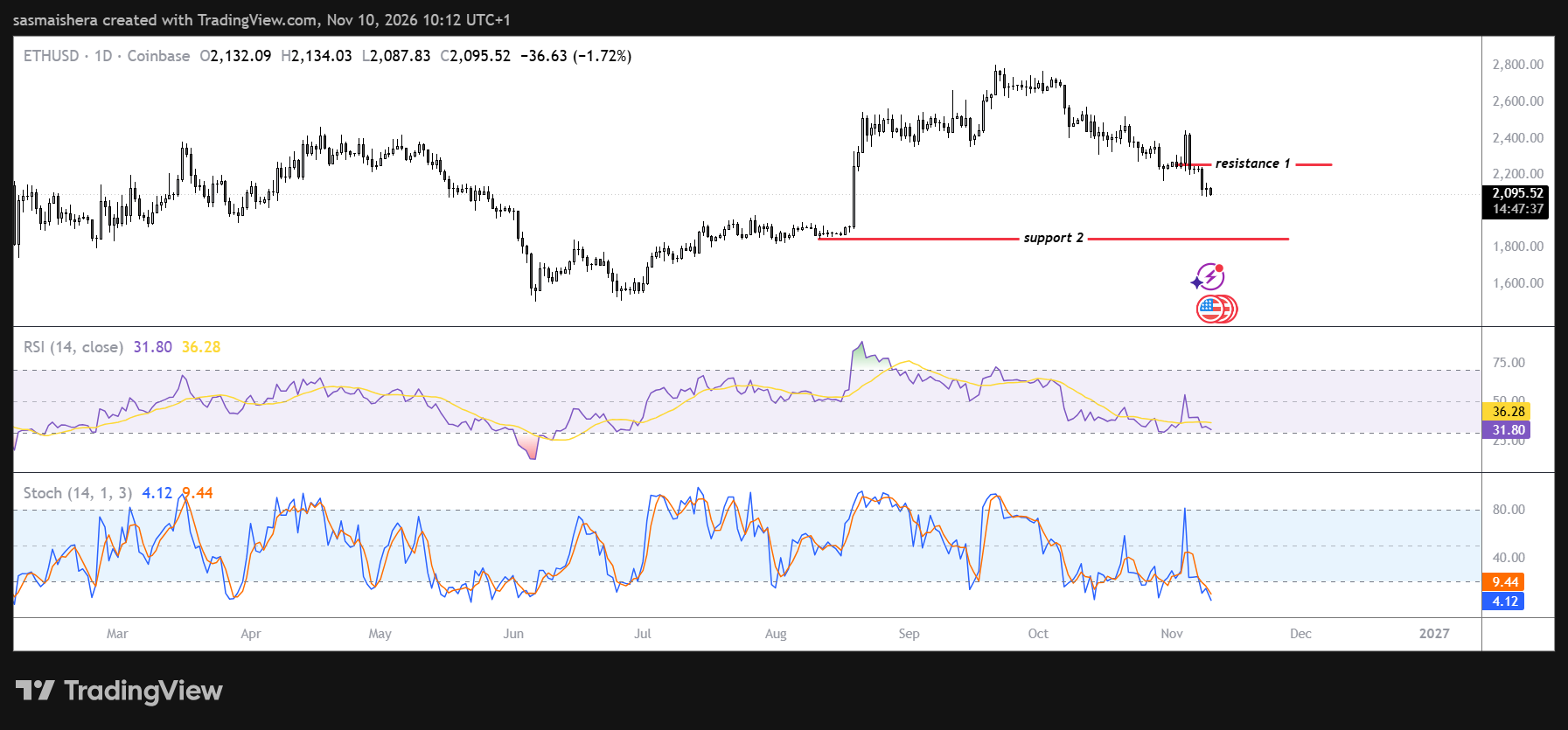
- •Ethereum's technical setup remains bearish with the token trading below its 20-, 50-, and 100-day EMAs near $2,291-$2,371, and a decisive break below the $2,101 support could accelerate declines toward $1,971 and potentially $1,827, while initial resistance sits at $2,204.
Ethereum (ETH) ticked higher on Tuesday, stabilizing after renewed selling pressure a day earlier, as investors weighed a debate over the network's long-term value proposition triggered by comments from co-founder Vitalik Buterin.
The token was up 1.3% on the day, a modest recovery that unfolded against the backdrop of an increasingly prominent dispute over whether Ethereum's investment case should rest on fee burning or on its credentials as a decentralized store of value.
Buterin argues ETH's value lies beyond fee burning
Buterin contended that Ethereum's investment appeal should rest primarily on its ability to function as a secure, decentralized store of value, rather than on the quantity of ETH permanently removed from circulation through transaction-fee burning.
In a post on X published on Sunday, he set out three reasons for favoring the store-of-value framing: the fee-burning thesis "never was as strong as it seemed"; optimizing for fee burning would require Ethereum and ETH to function in ways that are very hard to reconcile with decentralization and capture resistance; and pursuing the store-of-value angle aligns with the network's distinctive strengths of decentralization and what he refers to as CROPS.
He added that EIP-1559, including its burn mechanism, is "fine and good" and should be kept, but argued there is no cause for disappointment if fee burn remains below 10% of breakeven indefinitely, because "the value of ETH comes from elsewhere."
The full post, preserved verbatim from X:
Expanding on why I believe “ETH as store of value (SoV)” makes much more sense to focus on than “ETH as fee-burning token”. Three primary reasons: 1. ETH as fee-burning token never was as strong as it seemed 2. Optimizing for ETH as fee-burning token would demand Ethereum and ETH function in ways that are very hard to make compatible with decentralization and capture resistance. 3. Meanwhile, optimizing for ETH as SoV is aligned with Ethereum focusing on its unique strengths (decentralization and CROPS) EIP-1559 (including its burn) is fine and good, we should keep them. But we should not feel sad if fee burn is < 10% of breakeven indefinitely; the value of ETH comes from elsewhere. The core idea: the big thing that people appreciate about Ethereum is decentralization and CROPS. The main pragmatic benefit that these things translate into is stability. SoV is the category where that is not an unneeded extra we merely put effort into for ideological reasons, but rather a pragmatic strength from the perspective of people putting in their assets. And in the era of AI disruption, stability will be highly valued.
— vitalik.eth (@VitalikButerin) November 8, 2026
Fee burning has anchored a significant portion of Ethereum's investment narrative since EIP-1559 went live in August 2021. The upgrade introduced a mechanism that permanently removes the base transaction fee from circulation, shrinking the amount of ETH available in the market. During stretches of elevated network activity, burned fees can exceed new token issuance, temporarily rendering Ethereum's supply deflationary.
The distinction between the two framings carries practical weight for ETH holders: under the fee-burning view, scarcity hinges on how much supply the network removes, while under the store-of-value view, the emphasis shifts to the durability of the network's security and decentralization guarantees.
Buterin, however, suggested that investors have attached too much weight to fee burning as a measure of Ethereum's economic value. He explained that much of the network's historical transaction-fee revenue originated from cryptocurrency-related activities, leaving it closely tied to the broader digital asset market.
He further warned that prioritizing higher fee revenue could create incentives for elevated transaction costs, greater protocol spending and more interventionist governance — developments that could undermine the decentralization and neutrality that distinguish Ethereum from traditional financial infrastructure.
Instead, he argued that Ethereum's long-term value should be anchored in its fundamental properties, particularly as artificial intelligence development accelerates. He highlighted a framework known as CROPS, representing censorship and capture resistance, open source, privacy and security, and said these characteristics could become increasingly important in a world where AI systems play a greater role in financial transactions and digital infrastructure. In his view, decentralization and CROPS translate into one pragmatic benefit above all: stability — a quality he expects to be highly valued in an era of AI disruption.
Whether the wider Ethereum community and its protocol stakeholders adopt this reframing in future debates over the network's economic direction remains an open question.
Bitmine's Ethereum treasury reaches 6.07 million ETH
Bitmine Immersion Technologies announced on Monday, in a post on X, that it acquired an additional 9,587 ETH over the previous week, lifting its total holdings to approximately 6.07 million tokens.
The company's Ethereum treasury now represents roughly 4.97% of the cryptocurrency's estimated circulating supply of 122.2 million ETH, moving Bitmine closer to its stated objective of accumulating 5% of Ethereum's total circulating supply. At the cited supply estimate, only about 36,600 ETH separate the company from that milestone.
Beyond its holdings, the company reported maintaining approximately 5.227 million ETH in staking positions through its Made in America Validator Network (MAVAN). Staking involves committing ETH to validator duties that support the network's operation, and staked tokens are subject to the protocol's activation and exit processes rather than being freely available for immediate trading.
Technical outlook: bears target the $1,971 support
Ethereum's technical setup remains bearish, with the cryptocurrency trading below its major Exponential Moving Averages (EMAs), trend-following averages that weight recent prices more heavily. On the daily chart, ETH sits beneath its 20-day, 50-day and 100-day EMAs, which are clustered between approximately $2,291 and $2,371. That positioning suggests sellers continue to dominate the broader market structure, with recovery attempts likely to encounter resistance.
Momentum indicators reinforce the negative reading. The 14-day Relative Strength Index (RSI), a momentum gauge scaled from zero to 100, hovers near 31, indicating weak buying momentum and placing Ethereum near oversold territory, while the Stochastic Oscillator stands near 9, reflecting more pronounced oversold conditions.
On the downside, immediate support sits around $2,101. A decisive breakdown below this level could accelerate the decline toward $1,971, the next significant support zone. If sellers maintain control and ETH fails to stabilize around $1,971, the correction could extend toward $1,827.
Despite the prevailing bearish conditions, Ethereum could attempt a short-term rebound if buyers begin accumulating around current support levels. The first significant resistance stands at $2,204, a level ETH would need to reclaim to establish an initial improvement in momentum. A sustained recovery above that barrier could open the door to a move toward $2,250, followed by the 20-day EMA near $2,291.
Additional resistance is concentrated around the 100-day EMA and the $2,355–$2,371 region, forming a substantial overhead supply zone. A convincing breakout above this cluster would represent a more meaningful improvement in Ethereum's technical outlook and could indicate that selling pressure is beginning to weaken. Against that backdrop, the immediate watchpoints are how ETH behaves around the $2,101–$2,204 band and whether the oversold momentum readings begin to reset.
This article was originally published by CoinJournal.

