Ethereum Tests $2,550 After 60.62% Q3 Rally
Key Takeaways
- •Ethereum’s third-quarter gain reached 60.62%, following declines of 29.26% in Q1 and 25.28% in Q2.
- •A weekly close above $2,550 would move ETH back above its 50-week simple moving average and strengthen the recovery structure.
- •Key downside references include the 50-week exponential moving average near $2,381.81, followed by support around $2,210 and $1,965.22.
- •Market data indicated that leverage unwinding and position clearing contributed more to Ethereum’s latest decline than direct spot selling.
- •Traders were reducing leverage ahead of the Federal Reserve decision, with thin weekend liquidity amplifying position exits.
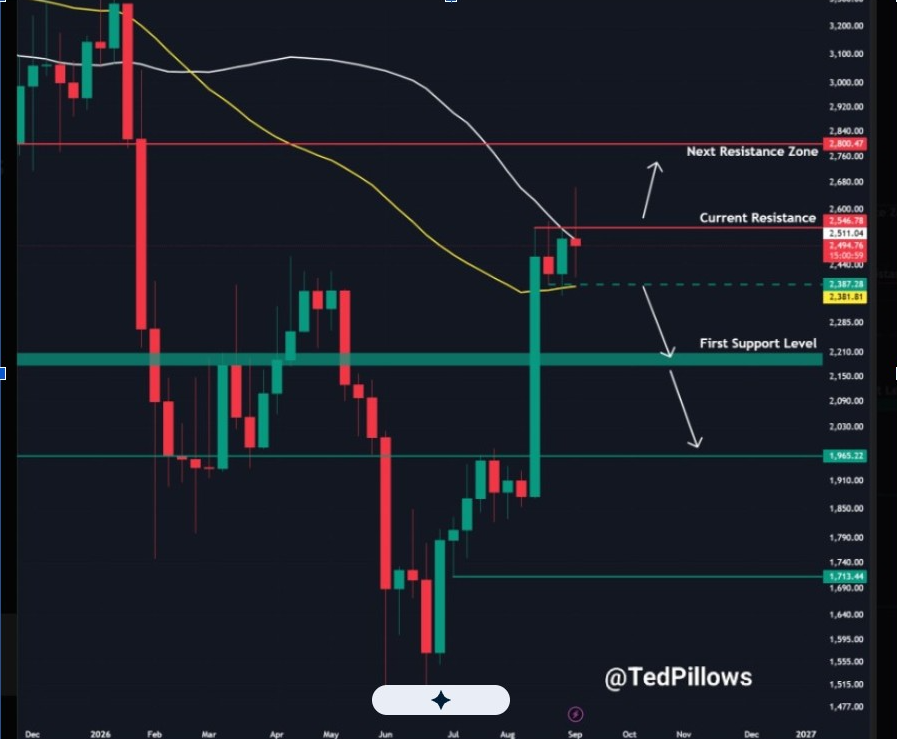
Ethereum traded near $2,513 on Sept. 14 after recovering above $2,500, as traders focused on resistance around $2,550 ahead of a Federal Reserve decision. Ether remains up about 60% in the third quarter despite retreating from a recent move toward $2,600.
The rebound followed two weak quarters earlier in 2026. ETH fell 29.26% in Q1 and another 25.28% in Q2 before reversing higher during the current quarter. A weekly close above $2,550 could reinforce the recovery structure, while a failure to hold $2,500 would keep lower support levels in focus.
$2,550 Weekly Close Remains in Focus
Ethereum reached a session high near $2,666 before moving back below $2,600. The weekly candle was trading near $2,494.76, leaving the $2,550 region as the nearest major barrier.
A weekly close above $2,550 would place ETH back above the 50-week simple moving average, which was near $2,511.04. If buyers regain control above that level, the next marked upside zone is around $2,800.47.
On the downside, the 50-week exponential moving average stood near $2,381.81, with another nearby reference level around $2,387. A deeper pullback could bring the $2,210 area into focus, followed by lower support near $1,965.22.
Q3 Gain Reaches 60.62% After Weak First Half
Ethereum’s price has risen 60.62% so far in Q3, according to Coinglass data, making it the asset’s second-best third-quarter performance in that dataset. Only Q3 2025 was stronger, when ETH gained 66.55%.
The current advance is also well above Ethereum’s historical Q3 average return of 12.28% and median return of 9.87%. ETH gained 59.5% in Q3 2020 and 31.86% in 2021, while it lost 48.69% in 2018. The third quarter also produced losses of 37.43% in 2019, 24.19% in 2024, and 13.64% in 2023.
The 2026 move therefore ranks near the top of Ethereum’s third-quarter history, although the quarter is not yet complete. The current figure reflects returns through the latest session rather than the final quarterly close, and price action during the rest of September will determine the completed Q3 result.
Pullback Develops as Leverage Unwinds
Ethereum’s latest decline occurred amid thin weekend liquidity and substantial position clearing. Market data from the move pointed to leverage unwinding as a larger driver for ETH than direct spot selling.
That pattern differed from Bitcoin, where the aggregated spot cumulative volume delta continued to decline in recent sessions. Bitcoin spot CVD fell toward 4.503K as BTC traded near $76,783. The measure has trended lower since early September despite several short Bitcoin rebounds.
By comparison, ETH faced greater pressure from leveraged positions. The distinction keeps both spot activity and derivatives positioning relevant to the next short-term move, particularly as traders reduce leverage ahead of the Federal Reserve decision.
Weekend trading also produced sharp position exits. Thin volume can amplify price moves when traders carry leveraged exposure into major events. Some Bitcoin short positions also appeared during the same period, while broader market activity remained weak after Friday’s brief squeeze.
Ethereum is now trading close to both major weekly moving averages. The 50-week SMA was near $2,511.04, while the 50-week EMA remained lower at about $2,381.81. ETH would need to recover above the higher average and close above $2,550 to strengthen the current Q3 recovery structure.

