ESMA Says Polymarket and Kalshi Lack Authorization to Serve EU Users
Key Takeaways
- •ESMA says marketing and selling event contracts in the EU generally requires authorization that Polymarket and Kalshi do not currently hold.
- •Contracts tied to financial variables may be treated as binary options and subject to retail-investor restrictions.
- •Blockchain-based contracts that are not financial instruments may fall under MiCA, while other products can be governed by national gambling laws.
- •Insider-trading rules apply only when an event contract qualifies as a financial instrument.
- •France and Spain have blocked access to the platforms, joining restrictions or actions in several other countries.
The European Securities and Markets Authority (ESMA) says Polymarket and Kalshi do not hold the authorization generally required to market and sell event contracts to users across the European Union.
Several countries are moving to regulate or ban prediction-market platforms amid concerns about insider trading, market manipulation, money laundering and other risks.
Why prediction markets may not be authorized in Europe
ESMA said that “the marketing and sale of event contracts in the EU generally requires an EU authorisation.” The authority indicated that major prediction-market platforms, including Kalshi and Polymarket, do not currently hold the required authorization.
ESMA also questioned why access to the platforms has not been blocked in all EU member states. It raised doubts about whether the sites can realistically prevent users from disguising their locations through virtual private networks (VPNs).
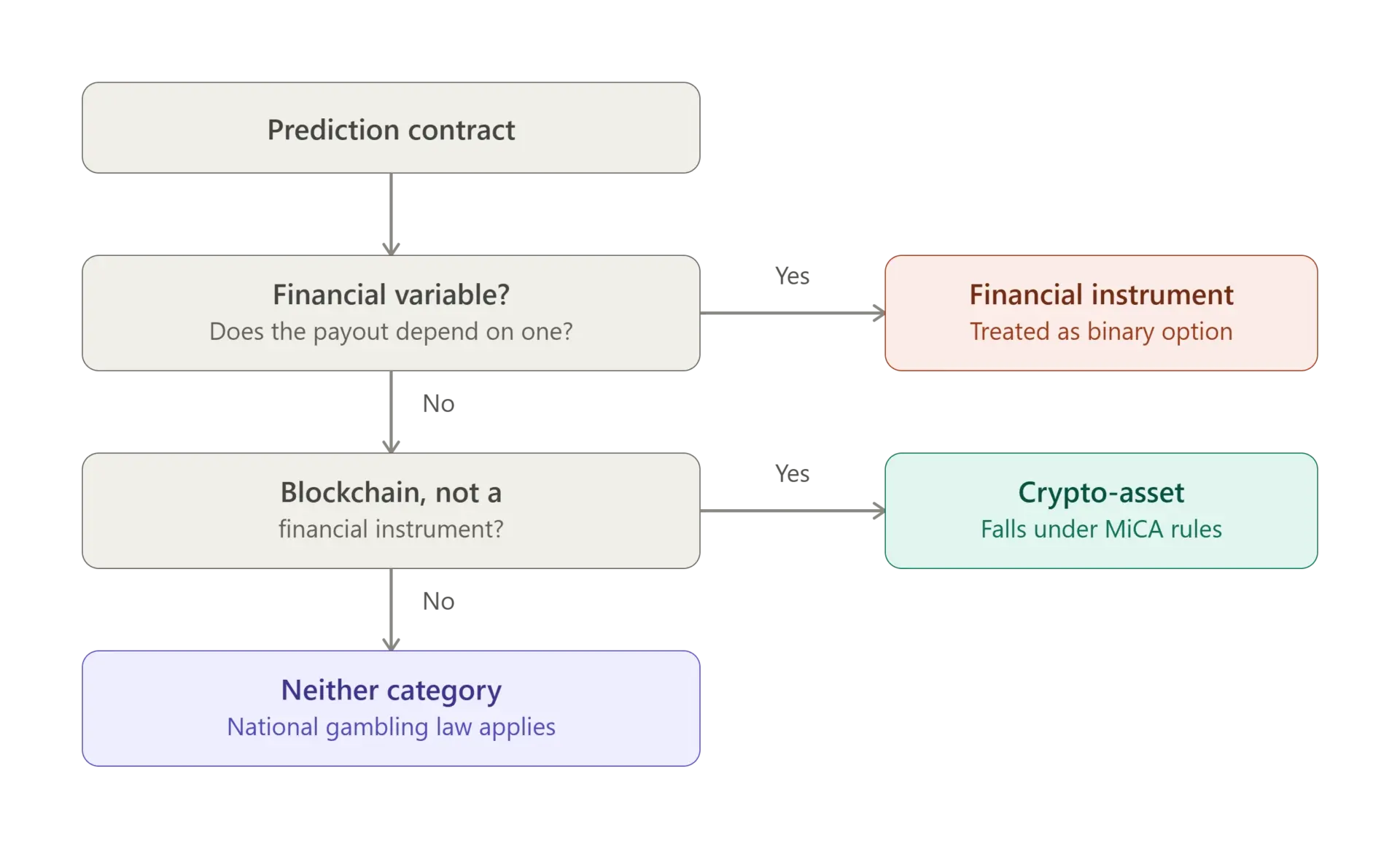
Depending on the subject of a contract, prediction products may fall under one of three regulatory frameworks.
This classification matters because it determines whether EU financial-services rules, crypto-asset rules or national gambling laws apply, and which authorization or restrictions may be relevant.
When a contract’s payout depends on a financial variable, ESMA considers it economically similar to a binary option, an all-or-nothing product that the EU barred from retail investors years ago following significant consumer losses. National intervention measures already prohibit the marketing, distribution and sale of such products to retail clients.
A contract that uses blockchain technology but does not qualify as a financial instrument may instead fall under the Markets in Crypto-Assets (MiCA) framework. Contracts that fit neither category may be governed by national gambling laws, which vary among EU member states.
In July, ESMA said existing binary-options rules apply to event contracts that qualify as financial instruments. Law firm Norton Rose Fulbright linked the same reasoning to MiFID II, the EU rulebook that defines financial instruments. Analysts cited by the firm estimate that prediction-market volumes could reach $1 trillion by 2030. Norton Rose Fulbright analysis
Do European insider-trading rules apply?
European insider-trading rules apply to prediction markets only when the relevant contract qualifies as a financial instrument.
According to Cryptopolitan, nine European gambling regulators moved against unlicensed platforms during the FIFA World Cup. Manuel Richard, director of Swiss gambling authority Gespa, cited insider trading, manipulation and money laundering among the risks associated with platforms operating without the required safeguards.
France ordered internet providers to block Polymarket in July, adding to restrictions imposed in Switzerland, Poland, Belgium, Portugal, Spain, Singapore and Brazil.
In May, Spain’s Consumer Rights Ministry temporarily blocked both Kalshi and Polymarket through internet-service-provider-level DNS and network measures because the platforms lacked gambling licenses. ESMA’s risk-monitoring report outlines the authority’s assessment of event contracts and applicable EU rules.
