Study Finds Endangered Species Act Listings Reduce Housing Permits
Key Takeaways
- •Each additional endangered species listing reduces annual housing permit flows by approximately ten percent of the average locality's total.
- •The Endangered Species Act's cumulative effect has removed an estimated 6.3 million housing units from the national stock between 1980 and 2024, roughly four percent of the 2025 housing supply.
- •The law constrains infill development in dense urban areas to a similar degree as greenfield expansion, despite the highest-value species habitat being located outside already-developed regions.
- •Tabarrok proposes relaxing ESA restrictions specifically in already-built areas as a compromise that could increase housing supply without meaningfully reducing species protection.
- •The Trump administration's efforts to scale back the ESA have prompted multiple lawsuits and are expected to face significant legal and political opposition given the law's status since 1973 as a cornerstone US environmental statute.
Max Tabarrok’s paper on the Endangered Species Act and housing (WP) has now been published in the Journal of Public Economics, a leading field journal. The paper argues that the moment an animal is added to the endangered species list, developers face higher compliance costs and greater liability risk. For empirical economists, the crucial point is that this regulation is not national in scope; it applies only in places where the species lives.
That locality creates many natural experiments: places where the law binds, nearby places where it does not, and a list that changes over time. There were 82 listings in 1970 and nearly 1,500 today, along with some de-listings that reduce regulation.
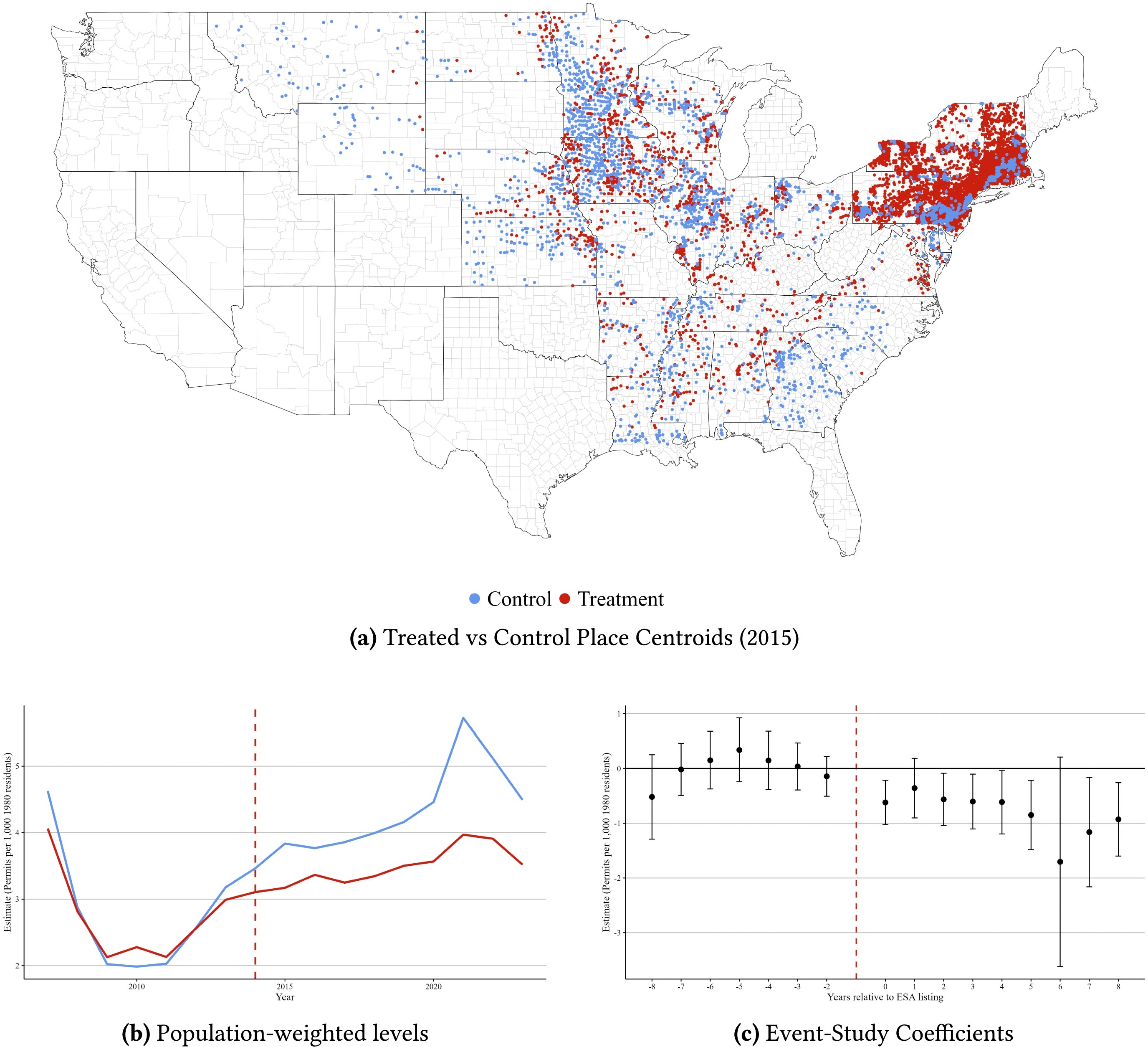
For example, one figure in the paper compares habitat areas, shown in red, and control areas, shown in blue, when the Northern Long Eared Bat was added to the endangered species list. The bottom-left panel measures annual housing permits per 1,000 1980 population in treatment areas versus control areas, while the bottom-right panel shows event-study coefficients. After the bat was listed, new housing permits fell in areas where bats might live relative to the control areas.
A second example looks at the Peregrine falcon after it was delisted. Before delisting, housing permits were lower in the red habitat regions than in the control areas, but after delisting the treatment areas caught up.
Overall, the paper reports that an additional endangered species listing reduces annual housing permit flows by 0.5 permits per 1,000 1980 residents, or about 10% of the average place’s permit flow. Accounting for spillovers and diminishing costs, Tabarrok estimates that the aggregate effect of the Endangered Species Act has reduced the national housing stock by roughly 6.3 million missing units over 1980–2024, equal to about 4% of the 2025 housing stock. To put that figure in perspective, widely cited estimates from Freddie Mac and the National Association of Realtors have put the cumulative U.S. housing shortage in the range of 3 to 7 million units, meaning the ESA's estimated contribution alone is comparable in scale to the entire shortfall some researchers have described.
The paper also addresses the question of benefits. Those are harder to measure, and it is not easy to determine whether the Endangered Species Act is effective. But using satellite data, Tabarrok finds that there are many places where the law binds on infill development.
At the intensive margin of housing production, new development often replaces existing buildings or fills space in already developed areas that would not host endangered species even if no new construction occurred. In those settings, the tradeoff with species protection does not bind, and it may even be positive sum if development substitutes for less dense greenfield expansion. For that reason, the extent to which the Endangered Species Act constrains development on the extensive versus intensive margin is important for assessing the tradeoff between housing production and species protection, and therefore for the law’s aggregate welfare effects.
To study this, Tabarrok extends the paper’s main empirical specification to satellite land-use data from the National Land Cover Database (NLCD) (Multi-Resolution Land Characteristics Consortium, 2025) and to heterogeneity within the Building Permits Survey. The goal is to identify where the Endangered Species Act’s effects are concentrated.
The NLCD is a set of satellite images of the United States compiled and pre-classified by the U.S. Geological Survey. It sorts 30-square-meter pixels into 15 land-use groups, including four levels of development, three types of forest, and two types of wetland. The dataset includes annual files going back to 1985. Tabarrok overlaps these pixels with the map of permit-issuing places in the Building Permits Survey using constant 2024 borders, then tracks changes in pixels within each place over time. The hazard rate of extensive-margin, or greenfield, development is measured by the flow of non-developed pixels such as forests or wetlands into any of the four developed land-use categories, divided by the total area of greenfield land use.
He concludes that the most urbanized 15% of places account for 90% of total permit flows, while the highest-value endangered species habitat lies well outside these developed areas. He also finds that the Endangered Species Act appears to restrict infill development in dense areas as much as it restricts greenfield development in exurban sprawl, citing Tables 9, 10, and 11. In his view, relaxing the law’s legal mechanism in already developed areas could increase permit flows in dense, energy- and land-efficient cities in California and on the East Coast, while reducing pressure on sprawling suburbs in the Sun Belt, and could increase both housing supply and endangered species habitat.
The Trump administration is trying to limit the Endangered Species Act, and multiple lawsuits have already been filed. The law, originally passed in 1973, has long been one of the most powerful environmental statutes in the United States, and any attempt to scale it back will face significant legal and political resistance. Tabarrok’s paper is therefore timely, and he says it points to a possible compromise that could satisfy both housing advocates and environmentalists: reduce the law’s bite on infill and redevelopment in already built-up areas, where the housing-versus-habitat tradeoff barely binds, rather than weakening it across the board.
In an addendum, the author notes that he is pleased to see the paper in print. He says Max began writing it before graduate school and has only just finished his first year. He also credits extensive advice along the way, especially from a strong pre-doc at Dartmouth under the auspices of Heidi Williams.
The post The Endangered Species Act Reduces Housing appeared first on Marginal Revolution.

