Elon Musk touts 'K2 economy' in X reply to chart showing US AI spending at 3.63% of GDP
Key Takeaways
- •A Brookings paper by Columbia University's Stijn Van Nieuwerburgh projects US AI infrastructure investment averaging 3.63% of GDP annually from 2025 to 2032, totaling $10.3 trillion.
- •The projected spending would be larger relative to the US economy than historical booms in railroads, interstate highways, telecom and fiber, canals, and electrification.
- •Elon Musk reacted to a chart of the projection on X by invoking the Kardashev scale, writing that an Earth economy is less than a trillionth the size of a K2 economy.
- •The paper warns that opaque off-balance-sheet financing structures could make correlated exposures hard to observe before a downturn, though it says it is premature to declare systemic risk comparable to earlier credit booms.
- •The OECD lifted its 2026 global growth forecast to 2.9% on AI infrastructure spending, and Van Nieuwerburgh is scheduled to present the paper at Brookings' fall conference on Friday.
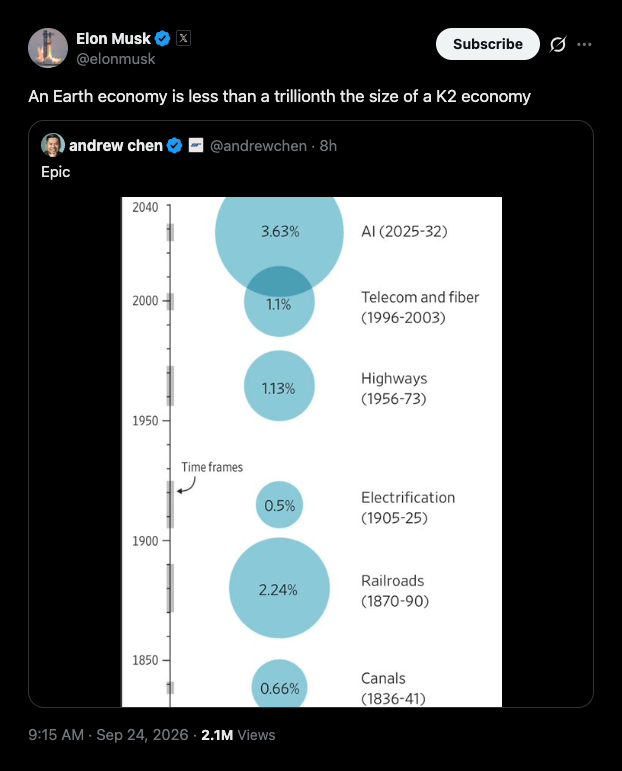
Elon Musk responded on X on Thursday to a chart projecting United States AI infrastructure spending at 3.63% of gross domestic product, replying with a one-line quote post: "An Earth economy is less than a trillionth the size of a K2 economy."
The chart was posted hours earlier by investor Andrew Chen, who captioned it "Epic."
Brookings pegs the buildout at $.3 trillion through 2032
The 3.63% figure comes from a Brookings Papers on Economic Activity paper by Stijn Van Nieuwerburgh of Columbia University titled "Financing the AI buildout." The paper projects that AI investment—spanning data center buildings, power systems, networking and specialized chips—will average 3.63% of US GDP annually from 2025 to 2032.
That would top every comparable investment boom in US history. Measured as a share of GDP—a yardstick that puts eras with very different price levels on a common footing—railroads averaged 2.24% between 1870 and 1890, while the interstate highway drive averaged 1.13% between 1956 and 1973. Telecom and fiber averaged 1.1% from 1996 to 2003, followed by canals at 0.66% and electrification at 0.5%.
"The projected buildout would be larger relative to the economy than the major U.S. canal, railroad, electrification, highway, and telecommunications investment booms," Van Nieuwerburgh writes.
The Brookings version of the paper estimates total AI investment of $10.3 trillion from 2025 to 2032—about $2.1 trillion more than a March draft of the same paper, which had put the figure at about $8.2 trillion, or 2.8% of GDP.
Musk's K2 reference points to the Kardashev scale
Musk's "K2" alludes to the Kardashev scale, a framework drawn up in 1964 by Soviet astronomer Nikolai Kardashev that classifies civilizations based on the energy they control. A Type II civilization commands close to the entire energy output of its parent star.
Musk's post did not reference the paper or its spending figures, but the analogy echoes a theme he has promoted before. In January, SpaceX pitched a plan to the Federal Communications Commission to launch up to 1 million orbital data center satellites as a first step toward Kardashev II status, Cryptopolitan reported.
Risk traced to off-balance-sheet financing
In the paper, Van Nieuwerburgh warns of a shift from transparent on-balance-sheet corporate spending toward opaque off-balance-sheet financing through joint ventures, private credit, securitization, special purpose vehicles and lease commitments—structures that keep spending off the corporate books, where total exposure is harder to tally.
Those structures, he writes, rely on "uncertain AI demand, rapid technological change, timely access to power and hardware, and the continued credit quality of a small number of [data center] tenants."
"It would be premature to conclude that AI infrastructure already poses systemic risk comparable to earlier credit booms," Van Nieuwerburgh writes. Off-balance-sheet structures nonetheless warrant attention "because they may make correlated exposures hard to observe before a downturn," he adds.
Separately, Cryptopolitan reported that the OECD lifted its 2026 global growth forecast to 2.9% on the back of AI infrastructure spending—a sign that the capex wave described in the paper is already large enough to figure in official global projections. Van Nieuwerburgh is scheduled to present the paper at Brookings' fall conference on Friday.

