El Salvador's Bitcoin Experiment Faces Retreat Five Years After Making BTC Legal Tender
Key Takeaways
- •El Salvador became the first country to grant Bitcoin legal-tender status in 2021 under President Nayib Bukele's leadership.
- •Remittances constitute approximately one-quarter of El Salvador's GDP, making reduced transfer costs a central justification for Bitcoin adoption.
- •In late 2024, the government agreed to make Bitcoin acceptance voluntary for merchants as part of a staff-level agreement with the International Monetary Fund.
- •Many Salvadorans continued relying primarily on the U.S. dollar for everyday transactions due to Bitcoin's price volatility and limited practical utility.
- •No other sovereign nation has replicated El Salvador's full legal-tender model for Bitcoin, though a small number of jurisdictions have pursued partial crypto-friendly frameworks.
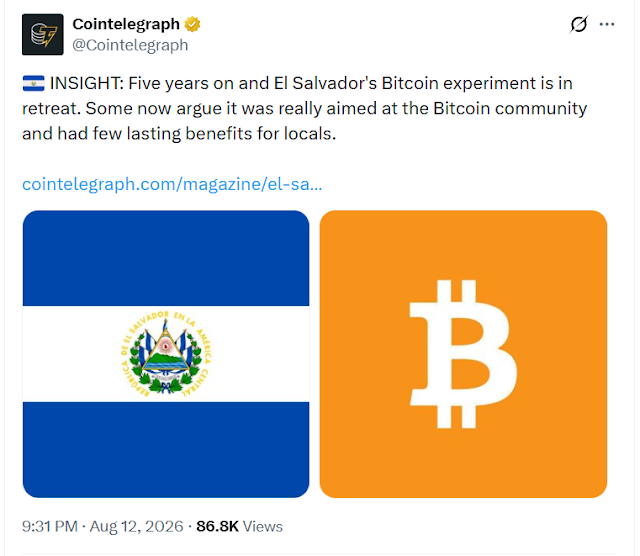
El Salvador's Bitcoin Experiment Faces Retreat Five Years After Making BTC Legal Tender
Five years after El Salvador became the first country to adopt Bitcoin as legal tender, the government's ambitious cryptocurrency experiment is confronting a markedly different reality. What was once promoted as a historic transformation of the global financial system has narrowed into a more limited Bitcoin policy, raising questions about whether the initiative delivered meaningful benefits for ordinary Salvadorans.
The decision, led by President Nayib Bukele, attracted worldwide attention when Bitcoin was granted legal-tender status in 2021. El Salvador had already operated on a dollarized economy since abandoning its own currency, the colón, in 2001, meaning the country had no independent monetary policy to adjust. Bitcoin was layered onto this existing framework. The government promoted the move as a path to greater financial inclusion, reduced remittance costs, and increased foreign investment. Five years on, that early enthusiasm appears to have diminished.
Recent coverage highlighted by Cointelegraph has fueled a growing debate over whether El Salvador's Bitcoin strategy ultimately benefited the broader population or primarily served as a signal to the global cryptocurrency community.
Bitcoin as a National Revolution
When El Salvador adopted Bitcoin, the announcement stood as one of the most dramatic experiments in cryptocurrency policy worldwide. The government argued that Bitcoin could help transform the national economy, with remittances forming a central pillar of the strategy.
Millions of Salvadorans live abroad, particularly in the United States, and regularly send money home to relatives. Remittances account for roughly a quarter of El Salvador's GDP, making the country one of the most remittance-dependent economies in the world. Officials contended that Bitcoin could reduce the cost and friction associated with transferring those funds, while also bringing more people into the formal financial system. At the time, the idea drew significant interest from Bitcoin investors, entrepreneurs, and technology companies.
The Chivo Wallet as Centerpiece
To encourage adoption, the government introduced the Chivo digital wallet. Citizens were offered incentives — including a $30 Bitcoin bonus — to download the app, and businesses were encouraged to accept Bitcoin payments. The government also installed Bitcoin ATMs and promoted the cryptocurrency as a modern alternative to traditional financial services.
The strategy was highly visible. El Salvador became a global destination for Bitcoin enthusiasts, with international conferences, cryptocurrency businesses, and Bitcoin-focused tourism becoming part of the country's new image. The government also launched a state-backed Bitcoin mining initiative powered by geothermal energy from the country's volcanoes, further burnishing its crypto-forward identity. However, visibility did not necessarily translate into widespread everyday use.
The Complications of Everyday Adoption
One of the biggest challenges has been convincing ordinary consumers to use Bitcoin regularly. Bitcoin's price volatility makes it fundamentally different from traditional national currencies — a person receiving Bitcoin could see its value shift significantly within a short period. For households operating with limited financial resources, that volatility makes cryptocurrency less attractive as a payment method.
Many Salvadorans therefore continued to rely primarily on the U.S. dollar for everyday transactions, producing a significant gap between the government's ambitious vision and actual consumer behavior.
Remittance Promises Meet Practical Limits
Remittances represented one of the strongest arguments for Bitcoin adoption. Salvadorans living abroad send billions of dollars home each year, and traditional remittance services involve fees and intermediary costs. Bitcoin appeared to offer a potential alternative.
However, consumers need more than a technically cheaper payment network. They require convenient services, price stability, and confidence that recipients can easily convert funds into the currency used for daily expenses. Those practical considerations limited Bitcoin's ability to replace established remittance systems, most of which continued to operate through well-established corridors with decades of built-up trust and infrastructure.
The International Bitcoin Community Embraces El Salvador
While domestic adoption remained uncertain, El Salvador became extremely popular among international Bitcoin supporters. Bitcoin conferences and tourism initiatives helped establish the country as one of the world's most recognizable cryptocurrency destinations, attracting entrepreneurs and investors interested in building businesses around Bitcoin.
Critics argue this raises an important question about the experiment's ultimate purpose: Was Bitcoin policy designed primarily to improve economic conditions for Salvadorans, or did it also function as a global branding strategy aimed at the international Bitcoin community?
Critics Question Long-Term Benefits
Five years after the original Bitcoin law, critics say there is limited evidence that cryptocurrency has fundamentally transformed the lives of ordinary citizens. Bitcoin ownership remains far from universal. Many businesses may technically accept cryptocurrency but do not necessarily receive a significant share of revenue in Bitcoin. Consumers, meanwhile, often continue to prefer traditional currency for everyday purchases.
That does not mean the experiment has produced no benefits — rather, the economic impact may be considerably smaller than the sweeping transformation originally promised.
A Shift in Government Approach
The most important development may be the government's gradual shift in strategy. El Salvador's Bitcoin policy has become more pragmatic as the country responds to economic and international pressures. Notably, the International Monetary Fund repeatedly urged El Salvador to narrow Bitcoin's role as a condition for financial assistance, and the government eventually agreed to make Bitcoin acceptance voluntary for merchants as part of a broader staff-level agreement with the IMF in late 2024. The original vision of widespread adoption has increasingly given way to a framework in which cryptocurrency remains important but is no longer treated as the center of everyday economic activity.
That shift is significant because it suggests that even one of Bitcoin's strongest government supporters has had to adjust expectations in the face of institutional and economic realities.
Bitcoin's Enduring Link to El Salvador's Identity
Despite the retreat from some original ambitions, Bitcoin remains closely associated with El Salvador. The country continues to attract cryptocurrency investors and entrepreneurs, and its government has maintained its Bitcoin-related identity on the international stage. El Salvador has also continued accumulating Bitcoin in its national treasury, with officials publicly reporting holdings.
For the global crypto industry, El Salvador remains an important case study. Few other governments have taken such a bold approach to Bitcoin, making the country's experience valuable regardless of whether the experiment is ultimately judged a success or failure.
Lessons for the World
The biggest lesson may be that government adoption does not automatically create consumer adoption. A government can designate an asset as legal tender, provide wallets and infrastructure, and offer incentives — but consumers ultimately decide whether they want to use that asset in daily life.
Bitcoin's decentralized nature may appeal to investors, yet everyday users often prioritize stability and convenience. That distinction is particularly important in developing economies, where financial margins are thin and currency stability can be the difference between solvency and hardship for households.
The Experiment Has Evolved, Not Ended
Describing El Salvador's Bitcoin experiment as a complete failure would be overly simplistic. The country has built infrastructure, attracted international attention, and demonstrated that a government can integrate Bitcoin into its financial system. It has also given researchers and policymakers a unique real-world case study.
The more accurate description is that the experiment has evolved. The original vision was extremely ambitious; the current approach appears more restrained.
A Reality Check for Bitcoin Adoption
El Salvador's experience offers a reality check for governments considering cryptocurrency adoption. Bitcoin can create new opportunities, but policy alone cannot guarantee widespread use. Infrastructure, education, financial literacy, exchange access, and economic incentives all matter. Most importantly, users need a compelling reason to change existing financial habits — and five years after El Salvador's historic decision, that remains one of the biggest challenges facing Bitcoin adoption.
The Bigger Picture
El Salvador's Bitcoin experiment has entered a new phase. The country that once positioned Bitcoin as a revolutionary national currency strategy now appears to be taking a more cautious approach.
The shift does not erase the significance of the 2021 decision. El Salvador changed the global conversation by becoming the first country to grant Bitcoin legal-tender status. But the years since have shown that turning Bitcoin enthusiasm into widespread everyday adoption is far more difficult than making cryptocurrency part of national policy. No other sovereign nation has replicated El Salvador's full legal-tender model, though a small number of jurisdictions have pursued partial crypto-friendly frameworks.
As highlighted in recent coverage referenced by Cointelegraph, critics increasingly argue that the experiment produced more value for the international Bitcoin community than for ordinary Salvadorans. Whether that judgment ultimately proves fair will depend on how the country evaluates the long-term economic effects of its cryptocurrency strategy.
For now, El Salvador's experience stands as both a landmark moment in Bitcoin history and a warning that technological ambition does not always translate into mass adoption.