edgeX on Arc: Bringing 150+ Perpetual Markets on the Economic OS
Key Takeaways
- •edgeX will make over 150 perpetual markets available to users funding accounts on Arc, including crypto assets, equities, gold, silver, and oil.
- •The launch will introduce Arc’s first continuous, around-the-clock onchain FX perpetual market through JPY trading.
- •Arc combines native USDC gas payments and settlement with deterministic finality below 350 milliseconds.
- •edgeX plans to add major FX pairs, USDC-based spot markets, and potentially non-USD stablecoins as margin after liquidity conditions develop.
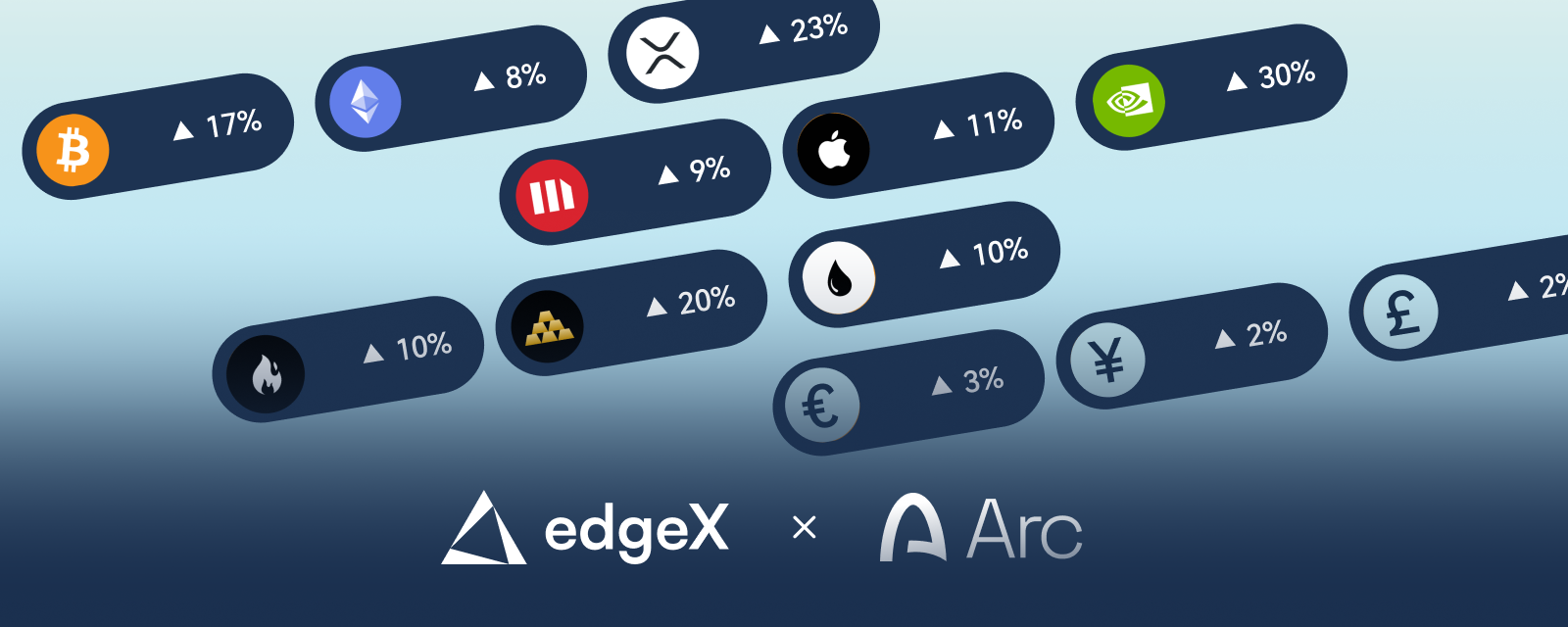
Arc mainnet goes live on September 16. As a Day 1 partner, edgeX will bring Arc users 150+ perpetual markets across equities, commodities, and crypto, along with the first 24/7 FX perpetual market onchain.
This partnership did not begin today. Circle Ventures is an investor in edgeX, and our teams have already worked together on native USDC issuance and CCTP integration for EDGE Chain. Launching on Arc is the natural next step: bringing edgeX's full market infrastructure to a settlement layer built around native USDC.
This article answers three questions. Why now? Why Arc? And what does this launch actually solve?
Stablecoins are entering their next phase: real economic activity
The first phase of stablecoins was a competition for scale. Supply is a balance sheet.
The next phase is a competition for intensity of use. Transaction volume and settlement frequency are economic activity.
Arc is Circle’s answer to that shift. It is not a general-purpose chain with stablecoins bolted on - it is a system redesigned from the base layer for the settlement of real-world assets. Three design choices make the objective clear:
Gas paid in USDC. The unit of account, the medium of settlement, and the cost of transacting become a single asset. Traders no longer need to hold a volatile asset simply to pay network fees. For market makers, operating costs and P&L are denominated in the same currency, removing the FX noise that gas expenses normally introduce. In a market that requires high-frequency quote updates, that flows directly into the economics of market making.
Sub-second deterministic finality. On most chains, a transaction is never quite "done" — it becomes progressively less likely to reverse as blocks pile on top of it. Arc removes the waiting: once a block is committed by its validators, it is final and cannot be reversed. Finality lands in under 350 milliseconds. For a trader, that means deposits credit immediately, withdrawals settle immediately, and liquidations resolve on a settled price rather than one that might still move.
A native FX engine. Arc ships with StableFX, providing institutional-grade RFQ pricing and 24/7 onchain PvP (payment-versus-payment) settlement - infrastructure a general-purpose chain cannot easily offer natively.
These three choices point to the same class of activity: high-frequency, continuous, stablecoin-denominated finance. And among onchain products, few use that infrastructure as fully as perpetual markets - continuous quoting, continuous matching, hourly funding settlement.
Perpetuals are demand that has already been proven
Over the past year, edgeX has continued expanding into real-world assets — from equities and commodities to currencies. Each expansion has met the same infrastructure constraint: general-purpose chains were not designed for the settlement and pricing of these assets. No native settlement layer, no institutional quoting layer, and a cost structure that rarely aligns with the settlement asset.
Arc is the first chain whose infrastructure assumptions align closely with where our product is going.
From Arc mainnet launch, users funding on Arc can trade the following on edgeX:
- 150+ perpetual markets. Core depth in BTC, ETH, and major crypto assets, alongside US and Asian equities, gold, silver, and oil. All margined and settled in native USDC.
- JPY perpetuals, new for Arc. The first continuous, 24/7 FX perpetual market onchain, built on Arc's native FX engine.
What edgeX makes possible on Arc
- A smoother trading experience: one account, one collateral pool. Margin is native USDC, and gas fees are paid in USDC as well. There is no need to hold a second asset across the trade lifecycle, and less exposure to the added risk and operational overhead of bridging.
- Commodity and equity perpetuals that never close. The hours when traditional exchanges are shut - overnight, weekends, holidays - remain tradable on edgeX. A single cross-margin system covers gold, oil, US equities, Asian semiconductors, and crypto, turning portfolio margin across uncorrelated assets into real capital efficiency.
- A starting point for onchain FX. Arc will host a growing number of merchants and payment institutions that settle in stablecoins: revenue arrives in USDC, while costs may be denominated in other currencies. That gap is genuine FX exposure, and onchain there has been no effective way to manage it. edgeX's FX perpetual market provides hedging and price discovery, complementing Arc's institutional RFQ execution layer — serving retail and professional participants through the venue best suited to each.
What comes next
- Expanding major FX pairs - ordered by real liquidity and demand rather than headline count. A market without sufficient depth introduces more risk than its absence.
- FX spot markets - beginning with USDC against non-USD stablecoins. Spot is a precondition for admitting these assets as collateral, not an afterthought.
- Non-USD stablecoins as margin - once the conditions above are met. At that point the margin system should recognize genuine hedges: EURC posted as collateral against a short EUR position is a natural offset, and charging full margin on both legs is a design flaw, not a risk control.
Arc is building a settlement chain for real-world assets. edgeX brings the derivatives market that belongs on top of it - starting on day one with BTC, NVDA, and JPY, and extends over time to every asset that moves, and that someone needs to hedge.

