ECB launches Pontes, settling tokenized asset trades exclusively in central-bank money
Key Takeaways
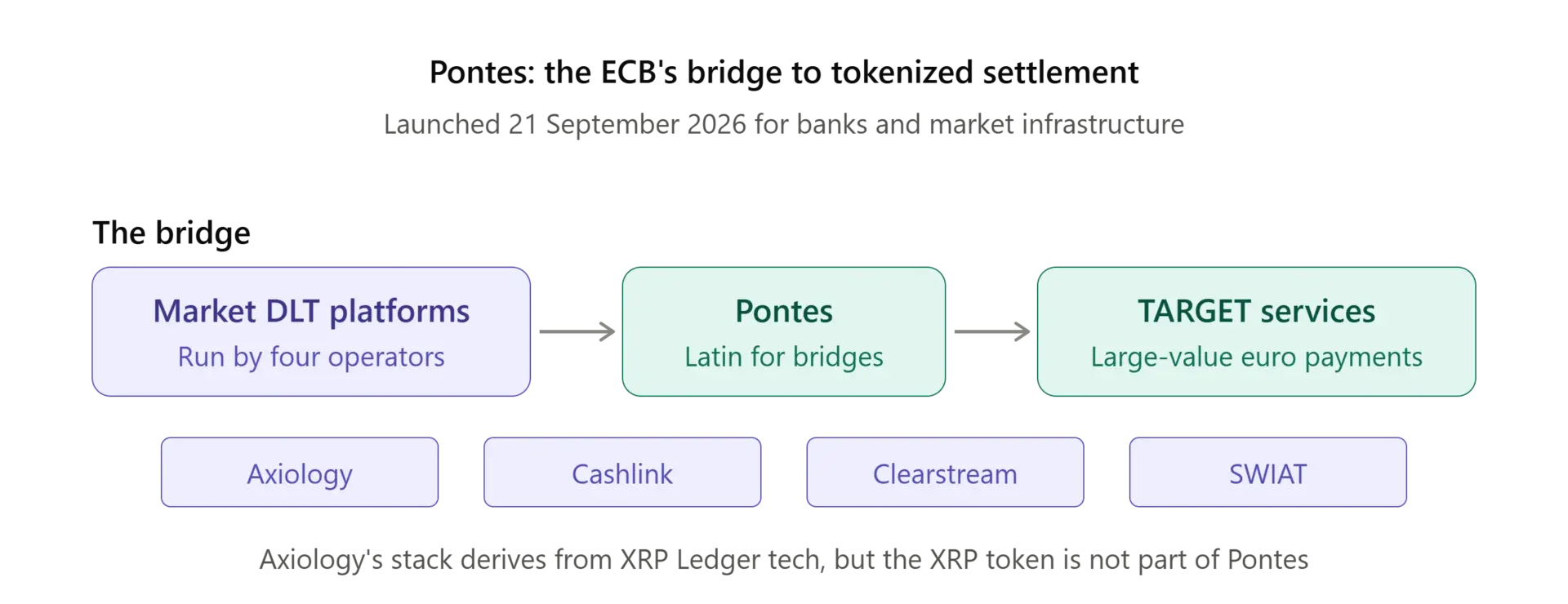
- •Pontes connects distributed-ledger platforms run by four operators—Axiology, Cashlink, Clearstream and SWIAT—to the ECB's TARGET Services, and is separate from the digital euro being developed for retail users.
- •Settlement occurs exclusively in euro-denominated central-bank money, with each trade becoming final only once recorded in the T2 payment system, providing the same legal certainty as existing euro payments.
- •The platform's design reflects the Eurosystem's position that central-bank money should remain the settlement anchor, even as tokenized deposits and regulated stablecoins may play a larger role in DLT markets.
- •The launch builds on more than 50 trials run between May and November 2024 with 64 market participants, which processed over €1.5 billion in DLT-based wholesale transactions.
- •Pontes is the near-term track of the ECB's July 2025 two-track tokenization strategy, starting as a limited-hours pilot while a 24/7 version, finalized eligibility criteria and the Appia blueprint are all expected by 2028.
The European Central Bank on Monday switched on Pontes, a new Eurosystem settlement rail that allows banks to settle tokenized asset trades — transactions in assets represented as digital tokens on distributed ledgers — exclusively in money issued by the central bank, keeping privately issued stablecoins and commercial-bank deposits out of the settlement layer, according to an ECB press release.
ECB President Christine Lagarde confirmed the launch following the Eurogroup meeting. She is due to deliver opening remarks at a Pontes roundtable in Frankfurt at 17:00 CET, after which Executive Board member Piero Cipollone will chair a panel, according to the ECB's schedule.
What Pontes does
Pontes, which translates as "bridges" in Latin, connects distributed-ledger technology (DLT) platforms run by market operators to the ECB's TARGET Services, the system banks already use to move large-value euro payments. Further details are published on the ECB's Pontes page.
Four DLT operators are involved: Axiology, Cashlink, Clearstream and SWIAT. Axiology runs a permissioned stack derived from XRP Ledger technology. However, that does not mean the XRP token or the XRP Ledger itself is part of the Pontes project, which settles exclusively in euros issued by the central bank.
Pontes is separate from the digital euro that the ECB is developing for retail users and households. The platform is built specifically for financial institutions and market infrastructure. For those institutions, the practical effect is that tokenized trades can run on DLT rails while the euro cash leg stays inside the Eurosystem's existing money framework.
Why central-bank money anchors the system
The ECB's decision to anchor the cash leg of tokenized trades in euro-denominated central-bank money, rather than stablecoins, is consistent with the central bank's previously stated position on stablecoins and central bank digital currencies. The Eurosystem holds that tokenized commercial-bank deposits and regulated stablecoins may take on a larger role as markets adopt DLT, but that central-bank money "should remain the anchor for settlement" — a principle embedded in how Pontes operates.
The platform offers a dual-settlement model. Participants can settle using digital tokens that represent central-bank money on a Eurosystem DLT platform, or they can settle in T2, the existing payment system. Either way, a trade becomes final only once it is recorded in T2, which gives every settlement the same legal certainty the euro payment system provides today. The anchor role matters because central-bank money is a claim on the central bank itself, not on any commercial bank, so neither side of a trade takes on credit exposure to the other's lender — the reason systems such as T2 settle in central-bank money, and why the Eurosystem has kept that anchor for itself rather than ceding it to private tokens.
Built on €1.5 billion of testing
Pontes did not arrive from nowhere. Between May and November 2024, the Eurosystem ran more than 50 trials with 64 market participants, testing how DLT-based wholesale transactions could settle in central-bank money. A separate ECB assessment, cited by EU Today, put the value processed during that phase at more than €1.5 billion.
The ECB approved its tokenization strategy in July 2025 as a two-track plan, token-city.com reports. Pontes is the near-term track, built to reach the market quickly. A second project, Appia, looks further ahead at a more deeply integrated ecosystem, with a blueprint expected in 2028.
Pontes itself starts as a focused pilot with limited operating hours, while an enhanced version designed to run around the clock is also targeted for 2028. The ECB is still finalizing eligibility criteria for the assets, participants and DLT operators that can join. Those criteria will shape who and what can use the rail as it moves from pilot toward the round-the-clock version and the Appia blueprint, both due in 2028.

