How E Don Kast is making Nigeria’s election results more transparent in real time
Key Takeaways
- •E Don Kast published real-time polling unit results during the August 15, 2026 Osun State governorship election, giving users a ward-by-ward picture of the vote before official figures were announced.
- •The platform was founded by Femi Olamijulo, an urban planner and geospatial policy analyst with dual master's degrees from Harvard, and accepts submissions of Form EC8A figures and photos from voters, party agents, journalists and observers.
- •Credibility is maintained through automated fraud checks, consensus scoring and community verification, with confidence scores determining whether submissions are published automatically or flagged for review.
- •The team has built a national electoral map covering all 8,809 wards and 176,846 polling units, and the platform has previously been used in the February FCT, Kano and Rivers by-elections and the June Ekiti governorship election.
- •While the Osun poll demonstrated that real-time result collation can work, full coverage of the 2027 general elections will require far broader mobilisation of trained observers, journalists and citizens.
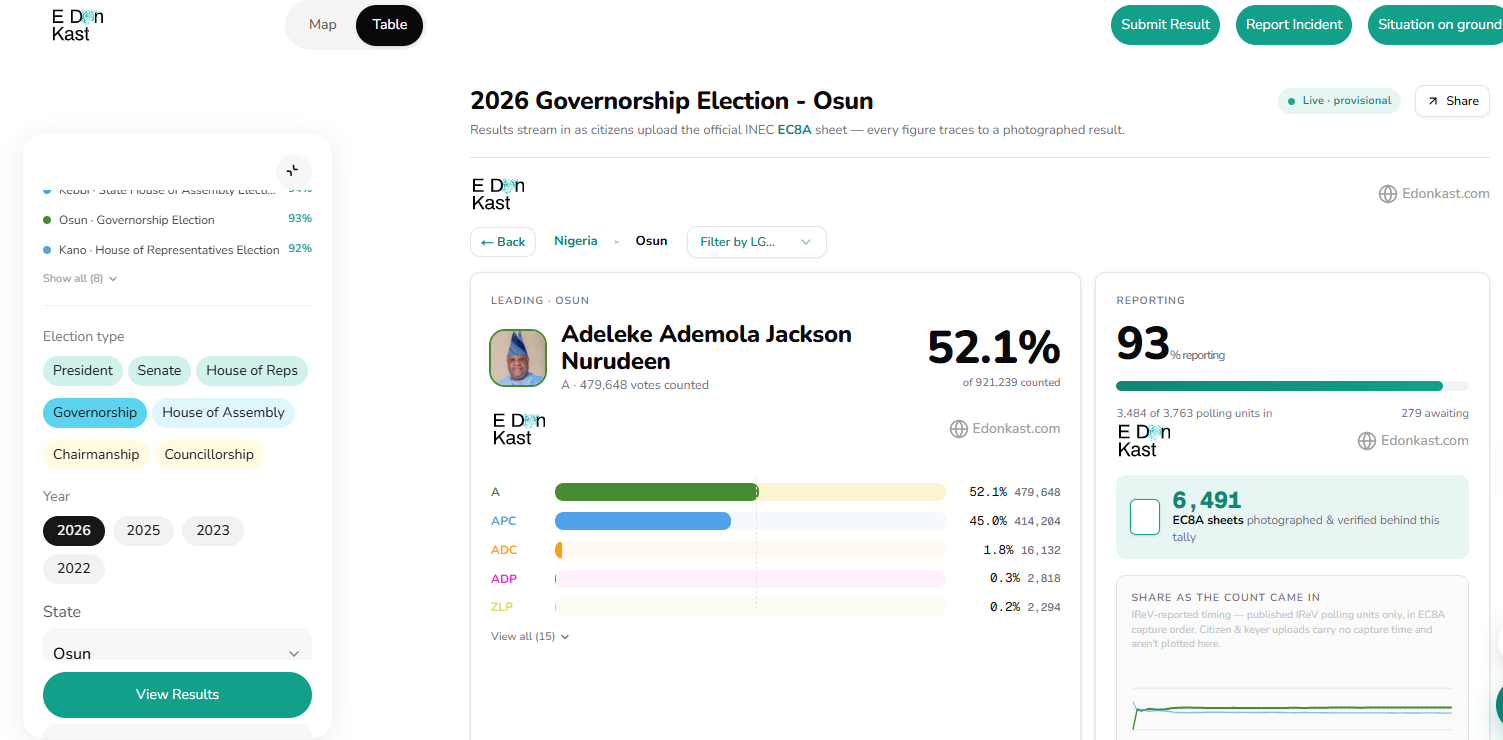
On August 15, 2026, while Nigerians were waiting for the official results of the Osun State governorship election, a platform called E Don Kast was already publishing real-time polling unit results. By the time the final figures were announced, users of the platform had access to a detailed, ward-by-ward picture of how the vote had unfolded.
Technext verified the platform’s performance during the election. E Don Kast is an independent election data platform built to address a recurring problem in Nigerian elections: discrepancies between results recorded at polling units and results later announced officially. The system captures data at the source, helping ensure that the figures announced at polling units remain intact throughout collation.
On election day, citizens at polling units, voters, party agents, journalists and observers can submit results directly through their phones. They enter figures from Form EC8A, the official INEC result sheet, and are encouraged to upload a photo of the form. After submission, the data goes through a verification process before appearing on a live map and results table.
E Don Kast was founded by Femi Olamijulo, an urban planner and geospatial policy analyst, with the goal of making Nigeria’s election results transparent from the polling unit upward. The platform allows users to upload photographs of official result sheets, aggregates submissions by polling unit, and flags discrepancies in the data.
Olamijulo, who holds dual master’s degrees from Harvard, said he was inspired by the real-time visibility of election results in the United States. He observed that Nigeria’s polling units can produce accurate results, but much of that clarity is often lost during collation.
The platform does not replace INEC or claim the authority to declare winners. Instead, it operates as a non-partisan initiative that provides a citizen-held record of polling unit results for comparison with official announcements. It has been used in several elections, including the February FCT, Kano and Rivers by-elections, as well as the June Ekiti governorship election, and was active for the Osun State governorship election.
Olamijulo’s team has also built a national electoral map covering all 8,809 wards and 176,846 polling units, which forms the backbone of the platform’s collection and display system.
Credibility is maintained through a layered verification process. When results are submitted, automated fraud checks look for duplicate entries, suspicious patterns and anomalies that could signal false data. Uploading photo evidence increases a submission’s confidence score.
The system then applies a consensus scoring process that compares results from different people at the same polling unit to see whether they match. High-confidence submissions are approved and published automatically, while lower-scoring entries are flagged for human or community review.
Community verification is a key part of the model. After a result is published, anyone can confirm its accuracy or dispute it with evidence. The more confirmations a result receives, the higher its confidence score becomes, creating a crowdsourced accountability system.
That structure matters because the reliability of the platform depends on the data people submit. If one person enters false information but many others submit accurate results, the algorithm is designed to identify the incorrect submission.
The need for independent verification of election results in Nigeria has been documented for years. During the 2023 presidential election, the Independent National Electoral Commission’s (INEC) IReV portal, which was intended to upload polling unit results in real time, faced multiple problems. Organisations such as YIAGA Africa and Situation Room said the results on the portal often did not match those recorded by party agents and observers at polling stations. INEC’s servers also struggled under heavy traffic, which delayed uploads in some states and undermined the portal’s real-time purpose.
Comparable issues were reported during the 2019 presidential election. The European Union Election Observation Mission said results management remained a weak point in Nigeria’s electoral process, citing numerous discrepancies between polling unit figures and final results. Kebbi State drew particular concern after civil society groups pointed to results that did not match observer records.
Looking further back, the 2011 elections in places such as Rivers and Bayelsa produced results that international and local observers described as statistically unlikely. Across several election cycles, the pattern has been consistent: polling units are where votes are most visible and most accurate, while integrity problems tend to emerge during collation, where results are counted upward.
E Don Kast was created to address that gap. It provides an independent, time-stamped and photo-evidenced record of polling unit results as they are announced, before they enter the collation process. That gives citizens, journalists and candidates a reference point against which to compare official results.
For the Osun election on August 15, that reference point was available in real time. As results came in from the state’s 30 local government areas, E Don Kast collected and organised them by ward and local government area, allowing observers to follow the vote as it developed. The platform also displayed confidence scores, showing which results were strongly verified by multiple observers and which were still awaiting confirmation.
Osun also served as a trial run for next year’s general elections. INEC used the poll to test its BVAS technology after problems during a mock exercise in August. Political parties assessed their ability to mobilise and monitor the election, while civic tech platforms such as E Don Kast tested whether real-time result collation could work at scale in Nigeria.
The August 15 results suggest the model can work, but its effectiveness depends heavily on the number of trained observers using it. In a presidential election with 176,000 polling units nationwide, full coverage will require much broader mobilisation than was needed in Osun.
That leaves the next challenge less about technology than participation. The platform’s tools and verification process are in place, but more observers, journalists, party representatives and citizens need to know about the system and how to use it.
If more people are trained to use it, the 2027 elections could be the first in Nigeria where it becomes much harder to hide the gap between what happens at polling units and what is eventually reported.

