Dow, S&P 500 and Nasdaq Rise as Warsh Flags Inflation Concerns at Jackson Hole
Key Takeaways
- •The Dow, S&P 500 and Nasdaq all closed higher on Friday, extending Thursday’s advance.
- •Warsh’s Jackson Hole remarks were interpreted as hawkish because he focused on inflation and did not rule out higher interest rates.
- •The CME FedWatch Tool showed the implied probability of a September 15-16 rate hike rising to 55.7% from 35.4% the day before.
- •The 2-year Treasury yield climbed to 4.3%, while the 10-year and 30-year yields fell.
- •Nvidia-driven tech strength continued to support the market even as expectations for tighter policy increased.
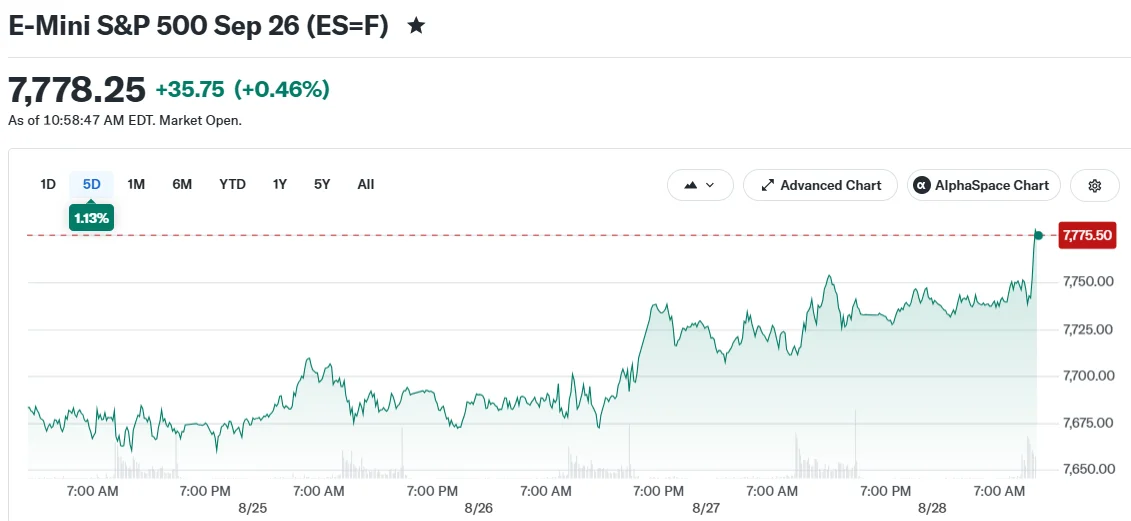
Stocks edged higher on Friday as Wall Street digested Federal Reserve Chair Kevin Warsh’s first Jackson Hole speech since taking the top job. The annual symposium, hosted by the Federal Reserve Bank of Kansas City in Wyoming, has long been a setting where Fed chairs signal shifts in policy thinking. All three major indexes finished the session in positive territory.
The Dow Jones Industrial Average rose about 0.37%, the S&P 500 gained 0.49%, and the Nasdaq Composite climbed 0.57%, extending Thursday’s tech-led advance.
Warsh’s remarks centered on inflation and were viewed as hawkish, with the Fed chief signaling concern that price pressures could remain above the central bank’s target. His comments left open the possibility of higher interest rates. The tone was in keeping with the reputation Warsh built as a Fed governor from 2006 to 2011 and as a prominent critic of accommodative policy in the years after leaving the central bank.
FED WARSH AT JACKSON HOLE (Summary): On policy:
• He gave no timetable for a rate hike and said the speech should not be viewed as forward guidance or a formal reaction function
• Short-term interest rates remain the Fed’s main policy tool
• A “good majority” at the July… pic.twitter.com/pUZUOUa0Lj — Wall St Engine (@wallstengine) August 28, 2026
Traders quickly adjusted their expectations. According to the CME FedWatch Tool, which translates fed funds futures pricing into implied probabilities for rate decisions, the probability of a rate hike at the September 15-16 Federal Open Market Committee meeting rose to 55.7%, up from 35.4% the previous day. The odds of rates remaining unchanged through year-end fell to 14.8% from 25.9%.
Peter Boockvar, chief investment officer at One Point BFG Wealth Partners, said Warsh did a good job of laying out his framework for guiding monetary policy decisions going forward.
Fed officials had been divided heading into Jackson Hole over whether to raise rates. Warsh’s speech did not eliminate that uncertainty, but it gave markets a clearer sense of what the Fed is watching.
Bond markets also moved in response. The 2-year Treasury yield, among the maturities most sensitive to expectations for the federal funds rate, climbed to 4.3%, while the 10-year yield slipped to 4.67% and the 30-year yield fell to 5.16%. Earlier in the month, longer-dated yields had reached multiyear highs amid concerns about inflation and the size of the national debt.
Tech stocks remained firm after Thursday’s rally, which was led by Nvidia. The chipmaker delivered a bullish long-term outlook tied to artificial intelligence demand, helping support the AI trade. Nvidia has grown into one of the largest weights in the S&P 500, giving its forecasts broad influence over index-level moves.
That momentum carried into Friday, even as expectations for a rate hike increased — a notable pairing, because tighter policy is typically viewed as a headwind for growth stocks whose valuations lean heavily on future earnings. Salesforce also posted a strong session on Thursday, logging its best single-day gain since 2020 after pushing back against concerns about a broader slowdown in software spending.
There were no major earnings reports on Friday. The University of Michigan’s consumer sentiment survey was released during the session, giving investors another gauge of how Americans are feeling about the economy; its inflation-expectations components are among the measures Fed officials monitor when judging price pressures.
Markets ended the week higher despite the renewed uncertainty around the path of interest rates after Warsh’s Jackson Hole address, with the September 15-16 FOMC meeting the next scheduled decision point in that debate.

