DogeOS Opens Chikyū EVM Testnet, Positioning Dogecoin as Programmable Capital
Key Takeaways
- •DogeOS launched the Chikyū public testnet on September 30, an EVM-compatible zero-knowledge rollup that uses Dogecoin for transaction fees while leaving the base chain unmodified.
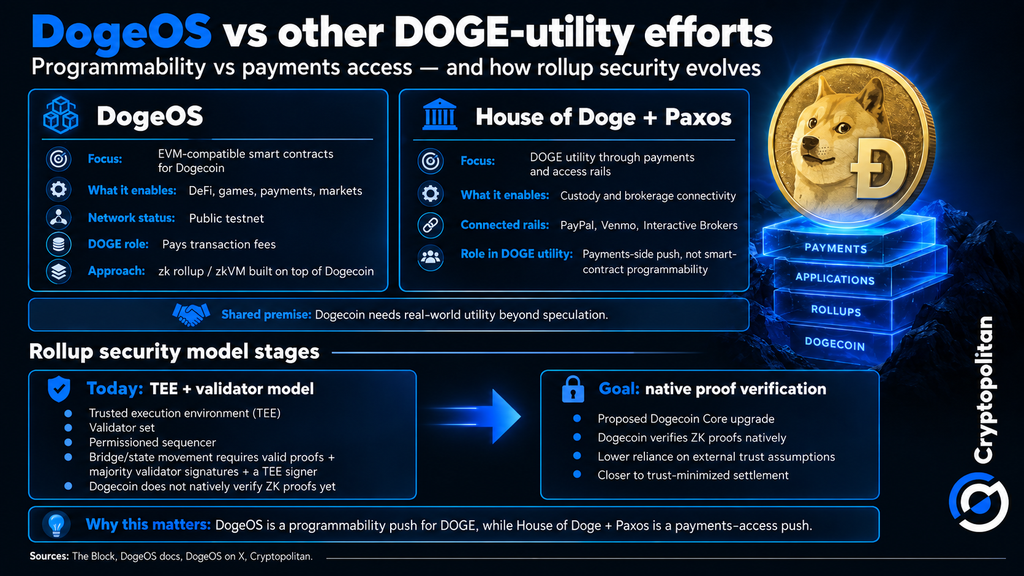
- •The network currently depends on a trusted execution environment, validators, and a permissioned sequencer because Dogecoin cannot yet verify zero-knowledge proofs, though an upgrade to Dogecoin Core has been proposed to enable on-chain ZK-proof validation.
- •DogeOS's documentation still lists its decentralized applications as coming soon, and the team says a mainnet timeline will be shared once further development milestones are reached.
- •Dogecoin's roughly $14.7 billion market capitalization and 8.5 million addresses with positive balances represent potential scale, but established EVM rollups such as Base, Arbitrum, and OP Mainnet already hold substantially more DeFi liquidity.
- •DOGE traded near $0.0945 on October 1, up roughly 0.3% over 24 hours, indicating the testnet launch did not trigger immediate significant price volatility.
DogeOS launched a public testnet on Wednesday, September 30, bringing Ethereum-style smart contracts to the Dogecoin platform. The project aims to expand DOGE's role with the technology, positioning the token as programmable capital for decentralized applications beyond payments and trading.
The Chikyū testnet is a zero-knowledge rollup compatible with the Ethereum Virtual Machine (EVM) that uses Dogecoin as its coin for transaction fees. The Dogecoin base chain itself remains unchanged, with applications built on top of it. That layered approach reflects Dogecoin's history: created in 2013 as a meme-inspired payments cryptocurrency, its base layer has never supported general-purpose smart contracts, which is why efforts like DogeOS build on top of the chain rather than modify it. A similar playbook has played out on Bitcoin, where layer-2 networks such as the Lightning Network and Stacks extend the original cryptocurrency's functionality without altering its base protocol.
What the testnet lets developers do
DogeOS describes itself as an EVM-compatible application layer, enabling Ethereum developers to work with familiar code, dependencies, wallets, and tools. EVM compatibility has become a common onboarding route for new networks, since much of the industry's smart contract tooling and application code is built around Ethereum's runtime. In effect, the testnet lets builders deploy Ethereum-style contracts while paying fees in DOGE. The network is designed to facilitate trading, lending, stablecoins, prediction-market betting, gaming, and various other kinds of applications.
In an announcement on X, DogeOS said its teams are working across payment solutions, decentralized finance, gaming, and marketplaces. The project's user manual, however, still lists its dApps as “coming soon,” a sign that the developer testnet does not yet amount to a mature ecosystem.
“We're focused on the public testnet, giving developers time to build and test applications while we validate the network. We'll share the mainnet timeline as reach the next development milestones.”
— Jordan Jefferson, DogeOS CEO, speaking to The Block
How the security model works today — and where it's headed
DogeOS is not yet fully trustless. The network currently depends on a trusted execution environment, validators, and a permissioned sequencer. Dogecoin itself cannot yet confirm ZK proofs; according to The Block, transfers through the bridge require valid proofs, a majority of validator signatures, and a TEE signer.
The DogeOS team has proposed an upgrade to the Dogecoin Core software that would enable ZK proofs to be validated directly on the base chain. Until that change is implemented, however, the system continues to rest on additional trust assumptions — and because Dogecoin Core is open-source software, the upgrade's fate rests with the base chain's developer community.
Whether DOGE's scale can pull in developers and liquidity
For developers weighing where to build, Dogecoin offers a large potential audience. BitInfoCharts counts around 8.5 million DOGE addresses with a positive balance — though an address does not equal an owner, since one address can hold funds for multiple owners and one owner can control multiple addresses.
CoinGecko puts DOGE's market capitalization at about $14.7 billion as of October 1. By comparison, established EVM rollups already show substantial DeFi liquidity: DefiLlama reports roughly $6.3 billion on Base, $1.4 billion on Arbitrum, and $487 million on OP Mainnet — figures that track value deposited in DeFi protocols.
As of October 1, CoinGecko showed DOGE trading at around $0.0945, an increase of roughly 0.3% over the previous 24 hours, with the price fluctuating between $0.0929 and $0.0979. The slight move indicates the DogeOS testnet launch has not triggered immediate significant volatility in DOGE, although a single day of trading is too short a window to judge whether developer interest can convert into real-world use and liquidity.
The broader backdrop matters as well: a Bank for International Settlements (BIS) bulletin in July warned that the proliferation of layer-1 and layer-2 networks may contribute to the fragmentation of liquidity and infrastructure, with new bridges creating additional trust, governance, and operational dependencies.
Dogecoin's other push toward utility
DogeOS is not the only project seeking to boost DOGE's usability. As reported by Cryptopolitan, House of Doge partnered with Paxos in June to connect Dogecoin to the custody and brokerage infrastructure used by PayPal, Venmo, and Interactive Brokers.
The approaches differ: House of Doge and Paxos concentrate on payments and accessibility, while DogeOS emphasizes programmability. Whether developers, liquidity, and native ZK-proof verification ultimately reach Dogecoin Core will go a long way toward determining the success or failure of the initiative. For now, DogeOS says it will share a mainnet timeline as it reaches its next development milestones.

