Dogecoin, Shiba Inu, and Maxi Doge: Three Canine Tokens at Different Stages
Key Takeaways
- •Dogecoin has attracted regulated U.S. investment products, including the REX-Osprey DOGE ETF launched in September 2025 and the 21Shares Dogecoin ETF listed on Nasdaq in January 2026.
- •Shiba Inu has developed Shibarium, an Ethereum Layer 2 network reporting over one billion processed transactions, more than 1,200 dApps, and 24,000 smart contracts.
- •Maxi Doge raised $4.83 million through its presale before listing on any exchange, with its token currently priced at $0.00028 and staking offering a 64% annual percentage yield.
- •Both Dogecoin and Shiba Inu have declined approximately 63-65% over the past year despite maintaining large communities and deep exchange liquidity.
- •Maxi Doge differentiates itself from established meme coins through a gym-focused competitive identity, allocating 40% of its token supply to marketing and 25% to a partnership fund.
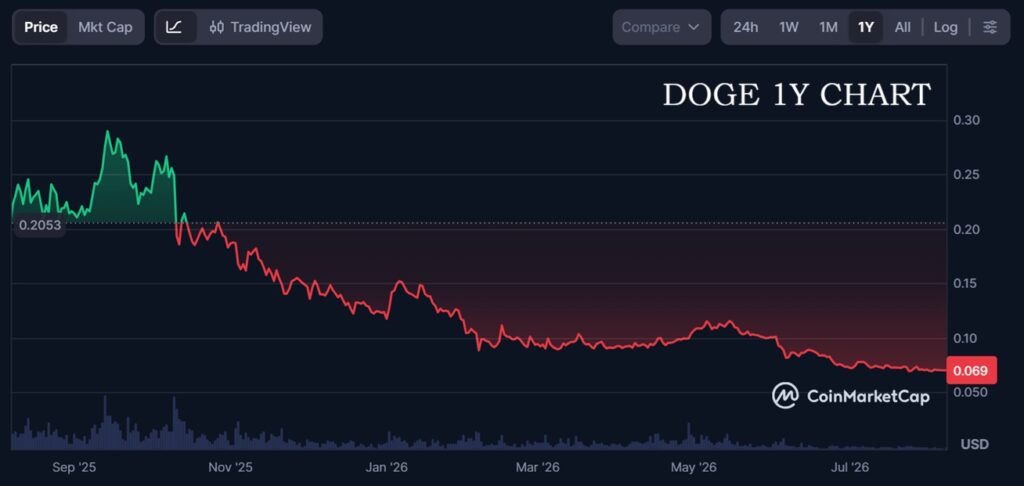
Bitcoin is trading at $64,954.70 after gaining 3.97% over the past week, while Ethereum has risen 3.25% to $1,915.20. Meanwhile, the two largest dog-themed cryptocurrencies have been comparatively quiet. Dogecoin has gained just 0.85% over the week and is down 65% over the past year, while Shiba Inu has fallen 63% over the same period.
This places the meme coin sector in a notable position: DOGE and SHIB both command large communities, deep exchange liquidity, and widely recognized brands, yet each faces the challenge of giving traders a fresh reason to return. Dogecoin has increasingly attracted regulated investment products, while Shiba Inu has spent years constructing infrastructure and merchandise around its original token.
A third contender, Maxi Doge (MAXI), has already raised $4.83 million before listing on any exchange, indicating that its approach is gaining traction rapidly.
The following comparison examines all three projects: DOGE offers history, SHIB offers an ecosystem, and MAXI represents an early-stage opportunity.
Dogecoin Still Sets the Standard for Meme Coin Recognition
Created in 2013 by software engineers Billy Markus and Jackson Palmer as a satirical take on the cryptocurrency boom, Dogecoin has outlasted nearly every joke token that followed it. It remains remarkably straightforward for a multi-billion-dollar asset. It operates as its own proof-of-work blockchain, with miners processing transactions and securing the network. Unlike the proliferation of meme tokens launched as smart contracts on Ethereum or Solana, DOGE functions as the native digital currency on the Dogecoin blockchain. The project continues to position payments and tipping as its primary use cases, rather than attempting to retrofit an elaborate decentralized finance narrative around the token.
What has grown around that simplicity is notable: Dogecoin now has regulated investment products available in the United States. The REX-Osprey DOGE ETF (DOJE) launched in September 2025 and holds both direct and indirect DOGE exposure. This was followed by the 21Shares Dogecoin ETF (TDOG) in January 2026, which trades on Nasdaq and enables investors to gain DOGE exposure through conventional brokerage accounts without needing a crypto wallet. The arrival of DOGE ETFs follows the broader trend of U.S. regulators approving spot cryptocurrency ETFs, which began with Bitcoin ETFs in January 2024 and Ethereum ETFs later that year, gradually expanding the universe of crypto assets accessible through traditional brokerage infrastructure.
Despite these milestones, DOGE has struggled to generate sustained momentum in recent months. At $0.069766, it is up 1.05% over 24 hours, up only 0.85% over the week, and down more than 60% over the year. That subdued performance is precisely what keeps it on traders' radars when searching for an established meme coin ahead of the next speculative rotation.
Dogecoin benefits from one advantage that newer projects cannot easily replicate: near-universal name recognition within the cryptocurrency space. It has weathered multiple market cycles, maintained a strong holder culture, and crossed into mainstream finance without abandoning the principles that created it. A future DOGE rally would require attention to return to meme coins — and when it does, the original dog token remains one of the most accessible destinations for capital.
Maxi Doge Turns the Dog Meme Into a Competitive Sport
Maxi Doge begins with something Dogecoin cannot easily recreate: novelty. The character is purpose-built for a different era of the internet. While DOGE emerged when memes could be charmingly purposeless, MAXI is designed for an age of gym maximalists, progress posting, trading leaderboards, and people turning nearly every hobby into a public competition.
Built around a gym-focused identity positioned for 2026, MAXI holders can stake tokens for rewards. The project plans community competitions for traders seeking the highest returns, and partner events are intended to include futures-platform integrations and gamified tournaments. The meme provides the character, and recurring competition is designed to give the community ongoing engagement.
We need a new crypto king … $MAXI pic.twitter.com/J7ydcJ5py4 — MaxiDoge (@MaxiDoge_) August 5, 2026
The presale has raised $4.83 million without the benefit of exchange trading. This figure demonstrates that the concept has attracted buyers before price momentum can serve as marketing, and the project suggests a $100 million market capitalization as its next target.
The gym crossover broadens the content available to the community. Fitness culture is already organized around streaks, transformations, challenges, and measurable improvement. Crypto trading has developed many of the same patterns, so Maxi Doge leans into the overlap as a caricature rather than simply attaching a dog mascot to an otherwise generic token.
MAXI is currently priced at $0.00028, with staking offering 64% APY. SolidProof and Coinsult have audited the smart contract. Token allocation directs 40% of the supply to marketing and another 25% to the Maxi Fund for exposure and partnership campaigns. The project's emphasis is unambiguous: MAXI is a meme coin engineered to maintain visibility.
As an early-stage project, MAXI has more room to grow than DOGE or SHIB if its community expands after launch. Established meme coins already carry enormous valuations, while MAXI is at the outset of that trajectory and has posted a strong start.
Shiba Inu Has Built Far Beyond the Original SHIB Meme
Launched in August 2020 by an anonymous creator known as Ryoshi, Shiba Inu initially positioned itself as a community-driven alternative to Dogecoin before taking nearly the opposite approach from its predecessor. Rather than preserving simplicity, it transformed the community built around a single meme token into an expanding blockchain ecosystem.
At the center of this effort is Shibarium, an Ethereum Layer 2 network designed for faster transactions and lower fees. Developers can deploy Ethereum-compatible applications on Shibarium instead of routing every interaction through Ethereum's mainnet. Shibarium enters a Layer 2 landscape that already includes established networks such as Arbitrum, Optimism, and Base, each competing for developer mindshare and transaction volume. BONE serves as Shibarium's native gas token, while SHIB remains the ecosystem's most widely recognized asset.
Shibarium gives SHIB something DOGE does not pursue as aggressively: an application economy. The official ecosystem now spans decentralized trading, liquidity pools, gaming, NFTs, and development tools. Shiba Inu reports that Shibarium has processed more than one billion transactions, while its developer page lists more than 1,200 dApps and 24,000 smart contracts.
SHIB also retains the supply-reduction mechanism that has long interested its community. Burns permanently remove tokens from circulation, with Shibarium transaction activity feeding an automated burn process alongside community-driven burn initiatives.
The challenge lies in translating that activity into renewed demand for SHIB itself. Still, the project has accomplished something uncommon among meme coins: surviving long enough for developers to build real infrastructure around it.
Three Dogs, Three Different Stages
DOGE, MAXI, and SHIB are all dog-themed cryptocurrencies, but treating them as interchangeable overlooks where each project stands. Dogecoin is the established monetary meme, now recognizable enough to be included in U.S.-listed ETFs. Shiba Inu converted its community into a broader Web3 ecosystem. Maxi Doge is far earlier in its lifecycle: $4.83 million has been committed before exchange trading has begun, and the project is still constructing the culture intended to sustain it.
DOGE and SHIB have demonstrated that an internet joke can endure long enough to become a serious crypto asset. Maxi Doge is now testing whether the next one should move beyond cuteness and start keeping score.

