Dogecoin Price Scenarios if Bitcoin Returns to $100,000 in 2026
Key Takeaways
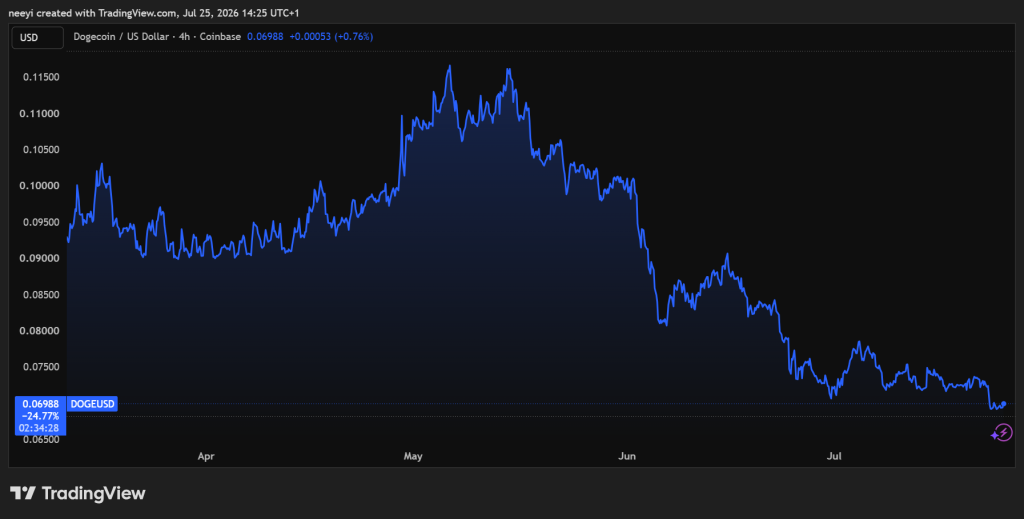
- •As of July 2026, Dogecoin trades between $0.068 and $0.075, approximately 90% below its May 2021 all-time high of $0.7376.
- •Bitcoin and Dogecoin share a rolling five-year correlation coefficient of 0.67, with Dogecoin typically exhibiting amplified percentage moves relative to Bitcoin.
- •Bitcoin is down about 25% year-to-date in 2026 and has stabilized near $64,000–$65,000 after peaking at $126,198 in October 2025.
- •Polymarket currently estimates only a 17% probability that Bitcoin reaches $100,000 before the end of 2026.
- •If Bitcoin returns to six figures, analyst scenarios project Dogecoin landing anywhere from $0.09 to $0.30 depending on the level of returning retail speculation.
Dogecoin’s next major move could depend heavily on whether Bitcoin can recover toward six figures, as DOGE remains closely linked to broader crypto market liquidity and risk appetite. As the original meme coin, Dogecoin often functions as a barometer for retail speculative interest in crypto—when retail enthusiasm returns, DOGE is typically among the first smaller assets to respond.
DOGE has spent much of the past two years moving lower, and a Bitcoin rebound to $100,000 would test whether the meme coin can still follow major market recoveries. Current conditions show both assets under pressure, although their paths into 2026 have differed. A Bitcoin recovery would require a shift in macroeconomic conditions and institutional demand, while Dogecoin’s response would depend on whether retail speculation returns alongside any Bitcoin-led move.
Dogecoin reached an all-time high of $0.7376 in May 2021, a level it has not approached since. That peak was driven by a confluence of retail trading frenzy, high-profile social media attention, and broader crypto market euphoria. After that peak, the coin entered a prolonged decline as retail enthusiasm faded, trading for years in a downward, range-bound channel.
A brief recovery arrived in late 2024 as broader crypto risk appetite improved. Dogecoin climbed to a two-year cycle high near $0.468 on December 8, 2024, before losing momentum and ending that year around $0.316.
The recovery did not continue into 2025. Dogecoin spent the year in a persistent downtrend, forming lower highs and lower lows for months. Even the launch of US spot Dogecoin ETFs in late November 2025 did not reverse the trend. The ETF approvals marked a milestone for mainstream financial access to Dogecoin, coming roughly two years after the first spot Bitcoin ETFs began trading. However, those products saw thin trading volumes and almost no net inflows. By the final hours of 2025, DOGE had fallen below $0.12, marking a correction of more than 70% from its late-2024 peak.
The weakness extended into 2026. Dogecoin prices moved toward $0.09 by March, and the decline struggled to establish a durable floor. As of July 2026, DOGE has been trading in a depressed range between $0.068 and $0.075, roughly 90% below its 2021 high. Weak macro momentum and directionless technical indicators have kept the token near those levels for months.
Bitcoin’s Record Rally Has Given Way to a 2026 Correction
Bitcoin’s trajectory has been different from Dogecoin’s, though it is also under pressure in 2026. The launch of spot Bitcoin ETFs in early 2024 changed market structure after the long 2022 bear market and the gradual recovery that followed.
Institutional adoption, the April 2024 halving and a friendlier US regulatory environment helped push Bitcoin above the $100,000 milestone in late 2024. Bitcoin ended that year near $93,586.
The rally continued through 2025. In March 2025, the US established a Strategic Bitcoin Reserve, which became a major catalyst and helped drive prices higher through the summer. Continued institutional ETF inflows pushed Bitcoin to an all-time high of $126,198 in early October 2025.
That peak was short-lived. Broad international tariff announcements on October 10, 2025, triggered a record $19 billion liquidation event that sharply pulled Bitcoin lower. The asset ended 2025 near $87,700.
In 2026, a different set of pressures has weighed on the market. Retail risk capital shifted heavily away from crypto and into artificial intelligence stocks, while trading volumes weakened. The rotation echoes patterns seen in previous cycles, where capital has moved between speculative asset classes based on perceived momentum. Higher US Treasury yields and tighter financial conditions contributed to more than $2.7 billion in net ETF outflows by mid-summer.
Bitcoin is down about 25% year to date. It briefly tested the $58,000 floor in June and is now stabilizing around the $64,000 to $65,000 range.
What Bitcoin Would Need to Reclaim $100,000 by Year-End
For Bitcoin to move from its current $64,000 range back to $100,000 by the end of 2026, both macroeconomic conditions and institutional behavior would need to change materially. Prediction platforms such as Polymarket currently put the odds of Bitcoin reaching six figures this year at 17%.
Several conditions would need to align.
Aggressive Fed rate cuts: Higher US Treasury yields have drawn institutional capital away from assets that do not generate yield. A clear shift toward lower interest rates would reduce the relative cost of holding Bitcoin instead of bonds.
A reversal of ETF outflows: Spot Bitcoin ETFs would need to move out of their current multibillion-dollar outflow trend. Renewed institutional inflows, potentially including allocations from 401(k) plans, would be needed to absorb floating supply currently available in the market.
Rotation away from the AI trade: Retail and speculative capital has moved heavily into artificial intelligence stocks throughout 2026. A fourth-quarter crypto rally would likely require some of that capital to rotate back into digital assets.
Regulatory breakthroughs: Passage of stalled crypto-friendly legislation, such as the US CLARITY Act, would give more conservative corporate treasuries the legal clarity they have been waiting for before entering the asset class.
Bitcoin’s Key Technical Boundaries
A review of the Bitcoin chart shows a relatively clear set of current boundaries, based on updated July 2026 technical analysis from Forbes Digital Assets and TradingView.
How Closely Dogecoin Tracks Bitcoin
Bitcoin and Dogecoin have a strong positive price correlation that typically ranges between 0.65 and 0.85 on a macro scale. A rolling five-year window puts their stable historical correlation coefficient at 0.67, indicating that Dogecoin’s price trends remain fundamentally tied to Bitcoin’s broader market direction.
Bitcoin acts as the main liquidity anchor for the crypto market and strongly influences overall sentiment. Major pivot points, including market peaks and bottoms, tend to affect Dogecoin. When Bitcoin declines, Dogecoin almost always follows the same broad downward path.
However, the two assets do not move by the same magnitude. Dogecoin behaves like a high-beta version of Bitcoin. In bullish cycles, a 5% rise in Bitcoin can produce a 20% or larger move in Dogecoin as retail speculation amplifies the trend. In bearish cycles, the effect works in reverse, with Dogecoin often recording much steeper percentage losses than Bitcoin.
The correlation can also break down temporarily. Asset-specific events, including high-profile social media endorsements, network upgrades or technical formations such as the February 2026 golden cross, can cause Dogecoin to rally independently even when Bitcoin is flat.
Bearish, Neutral and Bullish DOGE Scenarios if Bitcoin Hits $100,000
Dogecoin is not guaranteed to move in lockstep with Bitcoin. Still, the historical correlation provides a framework for three possible outcomes if Bitcoin returns to $100,000.
Bearish scenario, $0.09 to $0.10: A Bitcoin move back to $100,000 would not automatically bring speculative retail capital back into meme coins. If institutional buying drives most of Bitcoin’s recovery while retail participation remains thin, Dogecoin could lag far behind Bitcoin’s percentage gain. Under this scenario, DOGE might only rise into the $0.09 to $0.10 range, a modest rebound that would still leave the coin far below its 2024 cycle high.
Neutral scenario, $0.13 to $0.15: In a more balanced outcome, Dogecoin would track Bitcoin’s rally close to its historical correlation coefficient of 0.67, with some added beta from returning retail interest. That path could place DOGE between $0.13 and $0.15, roughly double its current range.
Bullish scenario, $0.25 to $0.30: A strong return of retail speculation, combined with Bitcoin’s recovery to $100,000, would likely activate the same high-beta effect Dogecoin has shown in previous bull cycles. If DOGE captures even part of the enthusiasm that pushed it to $0.468 in December 2024, prices could move back into the $0.25 to $0.30 range.
Dogecoin has endured severe drawdowns before, and its price has consistently remained tied to Bitcoin’s broader direction. Whether Bitcoin actually reclaims $100,000 this year remains uncertain.
FAQs
Dogecoin could theoretically return to its previous high, but the odds are described as extremely slim. Dogecoin’s all-time high was $0.74, reached on May 8, 2021.
Dogecoin (DOGE) is widely considered a realistic candidate to reach $1, which would require a market capitalization of around $150 billion. That view is supported by the potential integration of X payment infrastructure and Dogecoin’s large community. For enterprise and layer-1 utility, Cardano (ADA) and TRON (TRX) are also closely watched alternatives currently trading under $1 with potential.

